
lithium crystal forms inspire this mirrored pink sauna on sweden’s reclaimed wasteland


Social Infrastructure and the Architecture of Climate Action
The Lithium Crystal Sauna builds upon Bigert & Bergström’s long-standing research into the architecture of climate simulation and civic gathering. It directly follows the lineage of their renowned Solar Egg project in Kiruna—a communal structure that addressed social displacement caused by regional mining extraction. Within the broader WasteLand master plan, the new sauna joins other site-specific installations, including the Broken Greenhouse series, which simulates diverse climate change scenarios within custom sculptural environments.
By blending landscape restoration with high-concept architectural design, the park utilizes reclaimed trees, native seed banks, and structural play networks to curate an interactive public realm. The Lithium Crystal Sauna acts as the spatial anchor for this landscape, transforming raw industrial legacy into a shared thermal room where energy flows, mineral extraction, and community rituals coalesce seamlessly.

Material Dualism: Metallic Skins and Subterranean Grottos
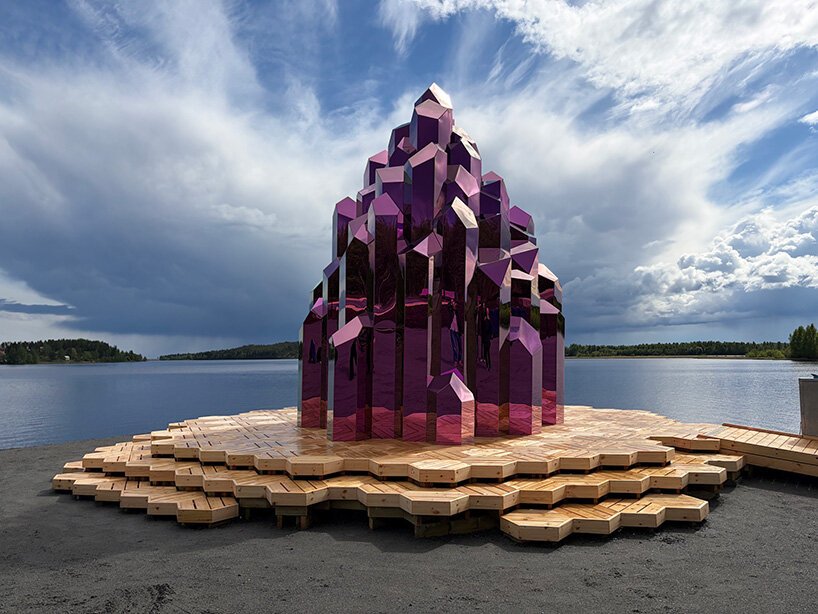
Bigert & Bergström engineered the pavilion as an asymmetrical lithium crystal—a deliberate form factor that links modern battery technology with human biology, referencing lithium’s dual role in clean-energy electrification and psychiatric mental health care. The underlying steel structural framework is wrapped in high-gloss, pink titanium-coated stainless steel mirrors. This polished shell deliberately fractures and re-assembles the image of the surrounding forest across its sharp, angular facets.
In direct contrast to the cold, high-tech exterior, the interior unfolds as a warm, organic grotto. The thermal envelope is lined with premium alder and heartwood pine, centering around a heavy-duty heater piled with local flint and olivine stones. Copper accents, integrated LED lines, performance insulation, and modern ventilation systems complete the structural layers, ensuring the pavilion functions flawlessly as a public health amenity while retaining its complex artistic edge.
Social Infrastructure and the Architecture of Climate Action
The Lithium Crystal Sauna builds upon Bigert & Bergström’s long-standing research into the architecture of climate simulation and civic gathering. It directly follows the lineage of their renowned Solar Egg project in Kiruna—a communal structure that addressed social displacement caused by regional mining extraction. Within the broader WasteLand master plan, the new sauna joins other site-specific installations, including the Broken Greenhouse series, which simulates diverse climate change scenarios within custom sculptural environments.
By blending landscape restoration with high-concept architectural design, the park utilizes reclaimed trees, native seed banks, and structural play networks to curate an interactive public realm. The Lithium Crystal Sauna acts as the spatial anchor for this landscape, transforming raw industrial legacy into a shared thermal room where energy flows, mineral extraction, and community rituals coalesce seamlessly.
Material Dualism: Metallic Skins and Subterranean Grottos
Bigert & Bergström engineered the pavilion as an asymmetrical lithium crystal—a deliberate form factor that links modern battery technology with human biology, referencing lithium’s dual role in clean-energy electrification and psychiatric mental health care. The underlying steel structural framework is wrapped in high-gloss, pink titanium-coated stainless steel mirrors. This polished shell deliberately fractures and re-assembles the image of the surrounding forest across its sharp, angular facets.
In direct contrast to the cold, high-tech exterior, the interior unfolds as a warm, organic grotto. The thermal envelope is lined with premium alder and heartwood pine, centering around a heavy-duty heater piled with local flint and olivine stones. Copper accents, integrated LED lines, performance insulation, and modern ventilation systems complete the structural layers, ensuring the pavilion functions flawlessly as a public health amenity while retaining its complex artistic edge.
Social Infrastructure and the Architecture of Climate Action
The Lithium Crystal Sauna builds upon Bigert & Bergström’s long-standing research into the architecture of climate simulation and civic gathering. It directly follows the lineage of their renowned Solar Egg project in Kiruna—a communal structure that addressed social displacement caused by regional mining extraction. Within the broader WasteLand master plan, the new sauna joins other site-specific installations, including the Broken Greenhouse series, which simulates diverse climate change scenarios within custom sculptural environments.
By blending landscape restoration with high-concept architectural design, the park utilizes reclaimed trees, native seed banks, and structural play networks to curate an interactive public realm. The Lithium Crystal Sauna acts as the spatial anchor for this landscape, transforming raw industrial legacy into a shared thermal room where energy flows, mineral extraction, and community rituals coalesce seamlessly.
The Lithium Crystal Sauna: Faceted Metallic Forms and Ecological Regeneration in Sweden
Sited along the Skellefte River in northern Sweden, the striking Lithium Crystal Sauna features a highly faceted, reflective envelope that mirrors the surrounding trees, moving water, and regenerating landscape. Designed by the Stockholm-based studio Bigert & Bergström, this avant-garde installation stands as the permanent architectural centerpiece of WasteLand—a climate action park established on the former Scharin industrial site. Following a meticulous seventeen-year soil remediation process, the contaminated land has been transformed into a public park fusing art, regional ecology, and civic interaction.
Unveiled in tandem with the Society Expo 2026 under the curatorial framework “From Waste to Promise,” the project introduces a functional community hub to a site previously defined by industrial extraction. The sculptural pavilion stands as a powerful regional symbol, taking a material heavily associated with the global green energy transition and repurposing its conceptual meaning into a tangible, human-scale space for public ritual and climate dialogue.
Material Dualism: Metallic Skins and Subterranean Grottos
Bigert & Bergström engineered the pavilion as an asymmetrical lithium crystal—a deliberate form factor that links modern battery technology with human biology, referencing lithium’s dual role in clean-energy electrification and psychiatric mental health care. The underlying steel structural framework is wrapped in high-gloss, pink titanium-coated stainless steel mirrors. This polished shell deliberately fractures and re-assembles the image of the surrounding forest across its sharp, angular facets.
In direct contrast to the cold, high-tech exterior, the interior unfolds as a warm, organic grotto. The thermal envelope is lined with premium alder and heartwood pine, centering around a heavy-duty heater piled with local flint and olivine stones. Copper accents, integrated LED lines, performance insulation, and modern ventilation systems complete the structural layers, ensuring the pavilion functions flawlessly as a public health amenity while retaining its complex artistic edge.
Social Infrastructure and the Architecture of Climate Action
The Lithium Crystal Sauna builds upon Bigert & Bergström’s long-standing research into the architecture of climate simulation and civic gathering. It directly follows the lineage of their renowned Solar Egg project in Kiruna—a communal structure that addressed social displacement caused by regional mining extraction. Within the broader WasteLand master plan, the new sauna joins other site-specific installations, including the Broken Greenhouse series, which simulates diverse climate change scenarios within custom sculptural environments.
By blending landscape restoration with high-concept architectural design, the park utilizes reclaimed trees, native seed banks, and structural play networks to curate an interactive public realm. The Lithium Crystal Sauna acts as the spatial anchor for this landscape, transforming raw industrial legacy into a shared thermal room where energy flows, mineral extraction, and community rituals coalesce seamlessly.
Material Dualism: Metallic Skins and Subterranean Grottos
Bigert & Bergström engineered the pavilion as an asymmetrical lithium crystal—a deliberate form factor that links modern battery technology with human biology, referencing lithium’s dual role in clean-energy electrification and psychiatric mental health care. The underlying steel structural framework is wrapped in high-gloss, pink titanium-coated stainless steel mirrors. This polished shell deliberately fractures and re-assembles the image of the surrounding forest across its sharp, angular facets.
In direct contrast to the cold, high-tech exterior, the interior unfolds as a warm, organic grotto. The thermal envelope is lined with premium alder and heartwood pine, centering around a heavy-duty heater piled with local flint and olivine stones. Copper accents, integrated LED lines, performance insulation, and modern ventilation systems complete the structural layers, ensuring the pavilion functions flawlessly as a public health amenity while retaining its complex artistic edge.
Social Infrastructure and the Architecture of Climate Action
The Lithium Crystal Sauna builds upon Bigert & Bergström’s long-standing research into the architecture of climate simulation and civic gathering. It directly follows the lineage of their renowned Solar Egg project in Kiruna—a communal structure that addressed social displacement caused by regional mining extraction. Within the broader WasteLand master plan, the new sauna joins other site-specific installations, including the Broken Greenhouse series, which simulates diverse climate change scenarios within custom sculptural environments.
By blending landscape restoration with high-concept architectural design, the park utilizes reclaimed trees, native seed banks, and structural play networks to curate an interactive public realm. The Lithium Crystal Sauna acts as the spatial anchor for this landscape, transforming raw industrial legacy into a shared thermal room where energy flows, mineral extraction, and community rituals coalesce seamlessly.
The Lithium Crystal Sauna: Faceted Metallic Forms and Ecological Regeneration in Sweden
Sited along the Skellefte River in northern Sweden, the striking Lithium Crystal Sauna features a highly faceted, reflective envelope that mirrors the surrounding trees, moving water, and regenerating landscape. Designed by the Stockholm-based studio Bigert & Bergström, this avant-garde installation stands as the permanent architectural centerpiece of WasteLand—a climate action park established on the former Scharin industrial site. Following a meticulous seventeen-year soil remediation process, the contaminated land has been transformed into a public park fusing art, regional ecology, and civic interaction.
Unveiled in tandem with the Society Expo 2026 under the curatorial framework “From Waste to Promise,” the project introduces a functional community hub to a site previously defined by industrial extraction. The sculptural pavilion stands as a powerful regional symbol, taking a material heavily associated with the global green energy transition and repurposing its conceptual meaning into a tangible, human-scale space for public ritual and climate dialogue.
Material Dualism: Metallic Skins and Subterranean Grottos
Bigert & Bergström engineered the pavilion as an asymmetrical lithium crystal—a deliberate form factor that links modern battery technology with human biology, referencing lithium’s dual role in clean-energy electrification and psychiatric mental health care. The underlying steel structural framework is wrapped in high-gloss, pink titanium-coated stainless steel mirrors. This polished shell deliberately fractures and re-assembles the image of the surrounding forest across its sharp, angular facets.
In direct contrast to the cold, high-tech exterior, the interior unfolds as a warm, organic grotto. The thermal envelope is lined with premium alder and heartwood pine, centering around a heavy-duty heater piled with local flint and olivine stones. Copper accents, integrated LED lines, performance insulation, and modern ventilation systems complete the structural layers, ensuring the pavilion functions flawlessly as a public health amenity while retaining its complex artistic edge.
Social Infrastructure and the Architecture of Climate Action
The Lithium Crystal Sauna builds upon Bigert & Bergström’s long-standing research into the architecture of climate simulation and civic gathering. It directly follows the lineage of their renowned Solar Egg project in Kiruna—a communal structure that addressed social displacement caused by regional mining extraction. Within the broader WasteLand master plan, the new sauna joins other site-specific installations, including the Broken Greenhouse series, which simulates diverse climate change scenarios within custom sculptural environments.
By blending landscape restoration with high-concept architectural design, the park utilizes reclaimed trees, native seed banks, and structural play networks to curate an interactive public realm. The Lithium Crystal Sauna acts as the spatial anchor for this landscape, transforming raw industrial legacy into a shared thermal room where energy flows, mineral extraction, and community rituals coalesce seamlessly.
Material Dualism: Metallic Skins and Subterranean Grottos
Bigert & Bergström engineered the pavilion as an asymmetrical lithium crystal—a deliberate form factor that links modern battery technology with human biology, referencing lithium’s dual role in clean-energy electrification and psychiatric mental health care. The underlying steel structural framework is wrapped in high-gloss, pink titanium-coated stainless steel mirrors. This polished shell deliberately fractures and re-assembles the image of the surrounding forest across its sharp, angular facets.
In direct contrast to the cold, high-tech exterior, the interior unfolds as a warm, organic grotto. The thermal envelope is lined with premium alder and heartwood pine, centering around a heavy-duty heater piled with local flint and olivine stones. Copper accents, integrated LED lines, performance insulation, and modern ventilation systems complete the structural layers, ensuring the pavilion functions flawlessly as a public health amenity while retaining its complex artistic edge.
Social Infrastructure and the Architecture of Climate Action
The Lithium Crystal Sauna builds upon Bigert & Bergström’s long-standing research into the architecture of climate simulation and civic gathering. It directly follows the lineage of their renowned Solar Egg project in Kiruna—a communal structure that addressed social displacement caused by regional mining extraction. Within the broader WasteLand master plan, the new sauna joins other site-specific installations, including the Broken Greenhouse series, which simulates diverse climate change scenarios within custom sculptural environments.
By blending landscape restoration with high-concept architectural design, the park utilizes reclaimed trees, native seed banks, and structural play networks to curate an interactive public realm. The Lithium Crystal Sauna acts as the spatial anchor for this landscape, transforming raw industrial legacy into a shared thermal room where energy flows, mineral extraction, and community rituals coalesce seamlessly.
The Lithium Crystal Sauna: Faceted Metallic Forms and Ecological Regeneration in Sweden
Sited along the Skellefte River in northern Sweden, the striking Lithium Crystal Sauna features a highly faceted, reflective envelope that mirrors the surrounding trees, moving water, and regenerating landscape. Designed by the Stockholm-based studio Bigert & Bergström, this avant-garde installation stands as the permanent architectural centerpiece of WasteLand—a climate action park established on the former Scharin industrial site. Following a meticulous seventeen-year soil remediation process, the contaminated land has been transformed into a public park fusing art, regional ecology, and civic interaction.
Unveiled in tandem with the Society Expo 2026 under the curatorial framework “From Waste to Promise,” the project introduces a functional community hub to a site previously defined by industrial extraction. The sculptural pavilion stands as a powerful regional symbol, taking a material heavily associated with the global green energy transition and repurposing its conceptual meaning into a tangible, human-scale space for public ritual and climate dialogue.
Material Dualism: Metallic Skins and Subterranean Grottos
Bigert & Bergström engineered the pavilion as an asymmetrical lithium crystal—a deliberate form factor that links modern battery technology with human biology, referencing lithium’s dual role in clean-energy electrification and psychiatric mental health care. The underlying steel structural framework is wrapped in high-gloss, pink titanium-coated stainless steel mirrors. This polished shell deliberately fractures and re-assembles the image of the surrounding forest across its sharp, angular facets.
In direct contrast to the cold, high-tech exterior, the interior unfolds as a warm, organic grotto. The thermal envelope is lined with premium alder and heartwood pine, centering around a heavy-duty heater piled with local flint and olivine stones. Copper accents, integrated LED lines, performance insulation, and modern ventilation systems complete the structural layers, ensuring the pavilion functions flawlessly as a public health amenity while retaining its complex artistic edge.
Social Infrastructure and the Architecture of Climate Action
The Lithium Crystal Sauna builds upon Bigert & Bergström’s long-standing research into the architecture of climate simulation and civic gathering. It directly follows the lineage of their renowned Solar Egg project in Kiruna—a communal structure that addressed social displacement caused by regional mining extraction. Within the broader WasteLand master plan, the new sauna joins other site-specific installations, including the Broken Greenhouse series, which simulates diverse climate change scenarios within custom sculptural environments.
By blending landscape restoration with high-concept architectural design, the park utilizes reclaimed trees, native seed banks, and structural play networks to curate an interactive public realm. The Lithium Crystal Sauna acts as the spatial anchor for this landscape, transforming raw industrial legacy into a shared thermal room where energy flows, mineral extraction, and community rituals coalesce seamlessly.
Material Dualism: Metallic Skins and Subterranean Grottos
Bigert & Bergström engineered the pavilion as an asymmetrical lithium crystal—a deliberate form factor that links modern battery technology with human biology, referencing lithium’s dual role in clean-energy electrification and psychiatric mental health care. The underlying steel structural framework is wrapped in high-gloss, pink titanium-coated stainless steel mirrors. This polished shell deliberately fractures and re-assembles the image of the surrounding forest across its sharp, angular facets.
In direct contrast to the cold, high-tech exterior, the interior unfolds as a warm, organic grotto. The thermal envelope is lined with premium alder and heartwood pine, centering around a heavy-duty heater piled with local flint and olivine stones. Copper accents, integrated LED lines, performance insulation, and modern ventilation systems complete the structural layers, ensuring the pavilion functions flawlessly as a public health amenity while retaining its complex artistic edge.
Social Infrastructure and the Architecture of Climate Action
The Lithium Crystal Sauna builds upon Bigert & Bergström’s long-standing research into the architecture of climate simulation and civic gathering. It directly follows the lineage of their renowned Solar Egg project in Kiruna—a communal structure that addressed social displacement caused by regional mining extraction. Within the broader WasteLand master plan, the new sauna joins other site-specific installations, including the Broken Greenhouse series, which simulates diverse climate change scenarios within custom sculptural environments.
By blending landscape restoration with high-concept architectural design, the park utilizes reclaimed trees, native seed banks, and structural play networks to curate an interactive public realm. The Lithium Crystal Sauna acts as the spatial anchor for this landscape, transforming raw industrial legacy into a shared thermal room where energy flows, mineral extraction, and community rituals coalesce seamlessly.
Material Dualism: Metallic Skins and Subterranean Grottos
Bigert & Bergström engineered the pavilion as an asymmetrical lithium crystal—a deliberate form factor that links modern battery technology with human biology, referencing lithium’s dual role in clean-energy electrification and psychiatric mental health care. The underlying steel structural framework is wrapped in high-gloss, pink titanium-coated stainless steel mirrors. This polished shell deliberately fractures and re-assembles the image of the surrounding forest across its sharp, angular facets.
In direct contrast to the cold, high-tech exterior, the interior unfolds as a warm, organic grotto. The thermal envelope is lined with premium alder and heartwood pine, centering around a heavy-duty heater piled with local flint and olivine stones. Copper accents, integrated LED lines, performance insulation, and modern ventilation systems complete the structural layers, ensuring the pavilion functions flawlessly as a public health amenity while retaining its complex artistic edge.
Social Infrastructure and the Architecture of Climate Action
The Lithium Crystal Sauna builds upon Bigert & Bergström’s long-standing research into the architecture of climate simulation and civic gathering. It directly follows the lineage of their renowned Solar Egg project in Kiruna—a communal structure that addressed social displacement caused by regional mining extraction. Within the broader WasteLand master plan, the new sauna joins other site-specific installations, including the Broken Greenhouse series, which simulates diverse climate change scenarios within custom sculptural environments.
By blending landscape restoration with high-concept architectural design, the park utilizes reclaimed trees, native seed banks, and structural play networks to curate an interactive public realm. The Lithium Crystal Sauna acts as the spatial anchor for this landscape, transforming raw industrial legacy into a shared thermal room where energy flows, mineral extraction, and community rituals coalesce seamlessly.
The Lithium Crystal Sauna: Faceted Metallic Forms and Ecological Regeneration in Sweden
Sited along the Skellefte River in northern Sweden, the striking Lithium Crystal Sauna features a highly faceted, reflective envelope that mirrors the surrounding trees, moving water, and regenerating landscape. Designed by the Stockholm-based studio Bigert & Bergström, this avant-garde installation stands as the permanent architectural centerpiece of WasteLand—a climate action park established on the former Scharin industrial site. Following a meticulous seventeen-year soil remediation process, the contaminated land has been transformed into a public park fusing art, regional ecology, and civic interaction.
Unveiled in tandem with the Society Expo 2026 under the curatorial framework “From Waste to Promise,” the project introduces a functional community hub to a site previously defined by industrial extraction. The sculptural pavilion stands as a powerful regional symbol, taking a material heavily associated with the global green energy transition and repurposing its conceptual meaning into a tangible, human-scale space for public ritual and climate dialogue.
Material Dualism: Metallic Skins and Subterranean Grottos
Bigert & Bergström engineered the pavilion as an asymmetrical lithium crystal—a deliberate form factor that links modern battery technology with human biology, referencing lithium’s dual role in clean-energy electrification and psychiatric mental health care. The underlying steel structural framework is wrapped in high-gloss, pink titanium-coated stainless steel mirrors. This polished shell deliberately fractures and re-assembles the image of the surrounding forest across its sharp, angular facets.
In direct contrast to the cold, high-tech exterior, the interior unfolds as a warm, organic grotto. The thermal envelope is lined with premium alder and heartwood pine, centering around a heavy-duty heater piled with local flint and olivine stones. Copper accents, integrated LED lines, performance insulation, and modern ventilation systems complete the structural layers, ensuring the pavilion functions flawlessly as a public health amenity while retaining its complex artistic edge.
Social Infrastructure and the Architecture of Climate Action
The Lithium Crystal Sauna builds upon Bigert & Bergström’s long-standing research into the architecture of climate simulation and civic gathering. It directly follows the lineage of their renowned Solar Egg project in Kiruna—a communal structure that addressed social displacement caused by regional mining extraction. Within the broader WasteLand master plan, the new sauna joins other site-specific installations, including the Broken Greenhouse series, which simulates diverse climate change scenarios within custom sculptural environments.
By blending landscape restoration with high-concept architectural design, the park utilizes reclaimed trees, native seed banks, and structural play networks to curate an interactive public realm. The Lithium Crystal Sauna acts as the spatial anchor for this landscape, transforming raw industrial legacy into a shared thermal room where energy flows, mineral extraction, and community rituals coalesce seamlessly.