
When Drawings Take Flight: The Art and Design of Kites
art for the open air
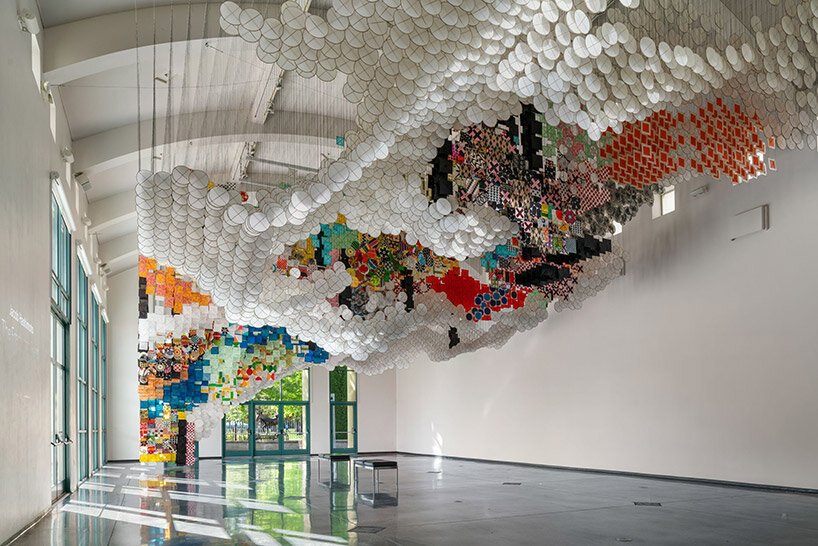
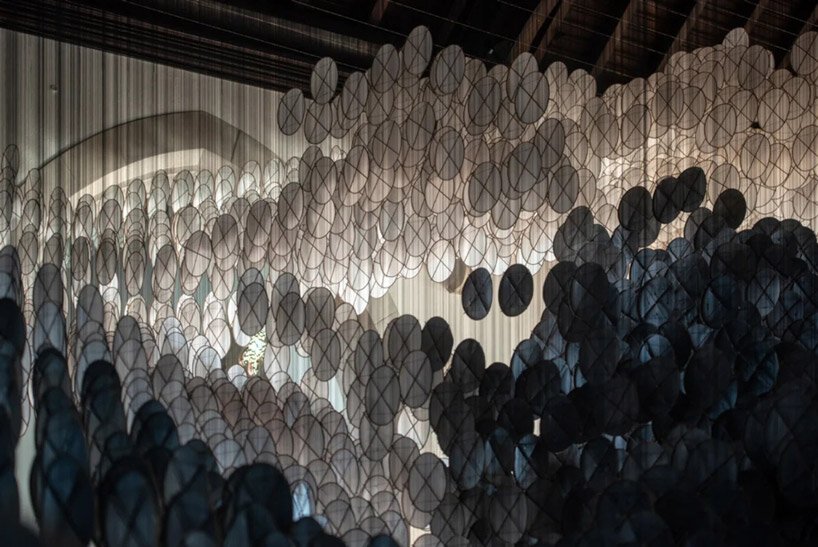
Later this month, SFMOMA’s Roberts Family Gallery will fill with nearly 75,000 hand-built kites. Jacob Hashimoto’s Giant Arc, opening August 22nd, 2026, gathers bamboo and Japanese paper from floor to ceiling, forming a canopy that thickens into clouds and loosens into open air. The pieces hang indoors, beyond the reach of weather, though the logic of flight remains visible in every thin rib and taut surface. A familiar object has multiplied until it reads as architecture.
The kite begins with a peculiar proposition: make an image light enough to leave the ground. Decoration has to work with lift, balance, tension, and the changing force of air. A painted face may stretch, and a tail may stabilize a shape while extending it across the sky. A sudden drop can rewrite the whole composition in seconds.
Early kites are generally traced to ancient China between 475 and 221 BCE, where wooden forms often imitated birds. Over centuries, the object moved through military signaling and ceremony, then into many forms of play, while its basic arrangement stayed disarmingly spare: a framed paper surface held by a line.
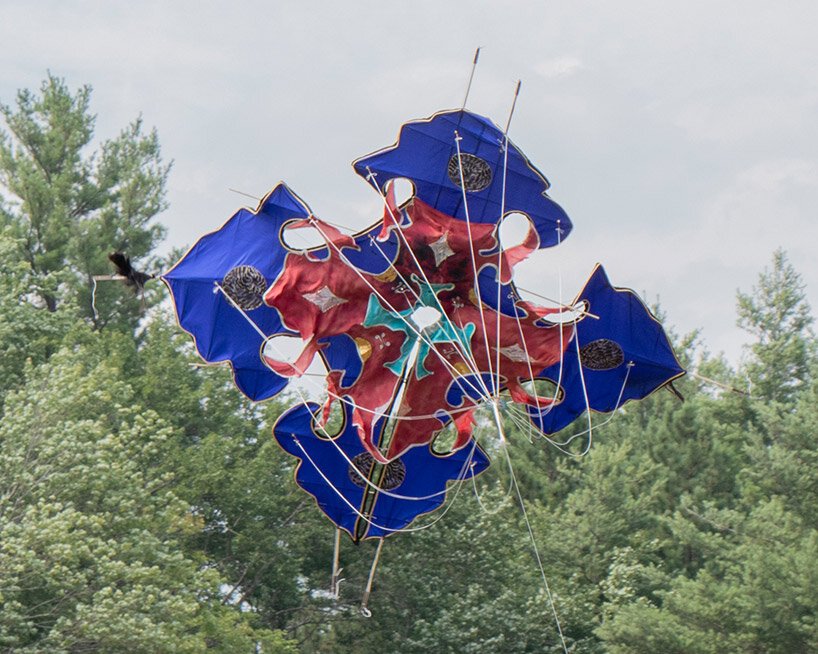
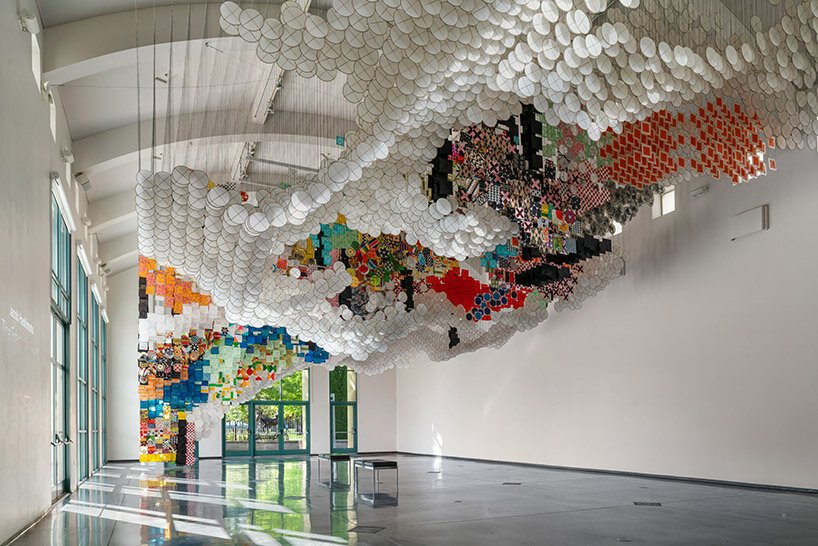 Jacob Hashimoto: Giant Arc, SFMOMA | image © Tobin Rogers (header image: Hai-Wen Lin, Send Them Their Flowers, 2024 | image courtesy the artist)
pictures built around the wind
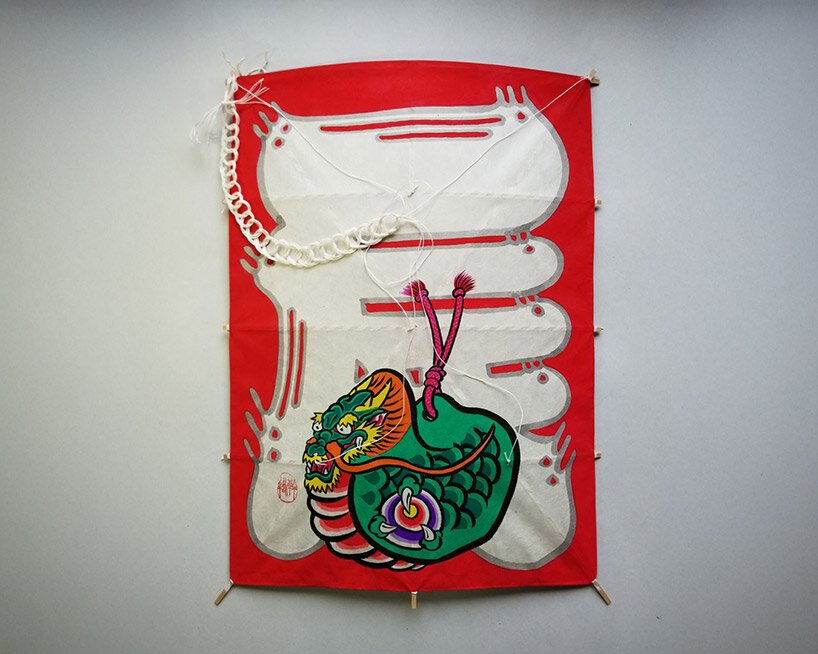
Japanese Edo kites make that relationship between image and structure easy to see. Bowed bamboo supports a rectangular sheet of washi, often painted with broad faces or warriors whose features stay legible from far below. The format developed in Tokyo during the Edo period and survives through makers including Mikio Toki, who has spent decades working within the regional technique. Thick black contours hold their own against the sky, while the slight curve of the frame gives the picture its lift.
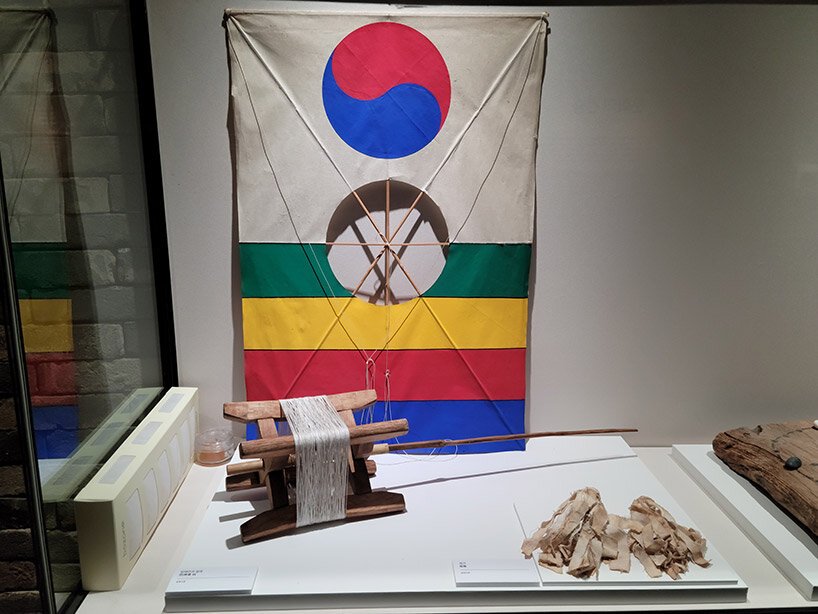
Korea’s bangpae-yeon, or shield kite, turns an opening into its defining feature. The rectangular kite has a circular wind window near its center, allowing air to pass through the surface and giving the flyer greater control. It can be guided up, down, left, and right, an agility used in traditional kite fighting. The hole also enters the graphic composition as a crisp piece of negative space. Engineering and ornament occupy the same sheet of paper.
Edo in the Sky: Traditional Kites of Japan – Japan Foundation, Sydney | image © Mikio Toki
A shield-shaped kite, kite reel, and jegi collected after Korea’s liberation | image via Wikimedia Commons
when a kite becomes a public monument
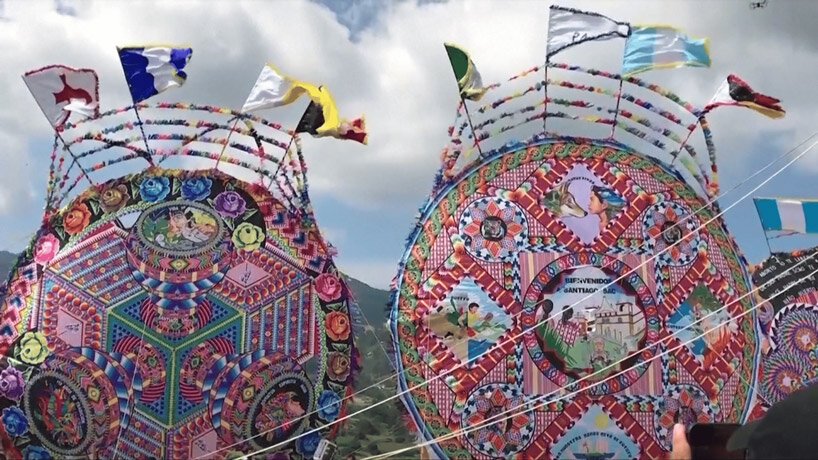
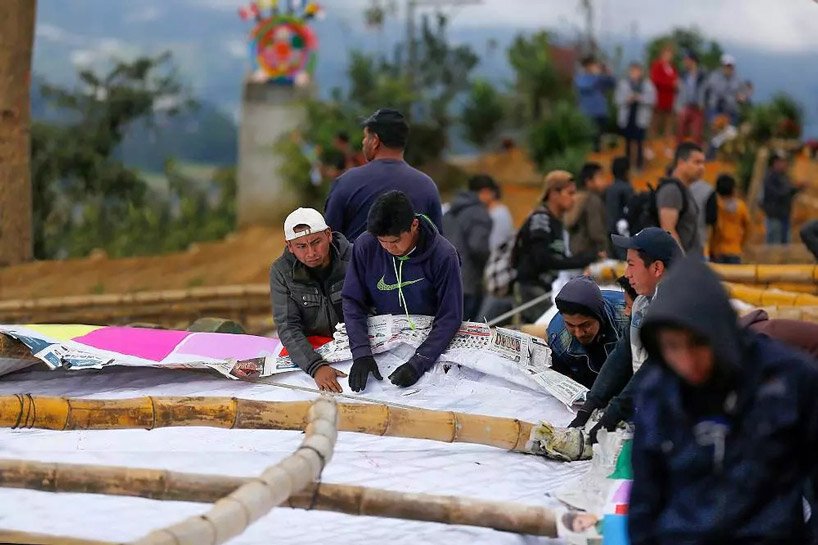
In the Guatemalan towns of Santiago Sacatepéquez and Sumpango, the kite expands into a communal monument. Groups work for months on giant circular barriletes made for the fairs of the Saints and the Dead. Their bamboo frameworks support dense paper compositions that can reach architectural scale, standing above the crowd like temporary facades before selected kites take to the air. The tradition dates to the late nineteenth and early twentieth centuries and centers on communication with ancestors.
Here, flight belongs to a longer process of building together. The image comes from many hands, and its audience gathers in the same field where it was assembled and raised. UNESCO added the kite-making technique to its Representative List of the Intangible Cultural Heritage of Humanity in 2024 (see here), recognizing the knowledge shared between generations in both towns. The scale is impressive, though the labor behind each paper surface gives the event its force.
Day of the Dead in Guatemala | image via AWN Network
Guatemalan kite-making process | image © UNESCO, Ministry of Culture and Sports
modern artists take the line
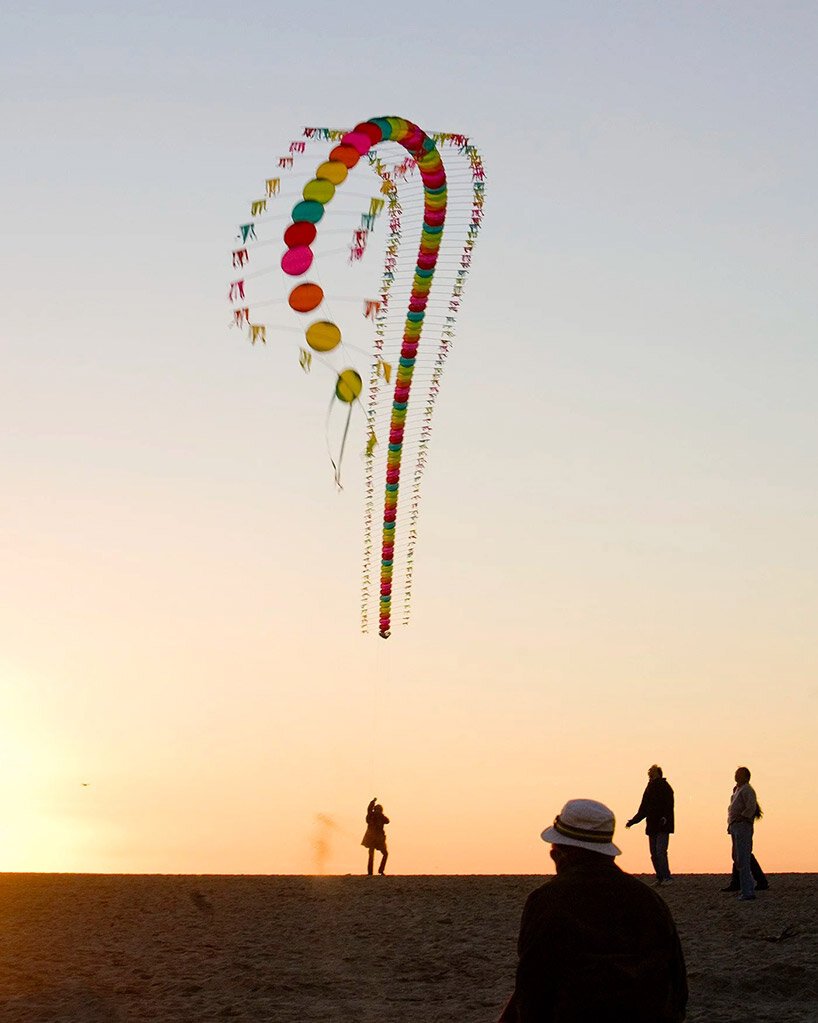
Tyrus Wong brought the same sensitivity he used in painting and film design to kites built for the beach. After retiring from Warner Bros. in 1968, the Chinese American artist made a 100-foot centipede and long strings of birds, flying them regularly at Santa Monica State Beach well into his later years. Each creature depended on repetition. Dozens of linked sections became a single twisting body once the wind pulled them into formation. The image only fully appeared in motion.
Sculptor Tal Streeter approached the kite as a form of airborne drawing. His 1972 exhibition Kites: Red Line in the Sky explored paper kites as sculpture, with slender frames and red marks set against open blue. He called them ‘flying paintings,’ a phrase that captures the shift from object to event. Jackie Matisse pursued a related idea through long-tailed kites made to play with color and line, letting light and cloud cover alter the work from moment to moment.
centipede kite, Tyrus Wong | image © Sara Jane Boyers
a museum with no ceiling
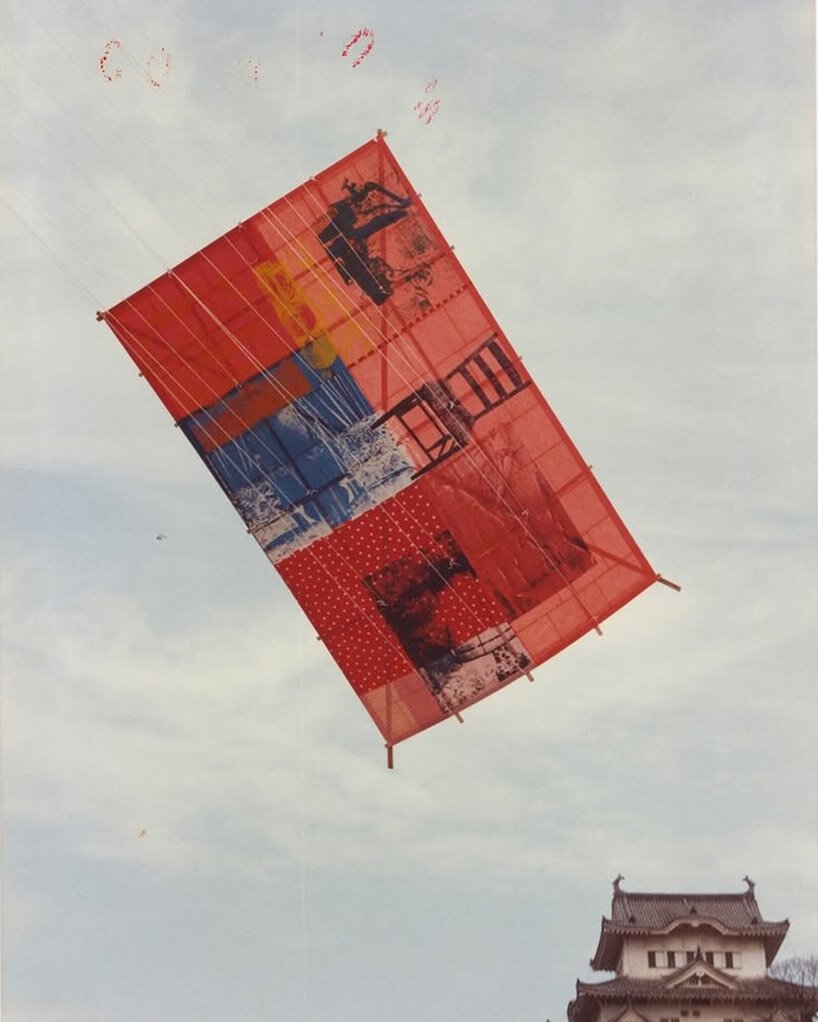
The Art Kites Project made that airborne exhibition model explicit. Organized by Paul Eubel at the Goethe-Institut Osaka beginning in 1987, the initiative invited 100 artists to develop images for Japanese kite forms built with the help of specialist makers. Robert Rauschenberg and Niki de Saint Phalle were among the participants. The works flew in Japan and Europe before traveling through museums, moving back and forth between sky and gallery wall.
Robert Rauschenberg, Sky House II, screenprint on silk collage, bamboo, 372 x 248 cm | image via ig/RRF
new textile design drawing from heritage
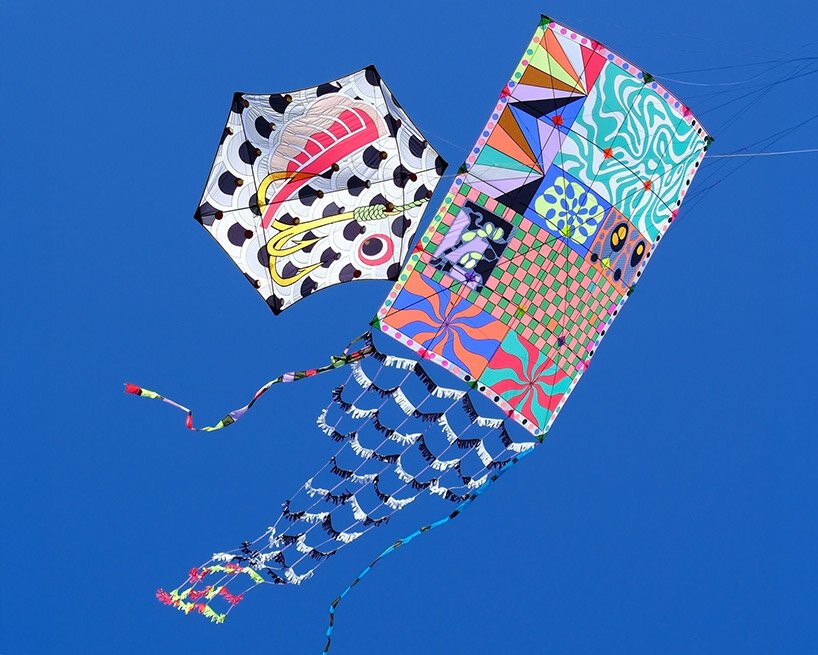
Kite Club returns to this territory through the language of contemporary product and textile design. Led by industrial designer Bertjan Pot with photographers Liesbeth Abbenes and Maurice Scheltens, the collective builds bold single-line kites from ripstop nylon and carbon-fiber frames. Many begin with traditional Japanese structures, then shift through pattern and proportion, sometimes by way of an improvised material.
During a 2025 residency at Museum Voorlinden, the group worked in public, invited guest makers, and helped repair kites brought in by visitors. Their book One Single Kite traces the construction of a demountable Kaku Dako from first cut to finished flight.
Kite Club, Bertjan Pot, Liesbeth Abbenes, Maurice Scheltens, Museum Voorlinden, 2025 | image courtesy Museum Voorlinden
between the body and the sky
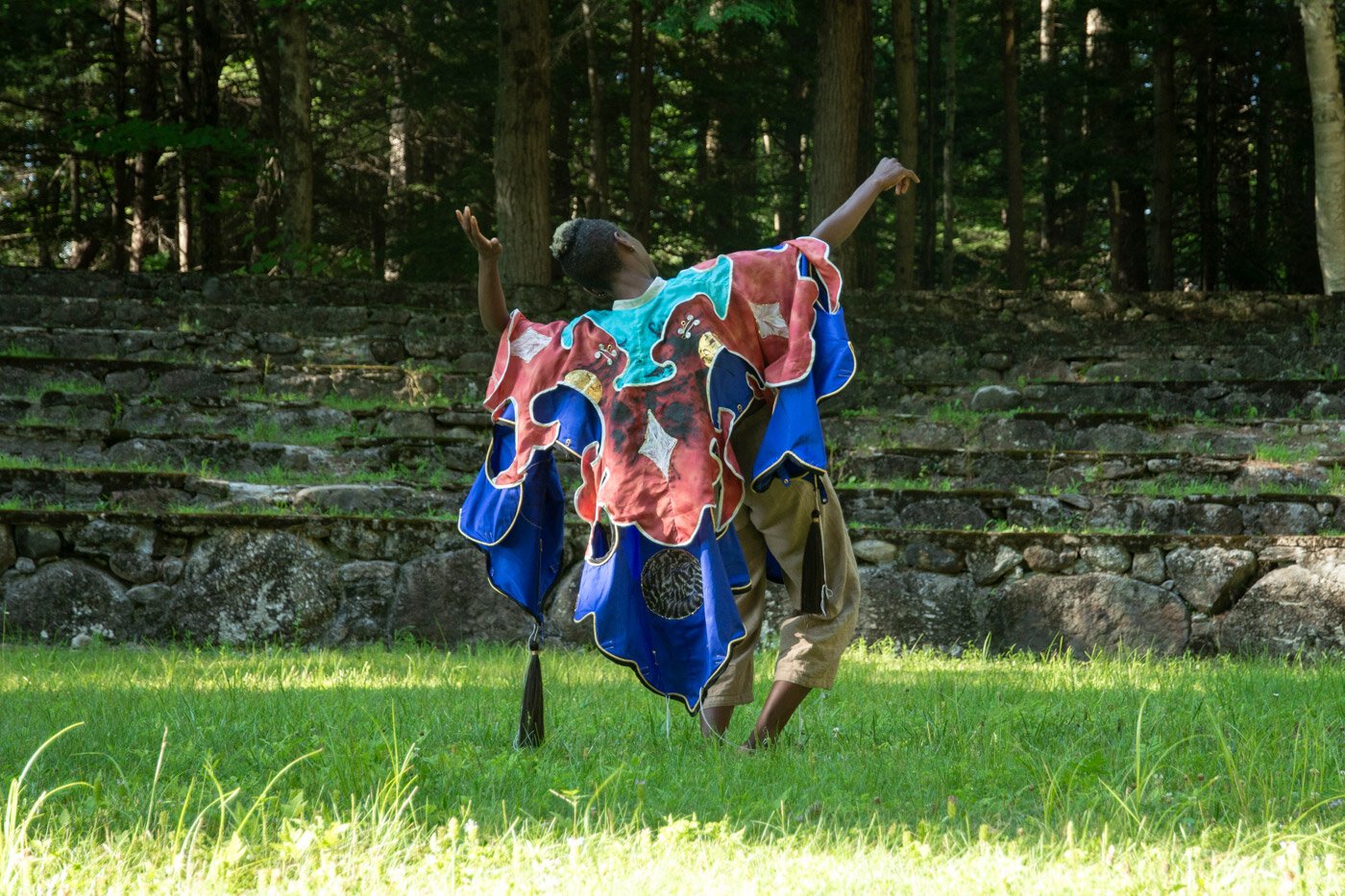
Chicago-based artist Hai-Wen Lin brings the kite close to clothing. Their hand-sewn textile works combine garment construction with flight engineering, creating pieces that can be worn and flown. Silk stretches across bamboo, while beads and dyed rope change the weight and movement of the surface. The Museum of Art and Design in New York describes the works as ‘couture for the wind,’ an apt phrase for objects that move between body and sky. Lin’s current exhibition at MAD remains on view through October 4th, 2026.
Cloud Collar, Hai-Wen Lin, 2023 | image courtesy the artist
Cloud Collar, Hai-Wen Lin, 2023 | image courtesy the artist
a kite as a module
Hashimoto’s Giant Arc brings the story back indoors, where the kite becomes a module for building space. Even there, the object keeps its association with instability. Its thinness suggests a gust could rearrange everything. That tension explains why artists and designers keep returning to the form. A kite can hold a painted image or define a temporary room. In flight, it can extend a person’s reach hundreds of feet into the air. It is a drawing with a condition attached: the image has to move.
The Eclipse, Jacob Hashimoto, Governor’s Island, NYC, 2018 | image © Timothy Schneck
This interview is part of designboom’s PLAY chapter, exploring what would happen if form didn’t follow function, but pleasure. Discover more stories that celebrate joy, imagination and playfulness here.