
When the air outside is dangerous, your building is either protecting you or it isn’t
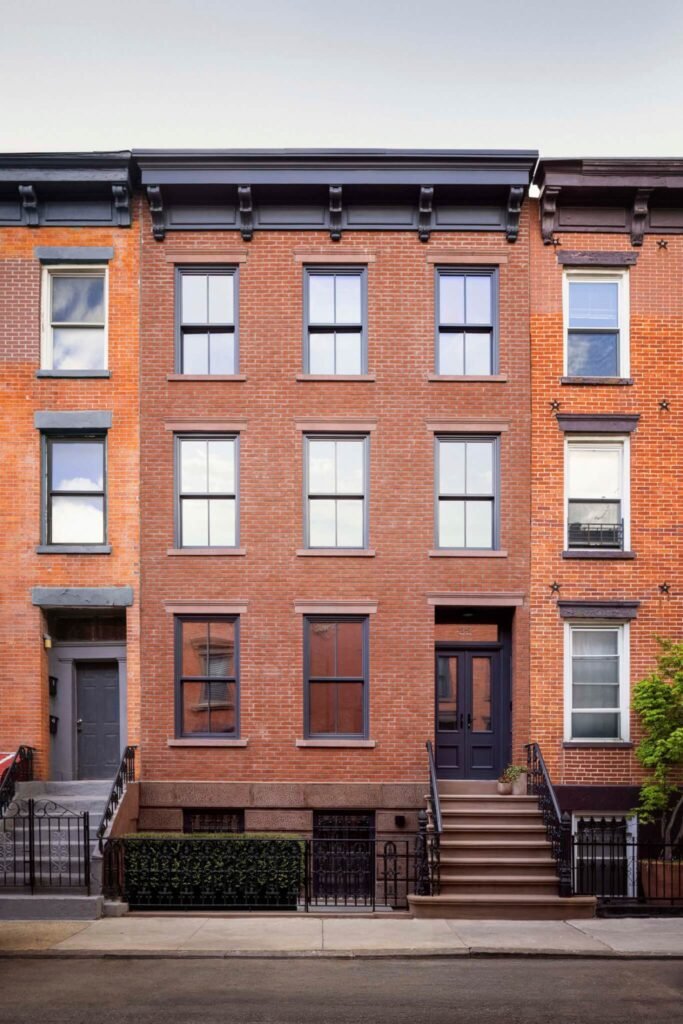

When air quality alerts go out across New York City—as they did last week, with smoke from wildfires burning in Canada settling over the five boroughs—the guidance from public health agencies is consistent: Stay indoors. Close your windows. Avoid unnecessary time outside. It’s good advice, but it leaves out an important question: What kind of indoors?
What no alert specifies is that “indoors” is not a uniform condition. A building is not a sealed box. In most homes, air is constantly moving through the building envelope—around window frames, beneath doors, through the countless small gaps that accumulate over decades of settling and wear. On a smoky day, fine particulate matter in that air—PM2.5, particles small enough to travel deep into the lungs—comes inside with it, even with the windows closed. For the vast majority of New York City’s housing stock, the difference between being inside and outside on a bad air quality day is smaller than we might assume.
There is an exception, and it’s measurable. The interiors of homes designed and built—or renovated—to Passive House standards are far more protected from outdoor conditions. These buildings bring in fresh air through a dedicated mechanical ventilation system with high-efficiency filtration, while the building envelope is sealed tightly enough to effectively eliminate leakage. On a smoky day, the difference is clear: An air quality monitor inside a Passive House will show clean indoor air, even while the city outside is facing hazardous conditions. That’s not an unintended benefit of Passive House design, but one of its central outcomes.
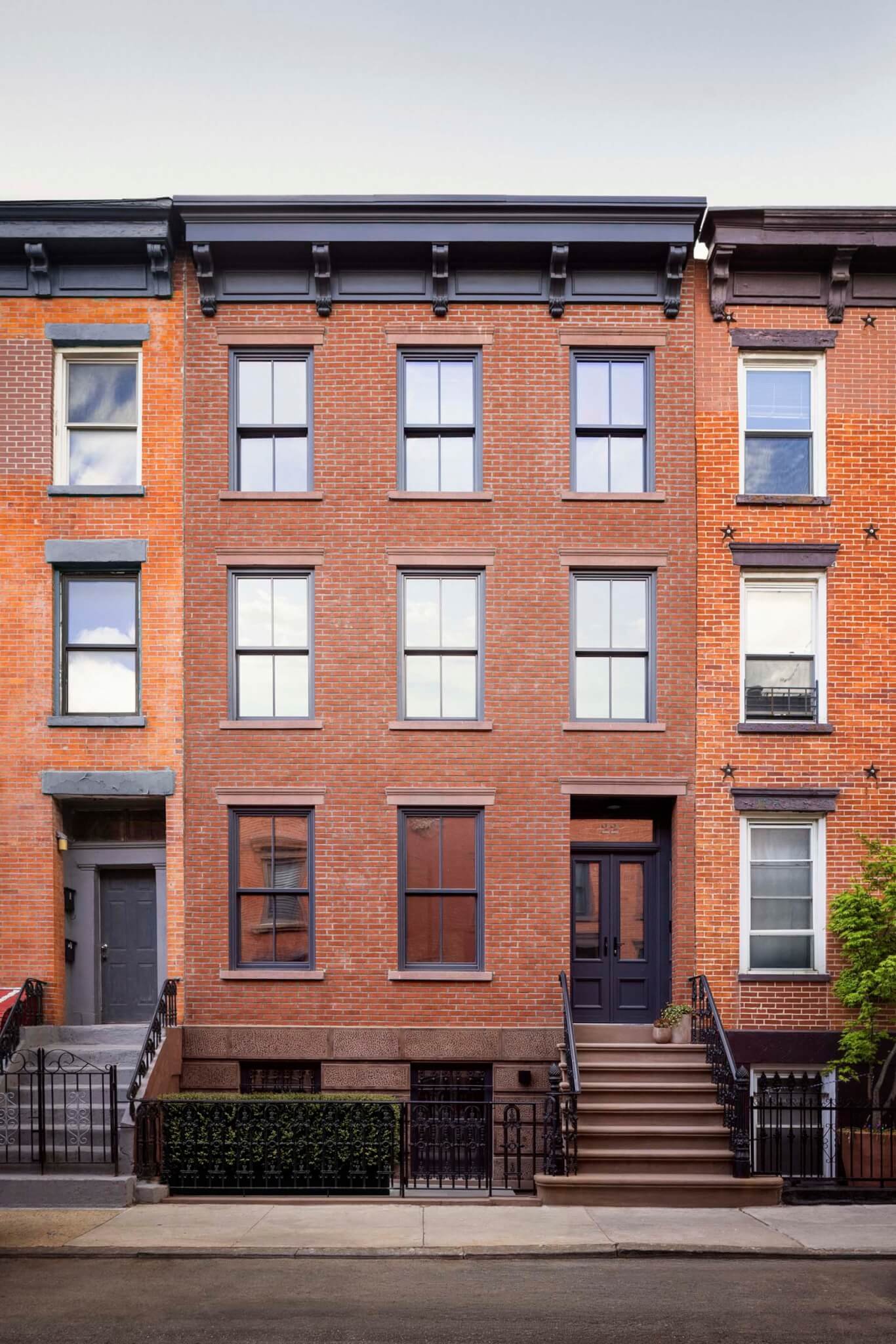 The city’s more than 200,000 townhouses and rowhouses predate modern energy codes, mechanical ventilation, and any expectation that outdoor air quality might one day require buildings to actively protect their occupants. (Eric Petchek)
Achieving that level of performance in an existing building requires treating the building envelope as a complete system. (reBuild Workshop specializes in this type of deep energy retrofit.) A continuous air barrier membrane is installed across the full exterior and sealed at every joint, penetration, and transition point where older buildings typically leak. Triple-pane, thermally broken windows replace the single- and double-glazed units common in pre-war homes, which reduces heat loss and eliminates the edge infiltration that standard windows allow even when closed. Every connection between walls, roof, and foundation is carefully detailed and tested.
The final result is measured through a blower door test, which depressurizes the building and quantifies exactly how much air moves through the envelope. A certified Passive House must achieve no more than 0.6 air changes per hour (ACH) at 50 Pascals of pressure. A typical New York brownstone that has not undergone this kind of work may have between 5 and 10 ACH. These are not minor upgrades; they represent a fundamentally different way for a building to interact with its environment.
Our clients understand this difference much more clearly now. Homeowners whose renovations we designed and built to Passive House standards have reached out during previous wildfire events—including the 2023 Canadian wildfires, when the sky over Brooklyn turned orange for days—not because something went wrong, but because something went right. Inside their homes, nothing had changed. Their air quality monitors showed the same readings they normally see. Meanwhile, neighbors were wearing masks indoors.
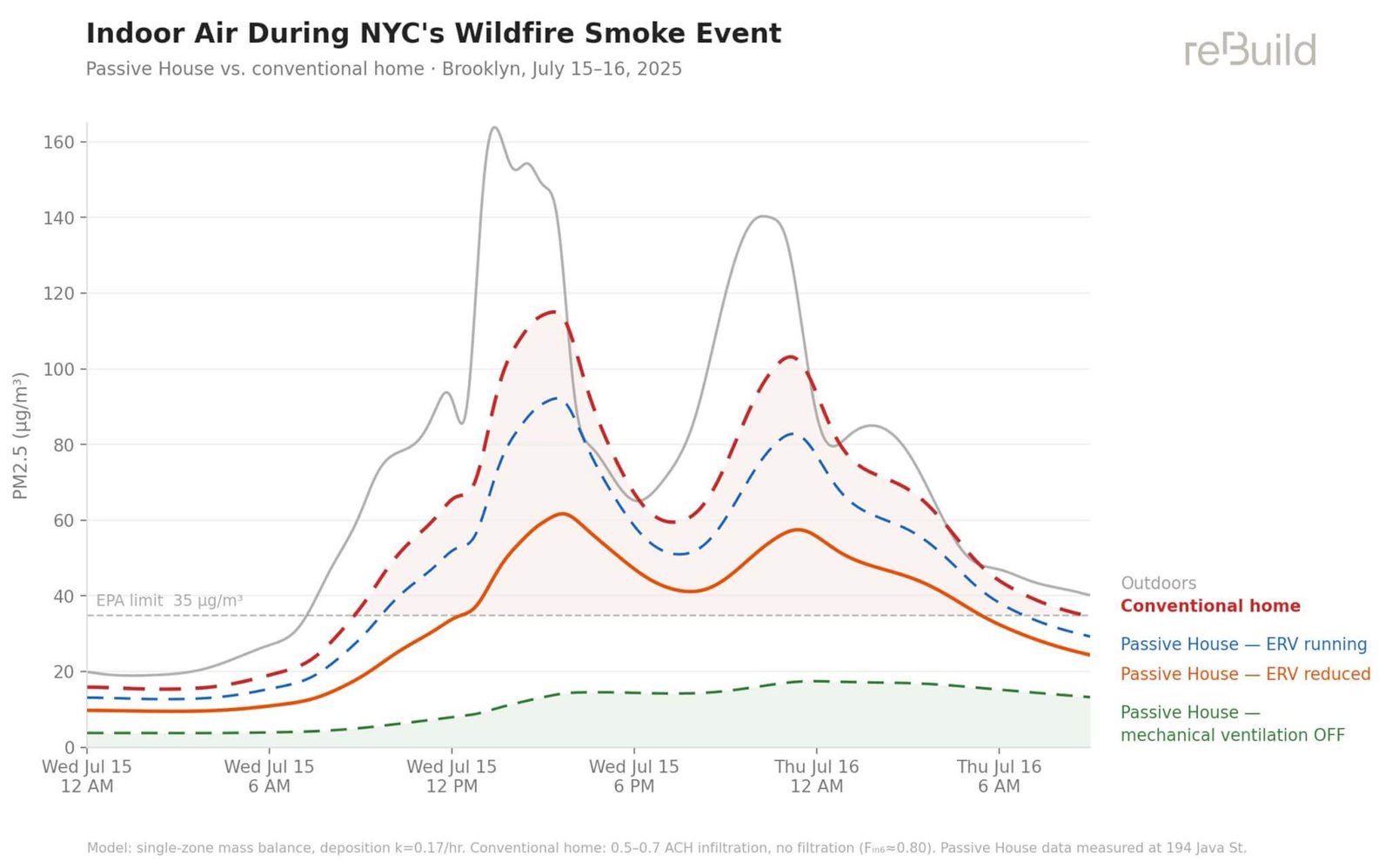
Measurements taken inside a Passive House in Brooklyn on July 15 and 16 showed indoor PM2.5 levels staying well below 35 micrograms per cubic meter throughout. (Courtesy reBuild)The numbers behind those calls are striking. Measurements taken inside a Passive House in Brooklyn on July 15 and 16 showed indoor PM2.5 levels staying well below 35 micrograms per cubic meter throughout. That concentration corresponds to an Air Quality Index (AQI) of 100, the EPA’s upper threshold for acceptable air quality; anything above it is classified as unhealthy for sensitive groups, and the scale climbs steeply from there. Outdoors, PM2.5 levels climbed above 150 micrograms per cubic meter, an AQI of roughly 200, deep in the “Very Unhealthy” range, where the general public is advised to avoid prolonged exposure entirely. The outdoor air was making people sick. The air inside that home was, by every health standard, normal.*
What the data also reveals is that the degree of protection depends on how long the event lasts. During the sharp spikes—when outdoor PM2.5 surged from 50 to 155 micrograms over two to three hours—the Passive House envelope acted as a buffer, and indoor levels barely moved. At those peak moments, indoor air was roughly 90 percent cleaner than in a conventional home. For context, “conventional” here means a prewar Brooklyn townhouse of the kind that makes up the majority of the borough’s residential stock: no mechanical ventilation, no filtration, and natural air infiltration through gaps and cracks at roughly 0.5 to 0.7 air changes per hour, the rate typical of an unsealed masonry building. In that scenario, outdoor air moves indoors with relatively little resistance. Over the sustained overnight period, when elevated outdoor concentrations persisted for many hours, the gap between the two building types narrowed somewhat to around 75 to 80 percent as the Passive House gradually reached a new equilibrium. Either way, indoor air in the Passive House remained within acceptable limits throughout. The conventional home offered no such margin: Tracking outdoor air closely in both scenarios, it exceeded the EPA guideline for essentially the entire duration of the event.
These smoky days are becoming more frequent, and the reasons are clear. Rising global temperatures, extended drought cycles, and changing precipitation patterns are creating wildfire conditions that were once considered extreme but are now recurring annually across the American West, Canada, and parts of Europe. The 2023 Canadian wildfire season burned more than 45 million acres and sent smoke across much of the eastern United States. Climate scientists have been clear that these events are not isolated anomalies but are part of a changing baseline, with impacts extending far beyond where fires actually burn.
An Energy Recovery Ventilator (ERV) installed in a house in Brooklyn. (Themis Haralabides)For city residents, the takeaway is simple: Wildfires are not a rural issue. The air quality problem belongs to everyone, and the building you live in either helps filter it or it doesn’t.
This is where New York City faces both a challenge and an opportunity. The city’s more than 200,000 townhouses and rowhouses—the brownstones, Italianates, and limestone-front homes that define neighborhoods across Brooklyn, Harlem, and the Upper West Side—were largely built between 1870 and 1930. They predate modern energy codes, mechanical ventilation, and any expectation that outdoor air quality might one day require buildings to actively protect their occupants. Most of these homes leak at rates five to ten times higher than Passive House standards. They remain, in the language of building science, tightly coupled to the outdoors.
A deep energy retrofit to Passive House standards is one of the most direct ways to change that condition. For century-old masonry homes that already require common upgrades like new windows, updated mechanical systems, and exterior repairs, the additional investment required to achieve Passive House performance can be relatively modest within the scope of a full renovation.
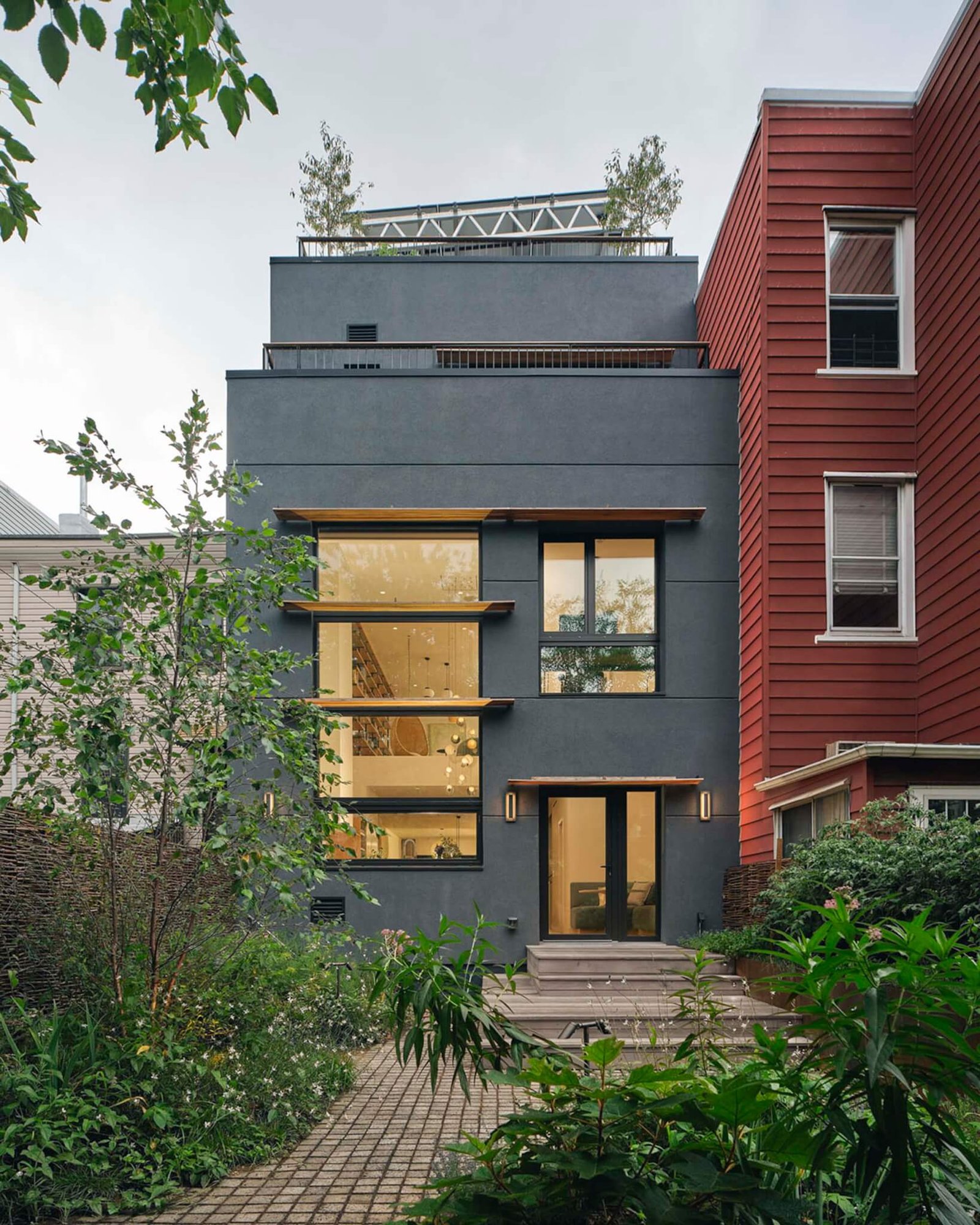
During the sharp spikes in AQI, a Passive House envelope acts as a buffer. (Ty Cole)The result is more than energy savings. A deep energy retrofit delivers a home that uses significantly less energy, maintains healthier indoor air, and provides a more stable environment regardless of what the climate delivers on a given day. As poor air quality events become increasingly frequent, that kind of resilience should be part of the conversation about how New Yorkers approach their aging housing stock.
“Stay indoors” is good advice. But the buildings we rely on should be designed to make it meaningful.
*One important caveat: A Passive House can only perform as well as its filtration system is maintained. A neglected or degraded filter reduces the building’s ability to protect indoor air quality. The airtight envelope provides the foundation, but regular maintenance of the ventilation system remains essential.
Themis Haralabides founded and leads reBuild Workshop, a design-build studio based in Brooklyn dedicated to transforming historic housing stock into enduring, high-performance homes that reflect how people live today. Uniting architecture, interiors, and construction within one integrated process, reBuild Workshop specializes in transformative townhouse renovations and additions across New York City.