
OMA completes its first built project in Japan, a series of site-specific installations at Edo-Tokyo Museum
Rem Koolhaas and Hans Ulrich Obrist, in 2011, published a seminal book about Japanese Metabolism—a postwar, albeit short-lived architectural movement championed by Arata Isozaki, Fumihiko Maki, Kisho Kurokawa, and others. Project Japan conveyed how the movement realized the ill-fated Nakagin Capsule Tower by Kurokawa, along with so many canonical works.
Now, more than a decade after the book by Koolhaas and Obrist hit the shelves, OMA has completed its first built project in Japan at Edo-Tokyo Museum—a massive cultural institution completed in 1993 that tells the history of Tokyo, originally designed by Japanese Metabolist architect Kiyonori Kikutake.
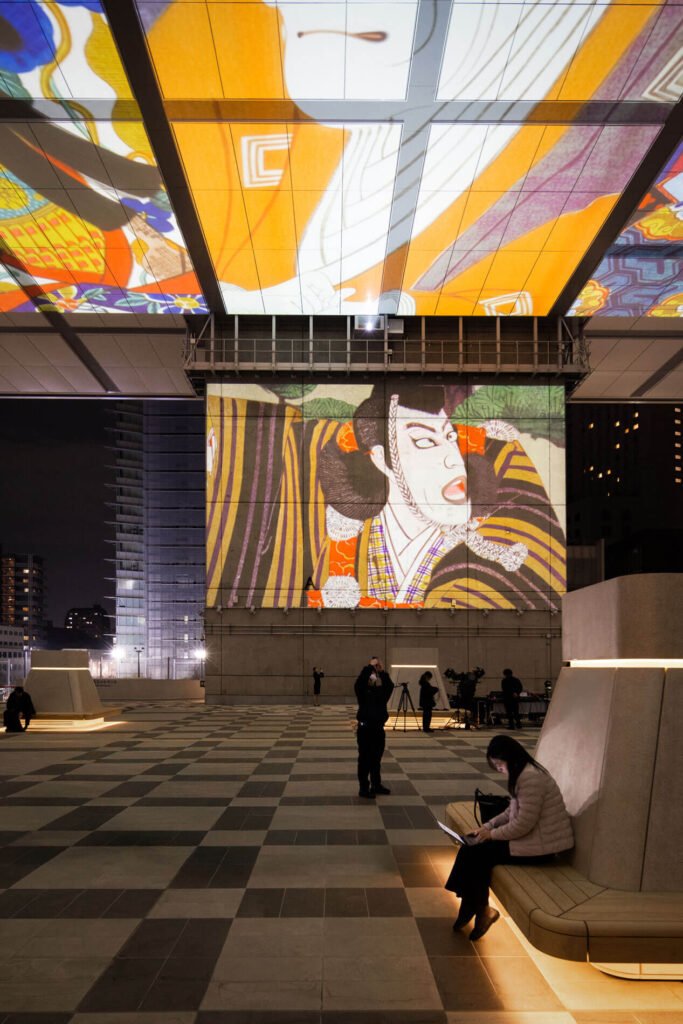
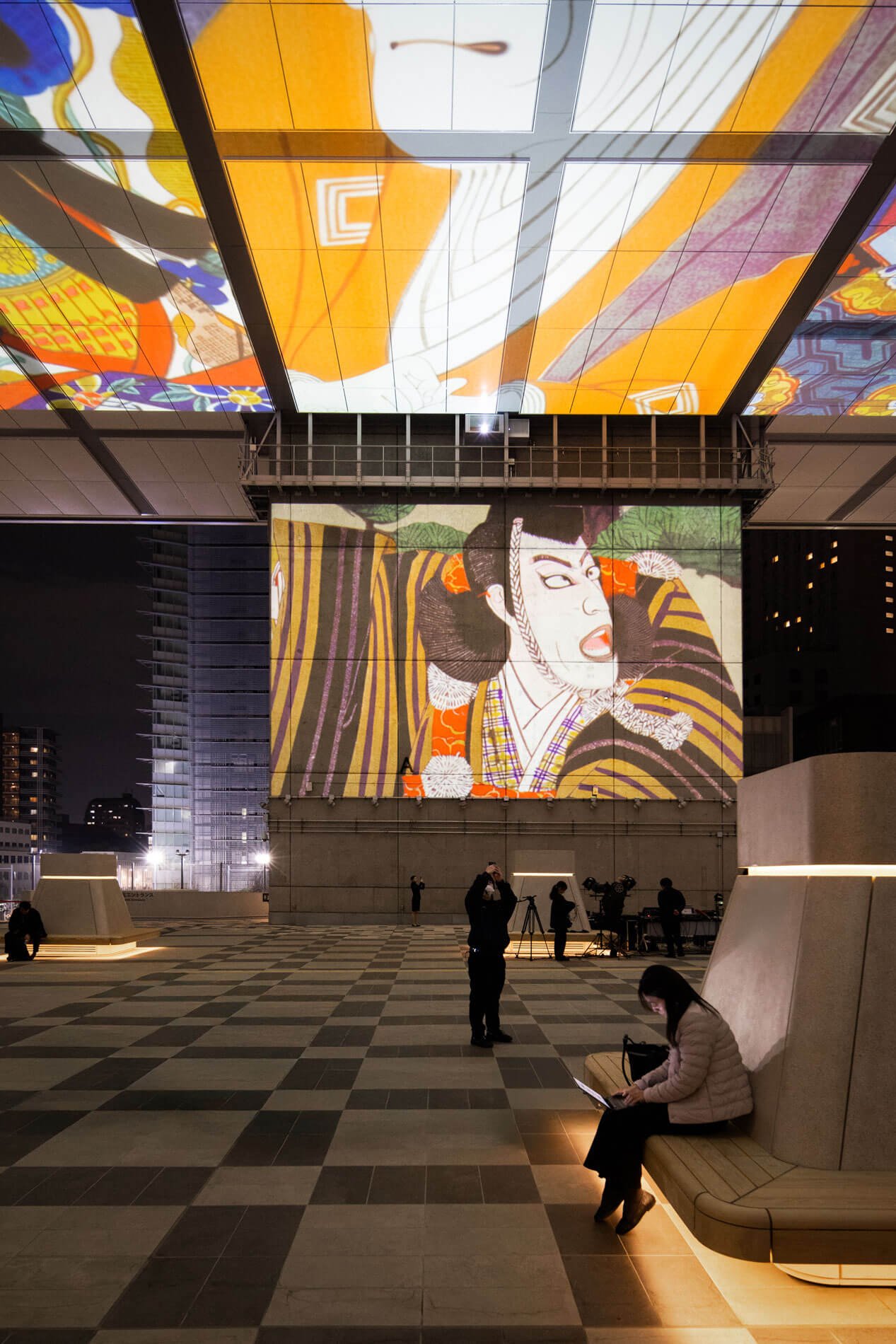 Imagery from the museum’s collection is projected onto ceiling and pilotis surfaces. (Vincent Hecht)
Edo-Tokyo Museum takes its name from the Edo period in Japan, which lasted approximately from 1603 through 1868. It reopened recently after four-years of renovations. The repairs were largely structural and mechanical; they included accessibility, insulation, and waterproofing upgrades, as well as improvements to the HVAC system.
The site-specific installations by OMA transform “underutilized spaces” in the museum into “canvases for surgical, scenographic interventions,” the firm shared in a statement, straddling the line between art and architecture.
Moving images depicting traditional Japanese patterns, flowers, and scripts—all pulled from objects in the Edo-Tokyo Museum’s collection—as well as scenes from the Edo period and modern urban life are projected onto the ceiling of an expansive outdoor plaza, and pilotis.
Projectors are hidden from view inside structures wrapped with benches, and inspired by tusjiandons, lanterns popular during the Edo period.
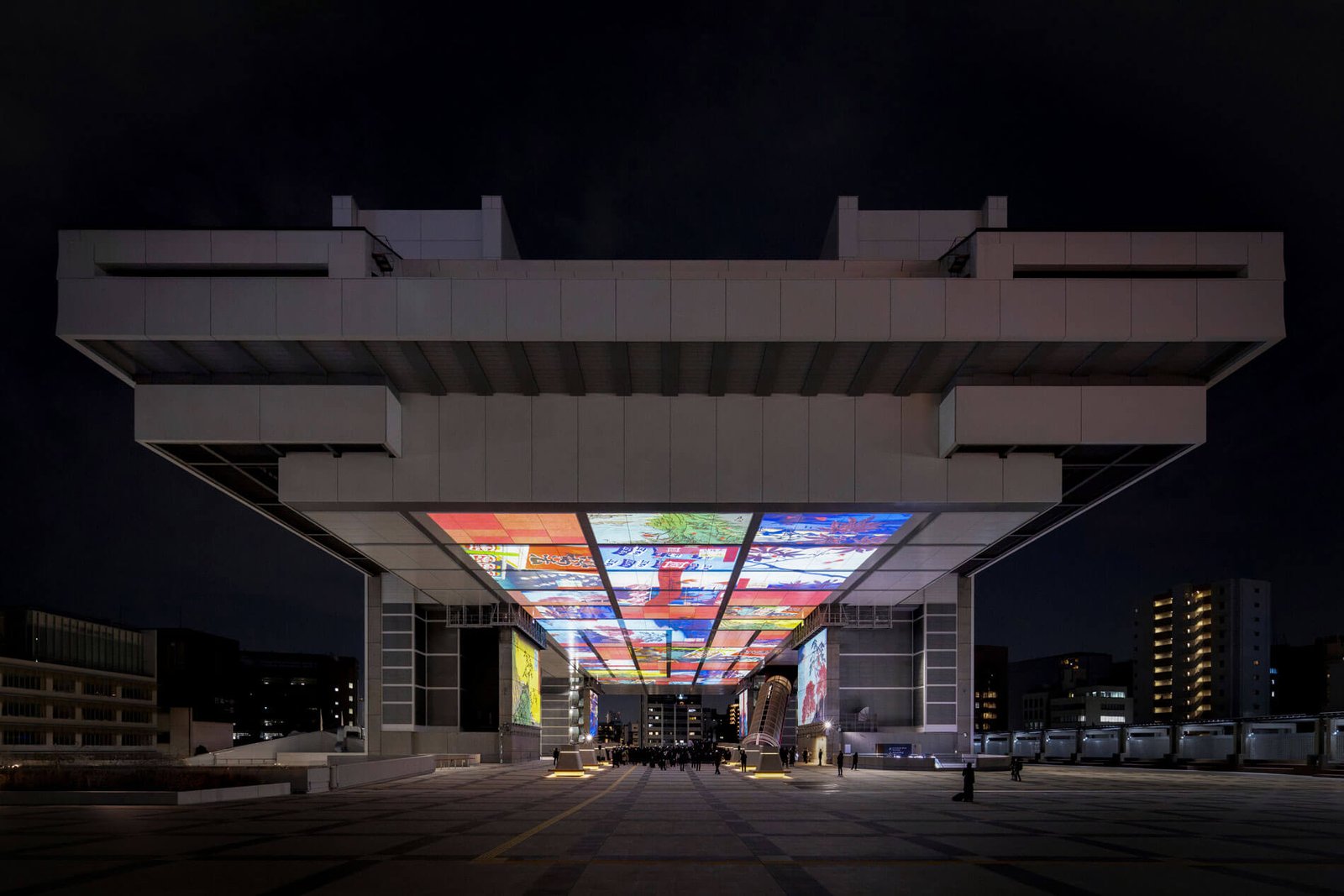 OMA designed projects that case images onto the underside of a massive ceiling, above an exterior plaza. (Vincent Hecht)
The western entrance of Edo-Tokyo Museum was refashioned to appear and function as torii, traditional Japanese post and beam gates. This is how Kikutake initially envisioned the space, OMA noted. To the eastern entry, a new circular sign designed by OMA was installed “based on an eye in a famous ukiyo-e portrait.”
“Rather than physically altering the existing architecture, we took a somewhat ‘non-architectural’ approach, focusing on fully activating its unique spaces and highlighting its extraordinary collection,” Shigematsu said.
“Using projection and light,” Shigematsu added, “the building becomes a medium that communicates the museum’s renewed identity outward and creates a more open and accessible experience for the public. It feels especially meaningful to be part of the ongoing life of one of Kikutake’s most important works, and our contribution aims to honor his philosophy—where buildings and the city are one organism.”
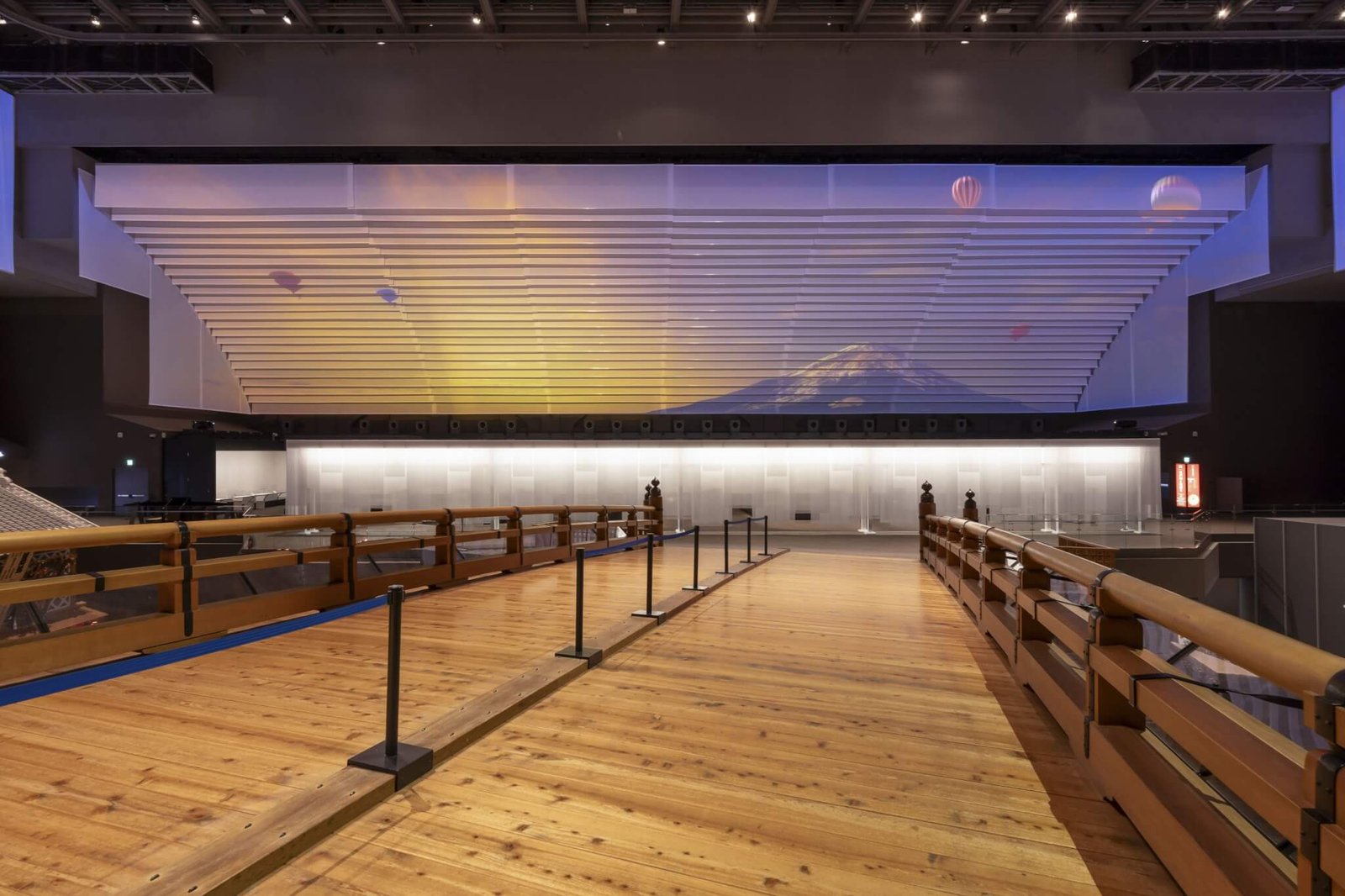 OMA also designed light projections inside the museum. (Vincent Hecht)
The project team at OMA was led by Shigematsu and included Takeshi Mitsuda, Sonia Grobelny, Woowon Chung, Mukey Pingmuang, and Paulina Beron.
Shigematsu and OMA New York also recently celebrated the opening of an addition it designed at the New Museum.