Ikon 5 Architects Envisions Rowan University’s Expanded Student Hub as a Transparent Agora

✕

When it was founded in 1923 as a teachers college, the New Jersey State Normal School at Glassboro welcomed 236 aspiring educators to a 25-acre campus comprising a new administration building and an Italianate mansion that housed the principal and a handful of dormers. Today, Rowan University is a state research institution whose enrollment totals more than 24,000 learners across 179 academic programs. A recently completed expansion of the Chamberlain Student Center by Ikon 5 Architects has reimagined that once-insular waystation as a hub befitting the transformed school in South Jersey.

Photo © Jeffrey Totaro
Located immediately south of a creek whose accompanying greenway serves as Rowan University’s primary east–west pedestrian route, approximately 10,000 people use the Chamberlain building daily during the academic year. The center didn’t necessarily engender a sense of shared identity among the waves of students passing through. According to Joseph Tattoni, design principal of New York–based Ikon 5, the brutalism-inspired brick building offered little visual communication to the greenway and even less interior daylighting, “which made people feel very isolated, even though it was their campus living room.”

Photos © Jeffrey Totaro
The 1970s-era student center failed to generate community programmatically as well as symbolically. Indeed, Rowan’s president Ali Houshmand asked Ikon 5 to encourage meaningful exchange in its project, likening the expansion to an agora. “He wanted this to be a place for demonstrations, presentations, and casual meetups,” Tattoni recalls of the request.

Photo © Jeffrey Totaro
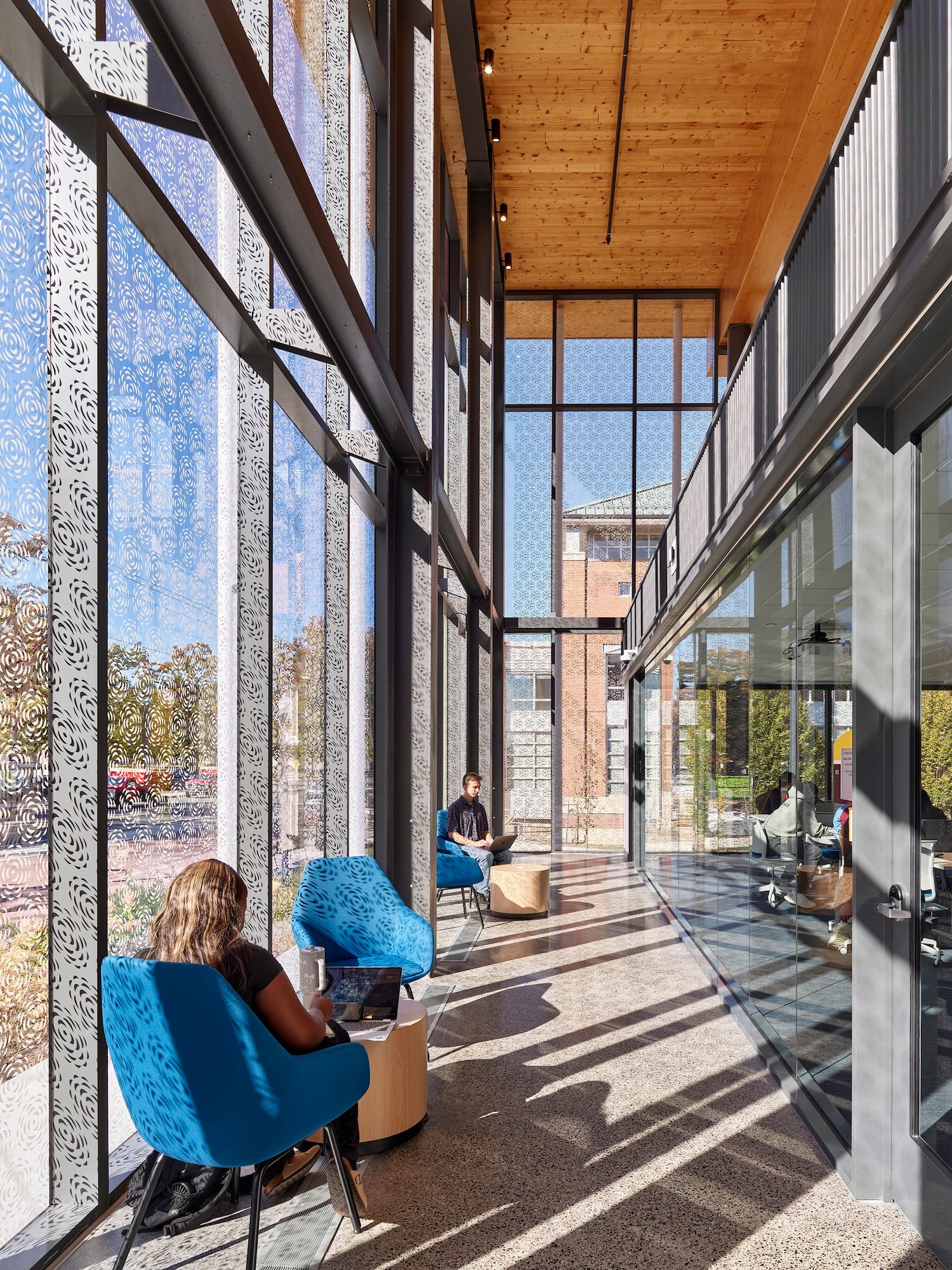
Photo © Jeffrey Totaro
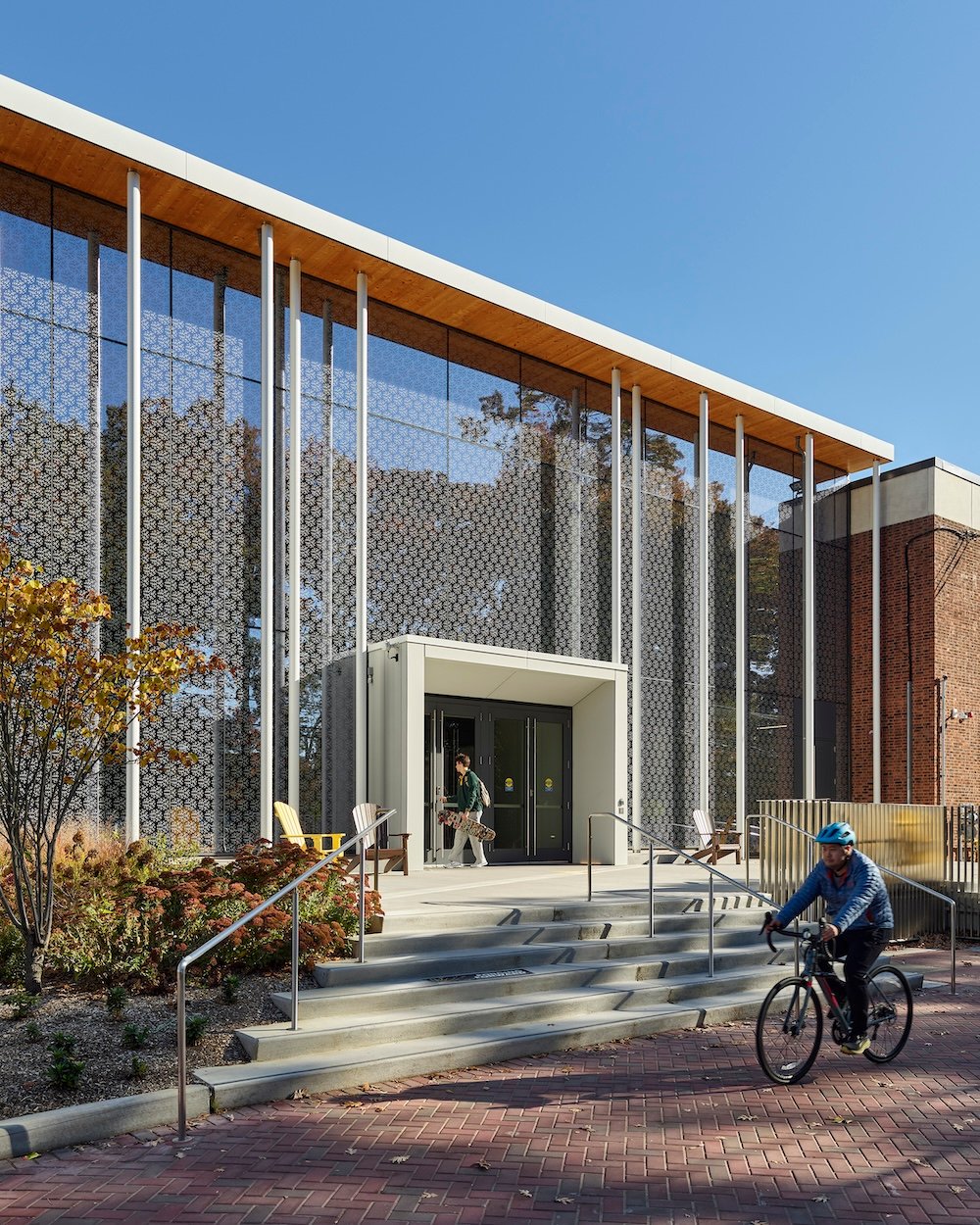
Conceiving of the agora as the material inverse of the Chamberlain center, Ikon 5 placed a glass volume along the existing building’s west side and wrapped it around part of its rear, north-facing elevation. Compared to the straightforward panhandle plan, the two-story agora is intricate in section. The addition traverses the gentle grade from the street to a creek-side plaza, and the design team articulated its mass-timber shed roof as a series of sawtooth-like tiers that modulate with the terrain and allow diffused sunshine into the interior.
Within the volume, the agora also mediates between campus levels thanks to the amphitheater anchoring its atrium-like lobby. The stepped form echoes the geometry of the roof while underlining the student center’s dual role as connector and stopping point. To realize Houshmand’s vision of the agora as a destination for intellectual enrichment, Ikon 5 treated the amphitheater as a flexible forum for presentations, informal gathering, and performances—even sourcing some overhead theatrical lighting for that purpose. A relocated coffeehouse, student government offices, group study rooms, and event spaces are looped around the lobby on both floors to, as Tattoni puts it, “give physical form to the school’s cross-disciplinary fertilization.”
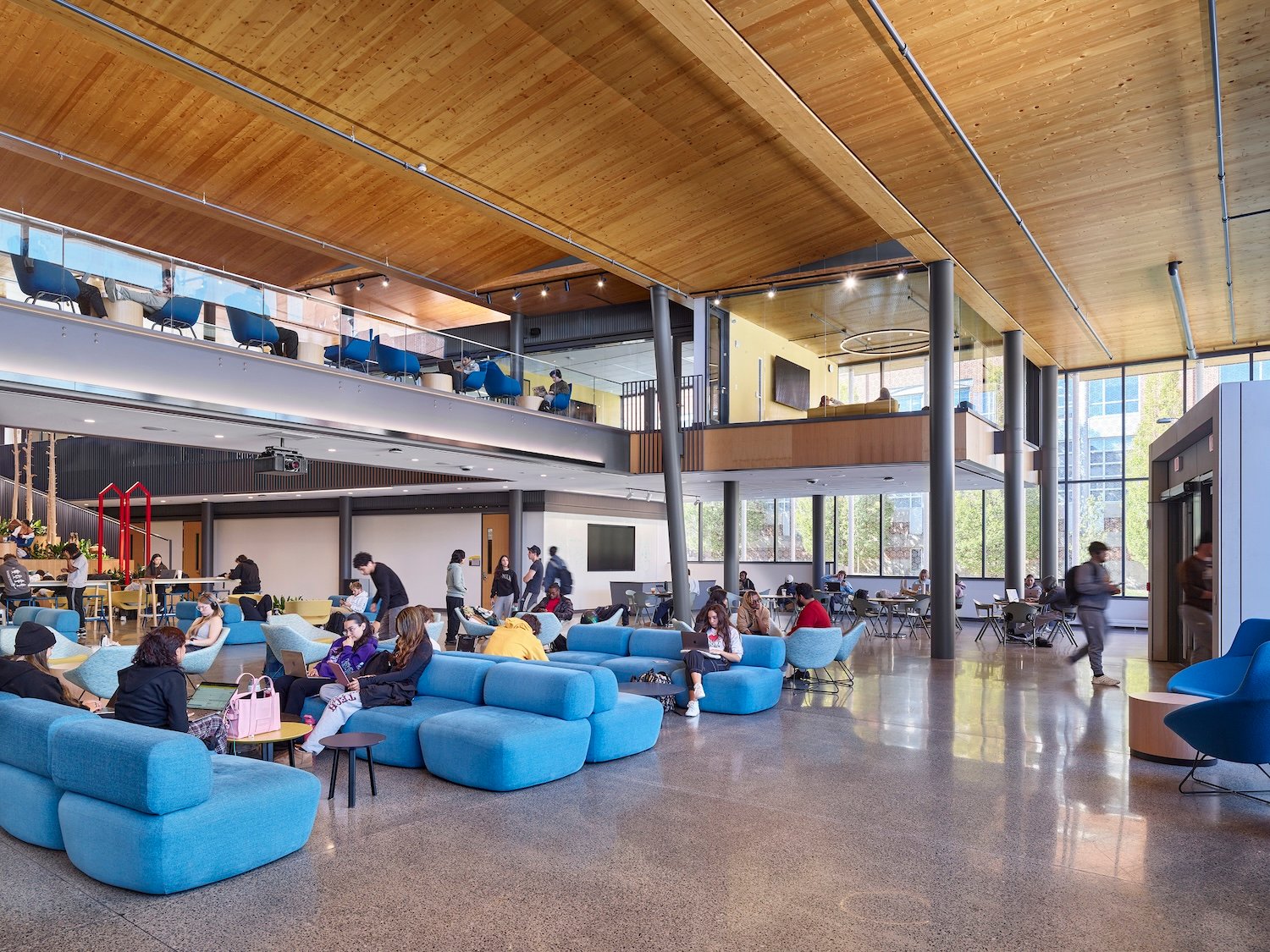
Photo © Jeffrey Totaro
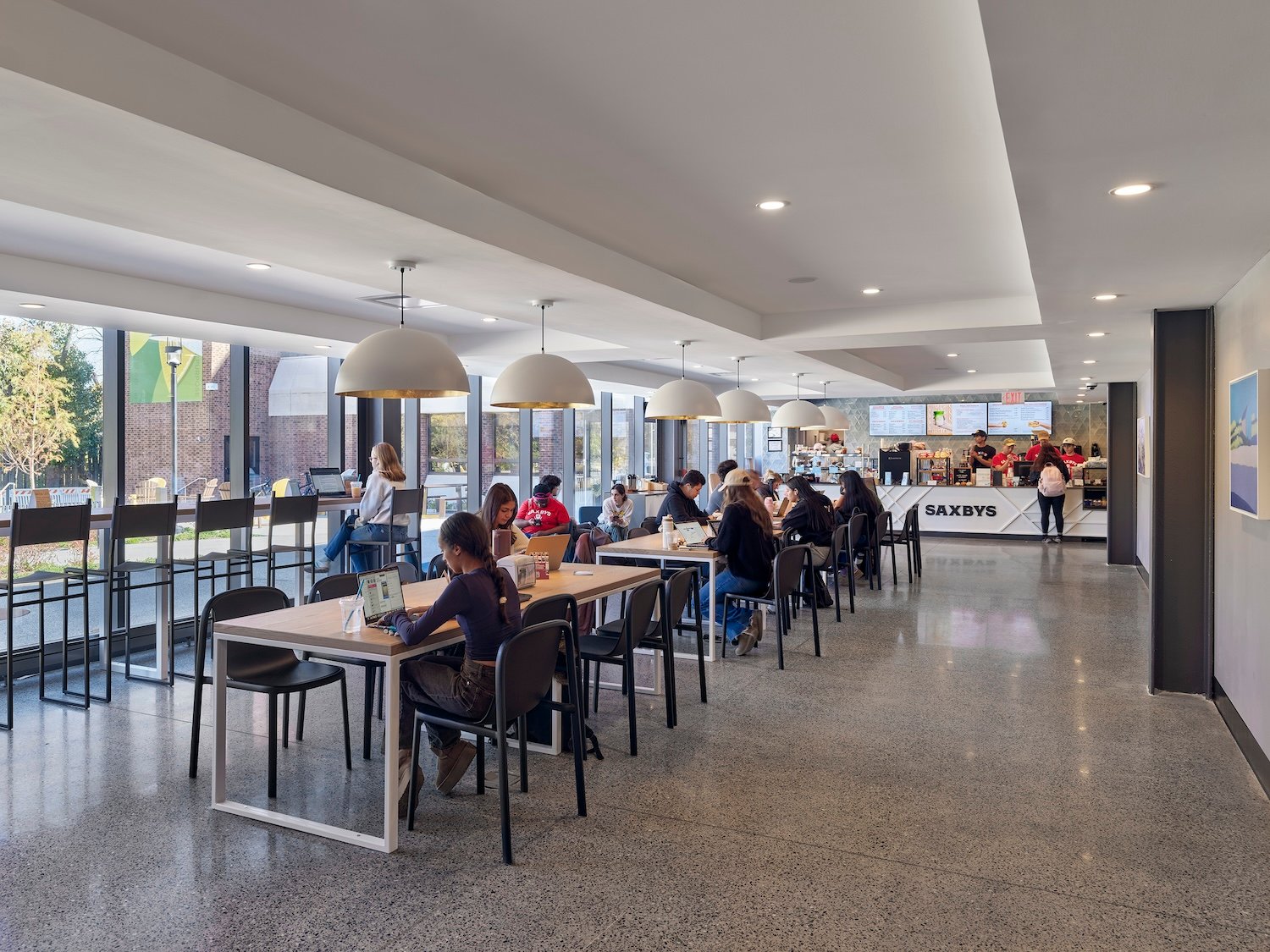
Photo © Jeffrey Totaro
While Tattoni explains that the agora was intended to concentrate activity and make it visible, he emphasizes that the project’s formal and material language is equally grounded in ecological context. The adjacent creek and greenway are connected to the New Jersey Pine Barrens, which the architect praises for supporting migratory bird paths, the region’s aquifer, and dense Atlantic cedar growth: “There’s a sense that this is a special place, and we wanted the building to remind students of that and to connect them to where they are.”
The reminders manifest in a series of strategies that inform the building’s structure and surfaces. A field of slender, irregularly spaced steel columns underneath the stepping roof is reminiscent of a stand of trees and their canopy, for example, and the glass envelope is overlaid with a ceramic frit patterned after Atlantic cedar pinecones. Inside, an art installation titled Batsto Homestead introduces bleached cedar trunks to the amphitheater. Together, the gestures frame the agora as both a landscape condition—a clearing in the pines—and a social engine.
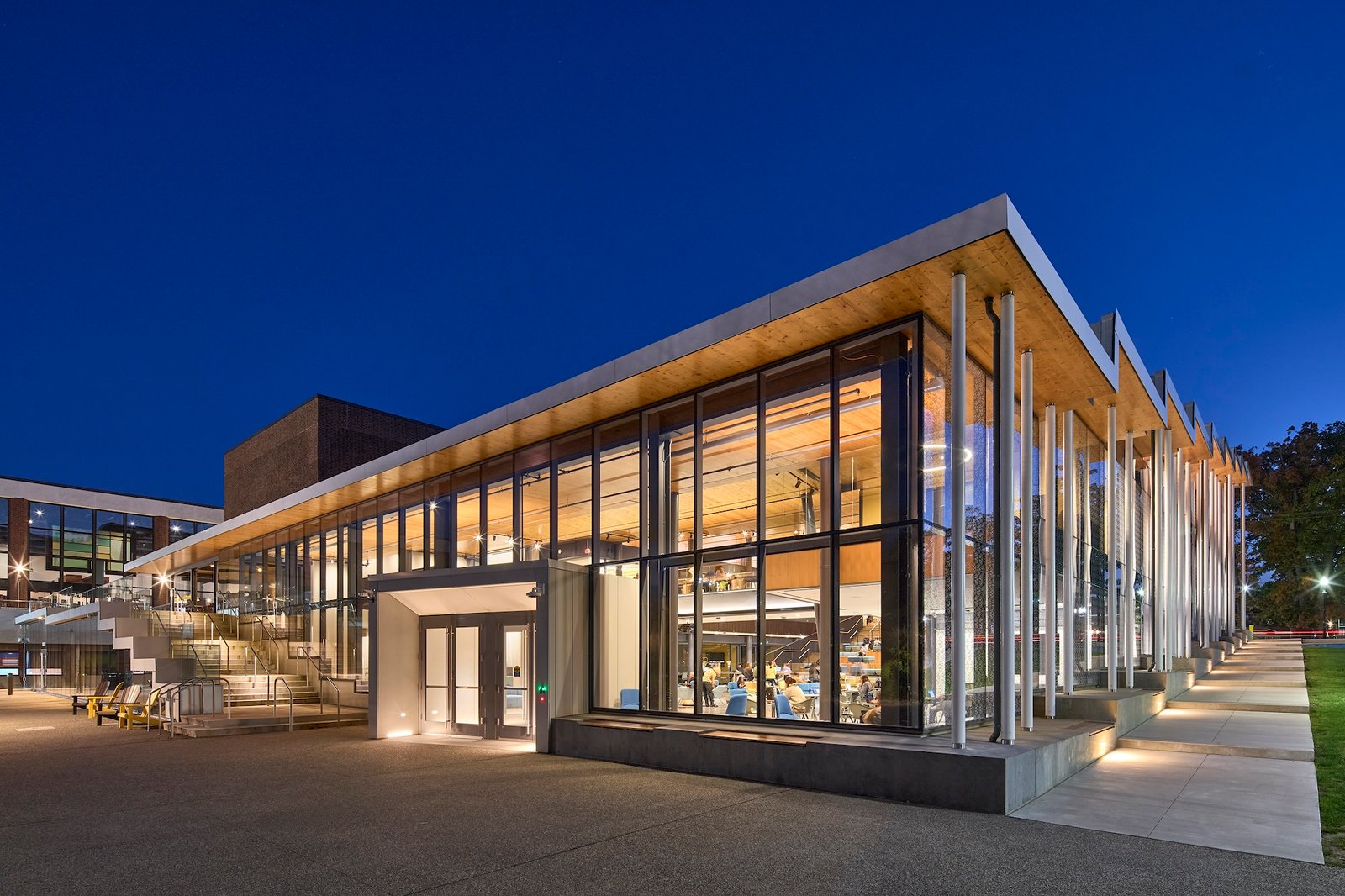
Photo © Jeffrey Totaro
For evidence that the strategy is taking hold, Tattoni reports of a recent visit when a group project materialized in a glass-walled meeting room while student athletes reviewed game footage in an adjacent space, their activities all visible. For the architect, the heartening walkthrough also suggests that Ikon 5’s expansion of the Chamberlain Student Center could be a lesson for similar facilities conceived during brutalism’s height. “These buildings are often well-built,” he observes, “but they’re not always welcoming. The opportunity is to breathe new life into them.”

Image courtesy Ikon 5 Architects