
Call For Ideas: Unbox 2026 Architecture Competition
Call For Ideas: Unbox 2026 Architecture Competition
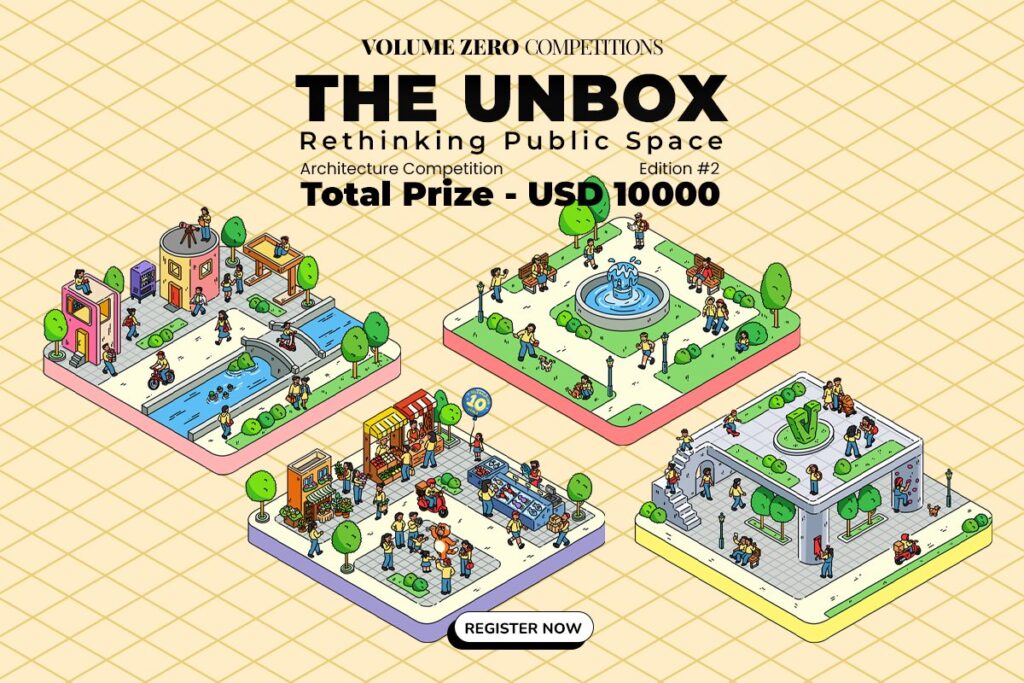
As Volume Zero celebrates a decade of shaping global architectural discourse, we are proud to introduce our 30th international architecture competition THE UNBOX 2026: a call to rethink the “DNA” of our shared environments. Marking our 10th anniversary, this competition stands as a testament to our ongoing mission: to empower designers who see architecture not just as a static monument, but as a living, breathing framework for human connection.
In an era defined by digital isolation and rapid environmental shifts, the spaces where we gather have never been more critical. UNBOX challenges the traditional reliance on massive, slow-moving civic infrastructure, inviting the global design community to “think small” for a big impact. We are looking for visionary micro-architectural solutions nimble, inclusive, and multifunctional; that can adapt to the speed of contemporary life. Join us as we enter our second decade of design innovation, and help us prove that even the smallest interventions can serve as powerful prototypes for a more democratic and resilient future.
Step outside the box; join Volume Zero in reimagining the pulse of our cities. –
Public space is where collective life unfolds. It is where communities gather, differences coexist, and civic culture becomes visible. From informal meetings to public debate, from everyday routines to shared celebrations, these spaces shape how we live together.
Yet the way we interact with these spaces is rapidly evolving. Digital platforms increasingly mediate how we communicate, work, learn, and socialize. At the same time, climate instability, social fragmentation, and spatial inequality are redefining the responsibilities of architecture.
While the world often focuses on large infrastructure and landmark architecture, everyday public life frequently unfolds in much smaller spaces. In this context, public space can no longer remain static. It must adapt, respond, and remain relevant. These small-scale environments can be delivered faster, adapted more easily, and implemented more affordably than large civic projects.
“Design Small. Big Impact!”
OPPORTUNITY:Public space remains one of the few truly democratic built-forms. It carries social, environmental, and cultural responsibility. These play a critical role in supporting social exchange, climate comfort, and inclusive gathering.
Today, these spaces must be capable of supporting diverse communities and multiple forms of use. They must respond to limited resources and environmental pressures while encouraging presence and interaction in an increasingly screen-mediated world.
This competition presents an opportunity to propose a micro public space that is adaptable, multifunctional, and context-sensitive. Rather than focusing solely on formal expression, participants are encouraged to explore how architecture can operate as prototype model of civic infrastructure serving real needs while strengthening shared experience. The spaces may work with combination of many functions that are not limited to• Libraries that double up as a Community Space.• Public Squares that host learning, play, performances• Observation Towers and Decks that act as Landmarks and Utilities• Bridges that acts like a art or viewing gallery• Playscapes that support climate resilience• Public toilets that goes beyond a humble civic infrastructure
“Less is More” – Mies Van Der Rohe (German-American architect)
CHALLENGE:UNBOX asks participants to open up what public architecture can be, to rethink how space is shared, sustained, and experienced. Participants are invited to design a micro public space with a maximum built-up area of 3000 square feet (278 square meters), designed to accommodate a minimum of 250 users per day.
The proposal must support at least three distinct uses across daily or seasonal cycles. It may take the form of a pavilion, a small public building, a hybrid landscape-architecture intervention, a modular system, or a deployable structure.
The design should demonstrate spatial clarity, multifunctional usability, and environmental responsibility. The proposals need to be sustainable as well as be a model for sustainability for its users. Participants are encouraged to explore non-conventional materials or innovative uses of traditional materials, responding to context, climate, and construction feasibility.
Technology may be incorporated where relevant, but it should reinforce physical interaction rather than replace it. Proposals should also address durability, maintenance, and long-term viability, acknowledging the realities that public spaces face over time.
The aim is not to produce a monument, but to propose a thoughtful and resilient piece of public architecture.
SITE SELECTION:Participants may select a site anywhere in the world, including urban centres, small towns, or remote landscapes. The chosen location must be clearly identified and justified.Entries should demonstrate a considered response to the social, cultural, and environmental conditions of the site. Participants must articulate who the space serves, what local need it addresses, and how the proposal engages with its context.
Site sensitivity and contextual awareness will be fundamental to evaluation.
SCHEDULE:Headstart Registrations: 5th March 2026 to 10th July 2026Early Bird Registration: 11th July 2026 to 11th September 2026Standard Registration: 12th September 2026 to 6th November 2026Closing date for Submissions: 3rd December 2026Announcement of winners: 5th February 2027
Registration Opens March 5, 2026Registration Closes November 6, 2026Deadline to Submit Project December 3, 2026Winners announcement Date February 5, 2027