
A Minoru Yamasaki–designed office building in Minneapolis will become a hotel

A Minoru Yamasaki–designed building in Minneapolis is about to become a hotel. But depending on who you ask, the building is read as a Roman temple, an insurance office, a jewel box, an oversized music box, or—per the critic Larry Millett, writing in his 2007 guide to the Twin Cities—“a temple to the gods of underwriting.”
On April 20 Minneapolis developer Chad Tepley walked a KARE 11 camera crew through the empty lobby of the Northwestern National Life Insurance Company headquarters at 20 Washington Avenue South. Tepley, who purchased the building in November for $7.1 million, described what he intends to do with it: 165 hotel rooms, a ballroom and pool deck in the former mechanical penthouse, a 17,000-square-foot patio built on top of the portico, and a restaurant along the reflecting pools. This is a 6,000-square-foot porch,” he said. “People know it as the porch to the city.”
John Pillsbury, who ran the largest life insurance company in Minnesota, interviewed 39 architects before picking Yamasaki for the job. The commission was for an insurance headquarters for about 500 employees—underwriters, actuaries, examiners—and a medical department equipped with an x-ray machine and an electrocardiograph, so the company could assess applicants’ mortality in-house. The insurance company changed names over the years, Northwestern National Life became ReliaStar, then ING, then Voya Financial. Voya moved out in 2023.
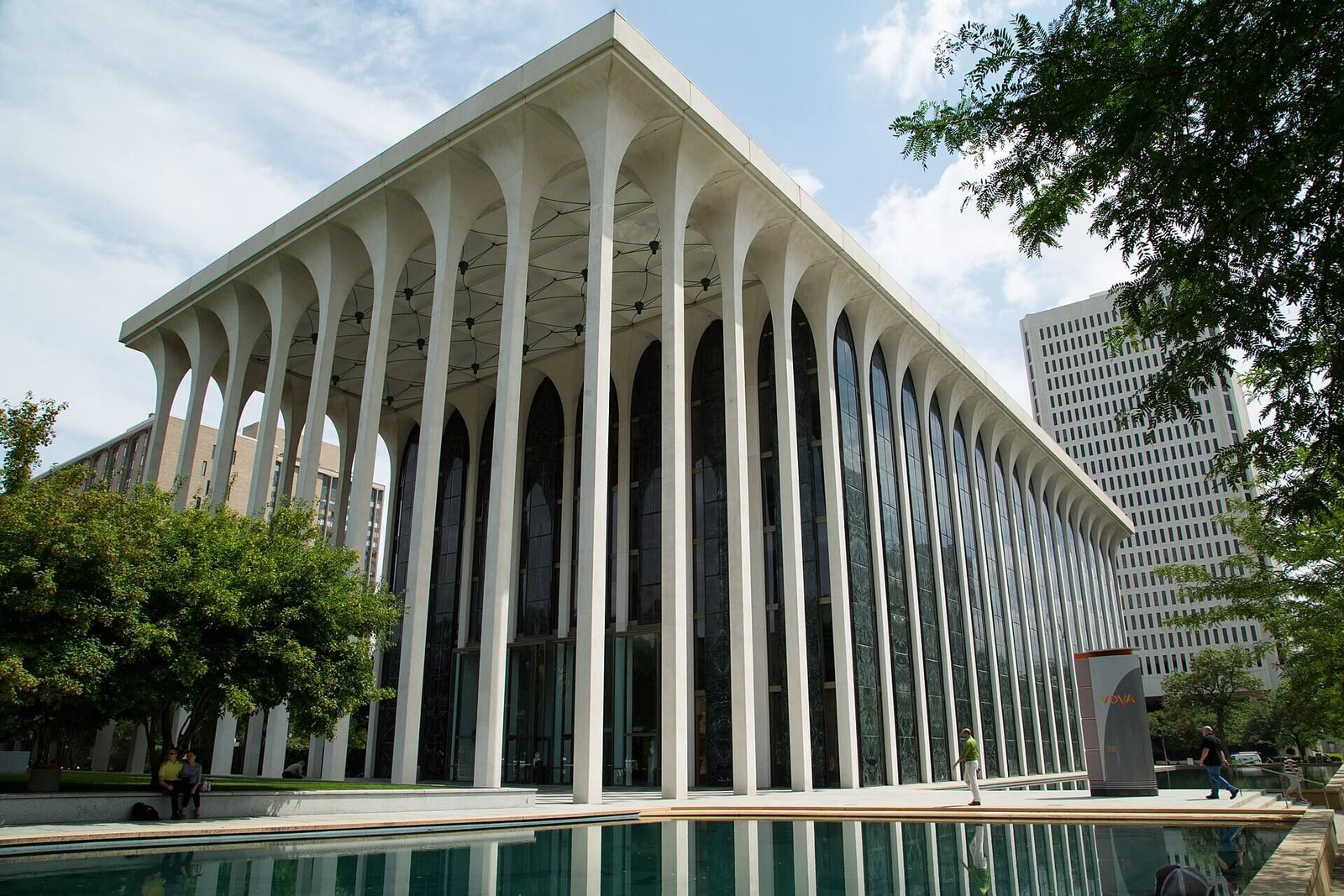 The Northwestern National Life Building reflected in one of its paired pools. The tower at right, 100 Washington Square, was a second Yamasaki commission for the company. (Matthew Deery/Wikimedia Commons/CC BY 2.0)
Yamasaki described his building design as “a park with a building in it.” He said the porch would be “delicate” and “a delight to walk through.” His partner Henry Guthard said the idea was a portico “you could look through”—a way to let the pedestrian mall that landscape architect Lawrence Halprin had just finished drawing for downtown Minneapolis unspool its full length and come to rest, visually, on the Hennepin Avenue Bridge. You could look through, though you were never invited in.
Yamasaki was born in Seattle in 1912 to Japanese immigrant parents, in 1942, when the United States began sending Japanese Americans to internment camps, he was on a job in New York that kept him out of the camps; his architecture firm helped rush his parents from Seattle to join him there. He spent his life designing buildings meant, as he put it in 1962, to give people “a serene architectural background to save [their] sanity in today’s world.”
“Though my architecture is often called too delicate,” he once said. “I cannot envision buildings which are too heavy and brutal just for sensational effect as being particularly enjoyable for people to experience each day.” He thought buildings should be kind to the body walking through them.
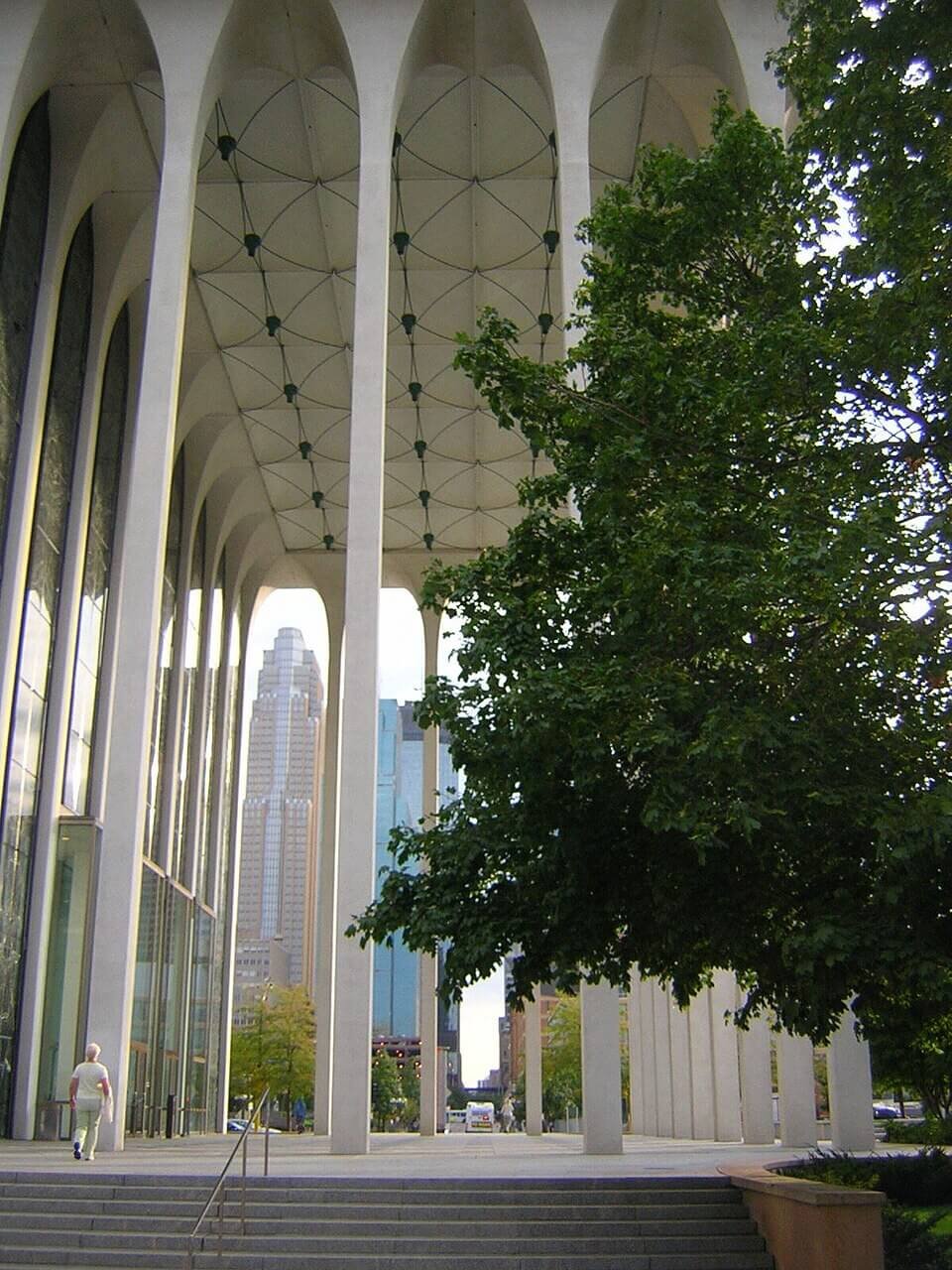 The view through Yamasaki’s portico, framing the Wells Fargo Center, 2008. (SusanLesch/Wikimedia Commons/CC BY-SA 3.0)
Loss of Sanity
In 1972, the Pruitt-Igoe public housing complex Yamasaki had designed in St. Louis was dynamited on live television, Yamasaki, watching, blamed himself. At a 1976 conference he asked “can people really live together peacefully?” He answered his own question: “In spite of my vision for how architecture could genuinely improve the lives of people, it seems that certain real social and economic conditions make this impossible.”
In 2001, his towers in lower Manhattan came down, and a wave of security retrofits passed over every other building he had ever designed. In Richmond, the Federal Reserve Bank he had drawn in the 1970s was wrapped in boulders and iron fences in the weeks after September 11; Style Weekly, a Richmond alt-weekly, wrote that fall that the building had become “an armed camp.” In Minneapolis, Tepley told KARE 11 that photographers who drifted onto the grounds started getting asked to leave. A building designed to be looked through became something to protect.
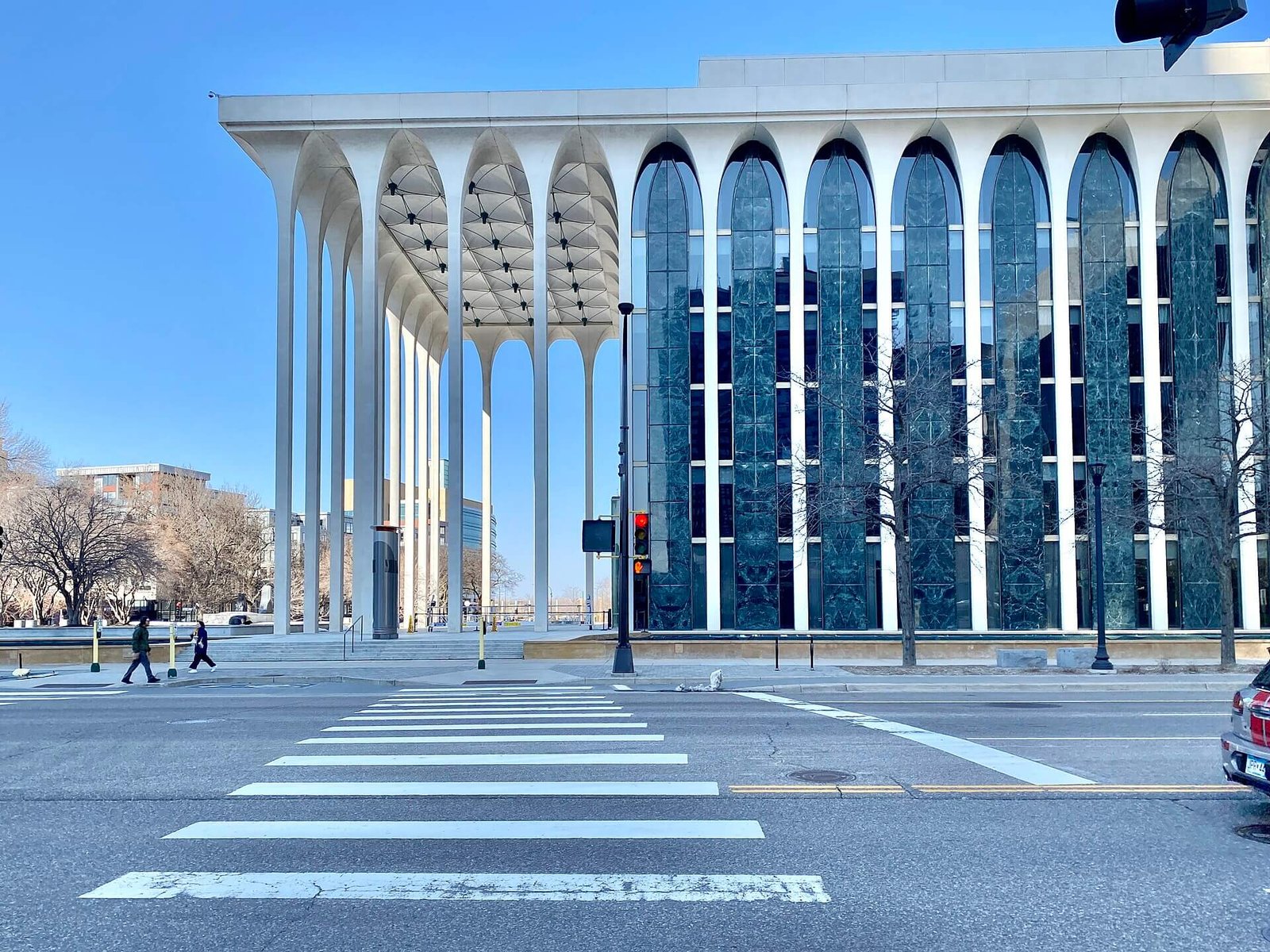 The east facade from Marquette Avenue, 2023, showing the portico’s cable-tension vault and Yamasaki’s green Vermont marble panels. (w_lemay/Wikimedia Commons/CC BY-SA 2.0)
Renewed Outlook
In 2028, if the financing holds and the historic tax credits come through, people will finally walk through the porch of 20 Washington for reasons other than a photograph or to work in an office. Rather they will be checking-in. They will be on the rooftop deck and eating dinner along the reflecting pools. It is a building designed as a civic gesture, in a country that has since taught us to call any building with an unlocked door a public one.
Yamasaki believed, in 1965, that a building could be both monumental and tender at the same time, and that the idea would survive whatever the building was used for. He lost that belief, more or less, by the end of his life. But the columns are still there.