
Nikyle Begay Resurrects Century-Old Diné Weavings
Nikyle Begay (Diné, Totsohní – Big Water, Deeshchiinii – Red Streak People, bįįh bitoodni – Deer Springs People) is a shepherd, weaver, and teacher based in Naabeehó Bináhásdzo (the Navajo Nation) in Sunrise Springs, Arizona.
Begay was destined to work with sheep from the very beginning. Following their birth, their grandmother buried their umbilical cord in the family’s sheep corral, a tradition that is said to shape a child’s future path. She prayed that Begay would be the descendant who maintained the family’s sheep flocks and carry her knowledge forward for generations.
Her prayers were answered. Begay took to weaving early on, and throughout their career, they have advocated for the value of ancestral Navajo Churro flocks, modeled high-quality breeding practices, and contributed to the ongoing revitalization of historic twill patterns.
In their own weaving practice, Begay has long been drawn to heritage weaving conventions, particularly the twill technique used to make saddle blankets. They possess an uncanny ability to reconstruct highly complex woven patterns, which they have used to reawaken techniques that were pushed to the margins of the trading-post economy that promoted regional styles to tourists and non-Native buyers over historic and functional styles. Because the trading post system historically promoted narrowly defined “regional styles” of Diné weaving to satisfy the aesthetic tastes of settler audiences, the characteristic durability of twill was less commercially viable. Begay is part of a growing movement of contemporary weavers rekindling Diné techniques and aesthetics after years of suppression by colonial market preferences.
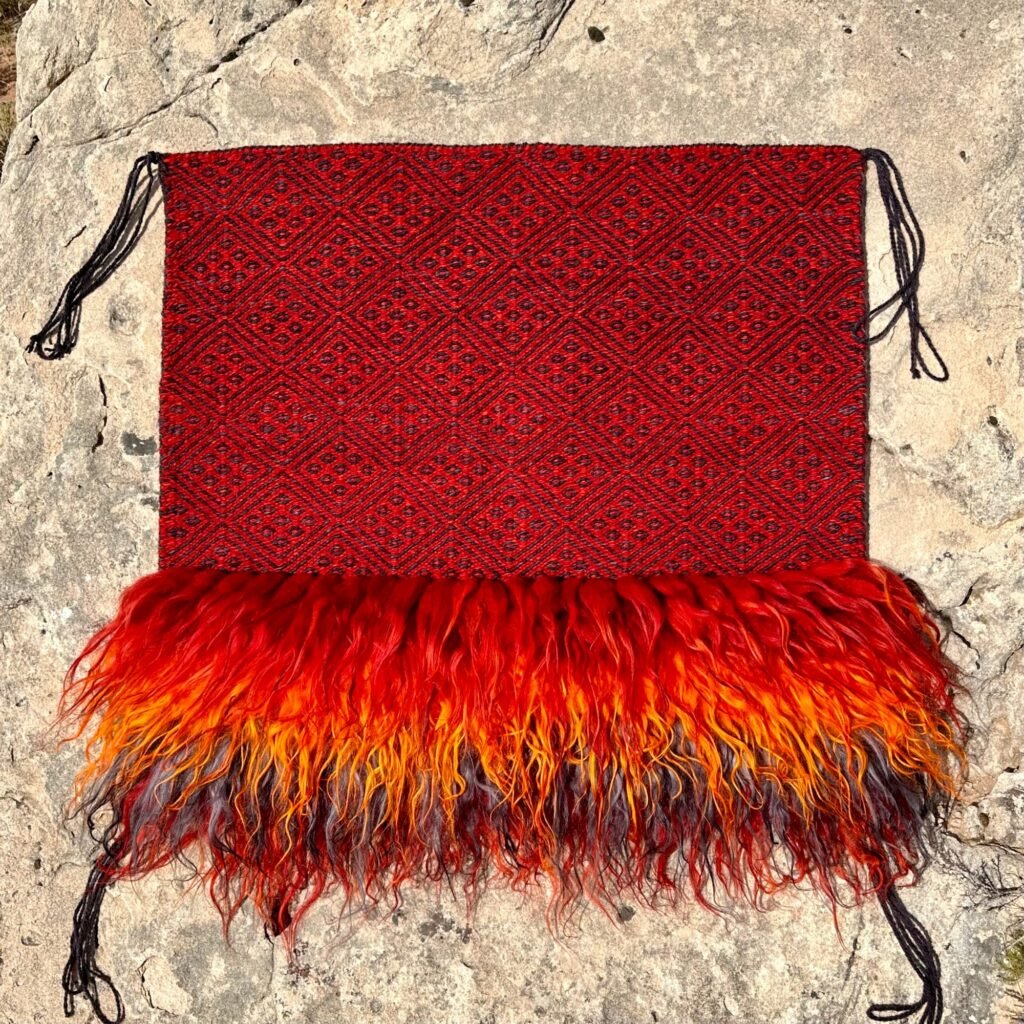
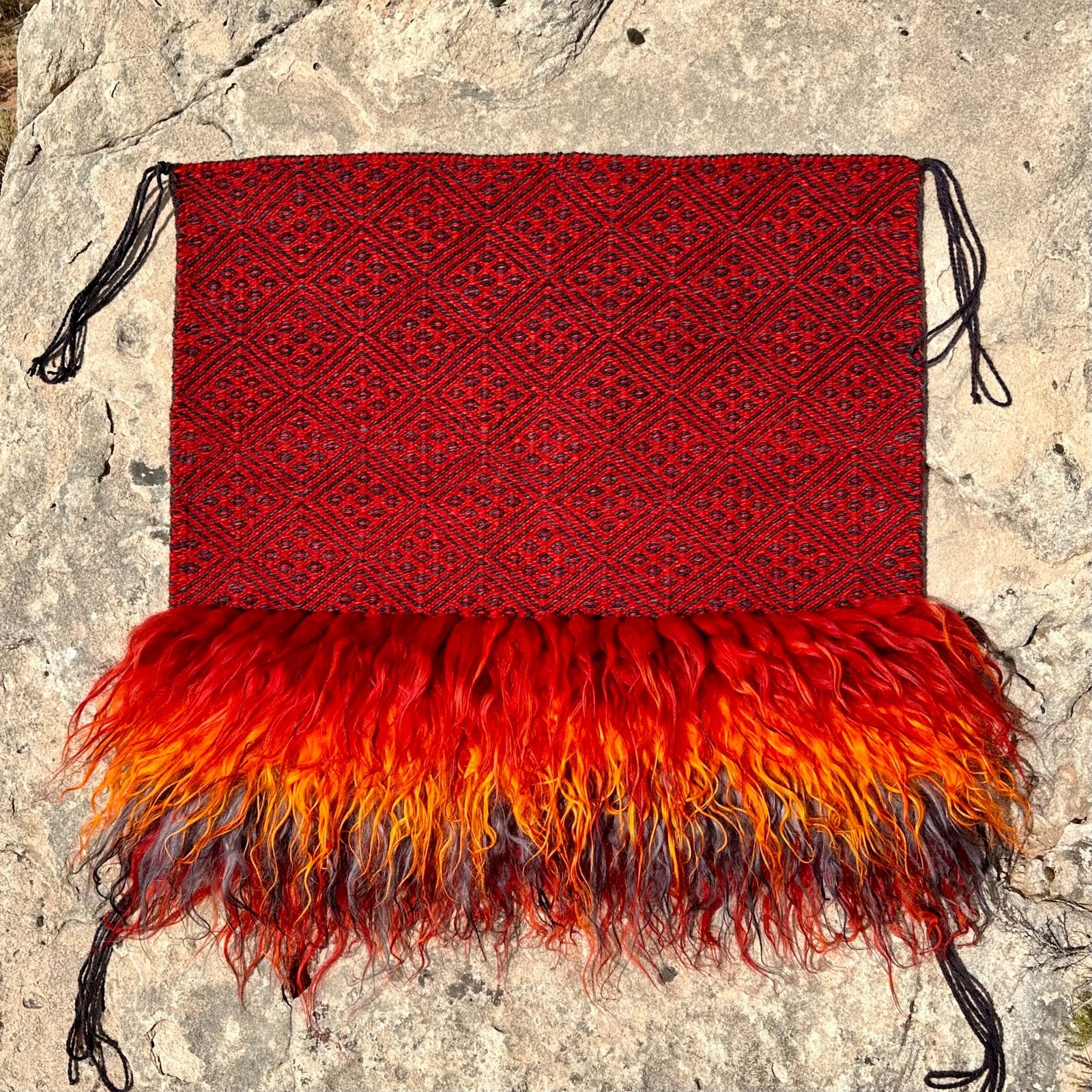 Nikyle Begay, “Kǫʼ- Fire” (2024)
Begay’s practice is also deeply nonhierarchical: Their weavings can be found on the walls of museums in exhibitions, including Smoke in Our Hair at the Hudson River Museum, and on the backs of horses. This dual presence reflects their role as a culture bearer, an artist who sustains and transmits cultural knowledge through equal parts practice, education, and daily use.
Moonoka Begay (no direct relation to the artist) and Zach Feuer spoke with Nikyle Begay over Zoom about their upbringing among sheep, disentangling weaving from colonial influences, and reclaiming queer Diné identity. This interview has been edited for length and clarity.
Moonoka Begay & Zach Feuer: How did you start weaving and shepherding?
NB: I was raised primarily with my grandmothers. I was always fascinated with sheep as a kid. I was just always so drawn to them. Anytime that I visited my grandmothers or my great-grandmothers, rather than going inside to say hello to everybody, I went straight for the sheep corral and I would just watch them. As I got older, I would stay out with the sheep from sunup to sundown on horseback or on foot. I just followed a daily path, going out at least two to three miles to the watering hole, and then slowly bringing them back.
At around age seven, I noticed my paternal grandmother weaving. She was a proficient twill weaver, which was quite rare back then. After watching her, I thought, “Wow, this is amazing.” So I took to it, and by about nine years old, I would sneak little pieces of yarn that she had and set up a loom on my own.
Back then, everything was very binary in terms of gender roles. The boys had to be outside doing work, and the women and the girls had to be inside, cooking and cleaning. My cousins and my uncles told me, “You can’t weave. You’re not a girl.” But with my grandma, she said, “If you wanna weave and if you’re going to take to the sheep, you’ve got to take to these other areas like shearing and processing the wool along with weaving.”
So I did. When she found that I was stashing little pieces of yarn and warp and trying to figure it out on my own, she told me to watch her from start to finish a few times. That’s how I learned to weave.
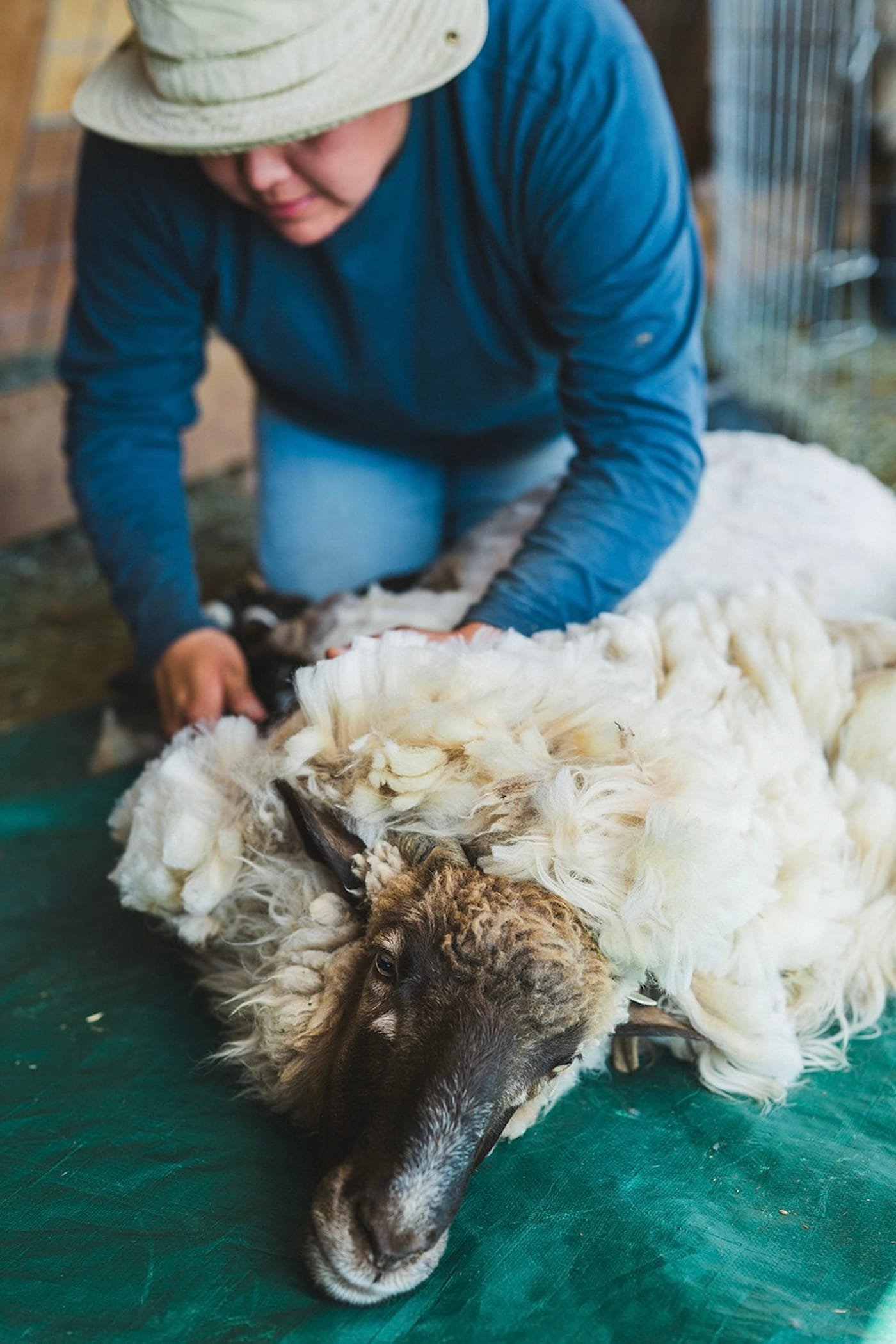 Begay shearing one of their sheep
MB & ZF: From 2021 to 2024, you ran the Rainbow Fiber Co-Op and distributed wool internationally, with an emphasis on natural, undyed colors. How and why did you start this project?
NB: The thought of bringing value to Navajo Churro wool has always been in the back of my mind, but it was during COVID-19 that it came into fruition. I started hearing stories of friends who are fellow shepherds and weavers getting sick, dying. One woman succumbed to complications when she had COVID, and I wondered what was going to happen to her sheep. I got so emotional thinking about all the knowledge that was lost and the sheep and sheep dogs who would be missing her. That was when the question came to me: How can I help these shepherds?
I called up my friend Kelli Dunaj, who also raises Navajo Churro sheep in Marshall, California, and asked her what we could do. We discussed how the wool economy was struggling, not only for the Navajo, but for other producers around the globe. With help from 4KINSHIP, One Earth, Fibershed, Vivo Barefoot, and First Nations Development Institute, we spread the word. Within our first week, we raised about $70,000. The next step was gathering the shepherds. We wanted to support the largest flocks of Navajo Churro sheep on the reservation. Knowing which shepherds raise which colors, we decided to offer a boutique yarn selection with dyed yarns along with an array of natural colors.
We used every part of the fleece from the sheep and had our first run done in Mora Valley Spinning Mill in New Mexico. We launched, and immediately we sold out. All the members continued investing earnings back into the Co-Op. That way, we became self-sustaining.
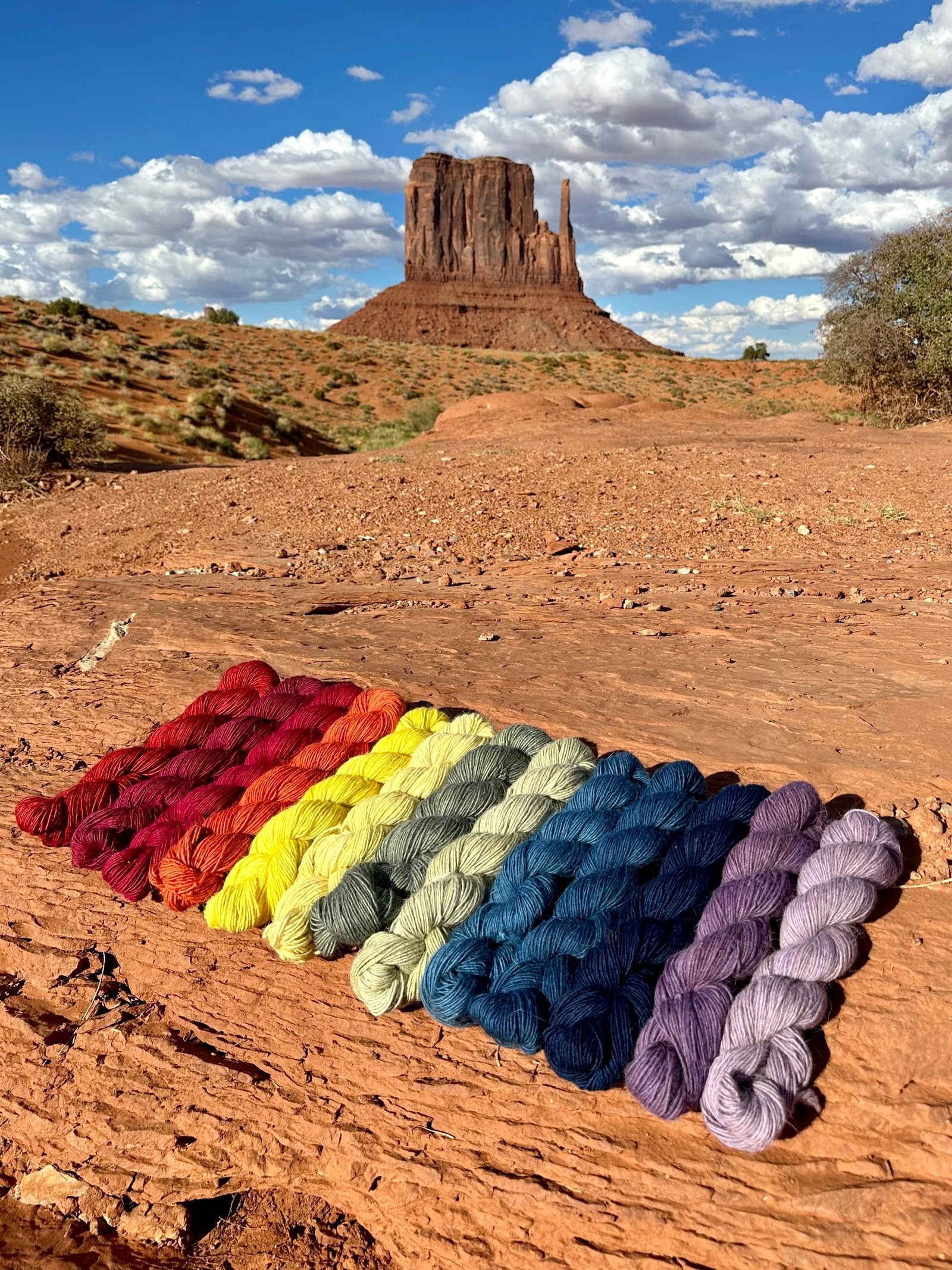 Rainbow Fiber Co-Coop Churro Wool (dyed colors)
MB & ZF: What breeding and husbandry practices specifically pertain to the production of weaving? Do you make decisions early on with sheep that affect the palette, texture, or overall aesthetic qualities of an artwork?
NB: I learned early on that I was not a dyer. The story goes that I was in my kitchen, and you’re supposed to be dying outside where the air is just fresh. But had my pots going and was just breathing in all of that noxious air. I was getting lightheaded and dizzy. The process started breaking my hair and I felt like I had a sunburn. It was awful. I was just a total beginner. Mind you, I was dying black and gray. So I thought, “Why not just breed my sheep for black and gray?” That would be a lot easier. I started making connections through platforms like Yahoo Groups. They had a sheep color genetics group that put me in contact with many more people who were breeding for natural, colored wool and fine-tuning their breeding practices to extract some of the more recessive color patterns.
I noticed other breeders and I were making mistakes in shearing our own sheep. The wool was beginning to become too coarse, starting to have more of a fiber that we call kemp, which is a short, opaque fiber that is way thicker than the actual wool fibers. Because I grew up adventuring to the Hubbell Trading Post and observing textiles woven before The Long Walk, I noticed that the rams’ wool that I was shearing was not the same wool that was used on blankets. That’s when my journey of visiting different collections truly began.
There’s one weaving that I do that has a natural color, with tufts at the bottom that are dark gray and almost black at the base. Then they fade in like an ombre into gray. That’s a natural color occurrence within that color pattern. I have bred to get those and incorporate them into my own weaving designs. So my breeding practices are fine-tuned.
 Begay’s sheep in Naabeehó Bináhásdzo
MB & ZF: Can you share more about the symbolism of those tufts?
NB: Before the introduction of the dazzling Germantown colors, moms would weave their sons’ saddle blankets in very fancy styles to communicate that they were ready to be married off. One of the methods to do this was to create thick tufts at the bottom, which would stick out from behind the saddle while the rider was sitting on top of their horse. The second reason for the tufts was for comfort because you can’t always butcher a sheep to make a pelt. Weavers began to weave the tufted rugs, not only for saddle covers but for bedding too.
MB & ZF: Your recent work is characterized by a singular, dominant dye color and natural Churro with some extremely complex and unusual twills. Can you tell us about this series?
NB: I love twill weaving. For many years, it has been undervalued, specifically by traders. When styles shifted from weaving blankets to rugs, traders would create their own regional styles by appropriating designs from Oriental rugs because this was what would sell in society. Many of these rugs went to New York City or Chicago, and then traders like J.B. Moore capitalized on the demand, even creating catalogs to trade rugs. Traders discouraged weavers from weaving twills, saddle blankets, and saddle seat covers because they weren’t saleable.
 Nikyle Begay, “Tó—Water” (2025)
Growing up going to the Hubbell Trading Post, I noticed that in the rug room, there were Ganado Red, Crystal, and Klagetoh from floor to ceiling. The little pile of saddle blankets was tiny compared to the rest. I wondered why, because I grew up seeing my grandmother weave a lot of saddle blankets, which were used around the community.
It was sad to see that other weavers stopped weaving the twill because traders didn’t value the technique. I made it my life’s goal, my mission in life, I should say, to bring the twill into its rightful place. It’s an integral part of Navajo weaving. If you look at a blanket pre-1860s, you’ll see that it’s actually woven in twill as a big blanket. And it’s not as thick as a saddle blanket. It’s both drapey and very utilitarian.
MB & ZF: Once you identified your mission to revitalize the twill technique, how did you begin the process? Did you call on the community for support?
NB: I told my grandmother that twill was my interest. I love using the warps to create the pattern rather than using the yarns to create the pattern. She would explain twill patterns to me and I would also turn to books. Although there are a lot of books written about Navajo weaving, there is usually only one paragraph, at most, dedicated to “subtle blanket weaving” or “double face weaving,” as they call it. There really aren’t many resources.
After learning the simplest diamond pattern, I was able to see and understand how the twill had worked. I figured out a lot of these patterns that hadn’t been woven in almost a hundred years. At a Sheep Is Life event, I met a woman who gifted me a loom. She explained, “My grandmother used to do this diamond pattern where it looked like this.” She drew a little sketch and I looked at it. I started picking warps and was able to recreate something she had only seen her grandmother do.
For some background, after the release from Fort Sumner, government agents forced patriarchy onto our people. Before that, it was all matriarchy. In the 1930s, when the grazing permits were issued to families, they were given to the head of household, who was then a man. Those papers were then passed down to certain children and oftentimes the favorite. That had happened in this woman’s family, so she didn’t have access to learning weaving because now it was closely guarded by one person who had held that grazing permit.
When I figured out that twill pattern, the internet was also getting bigger and people were posting more archival photos. I began to see earlier forms of twills, mostly samplers that were unfinished. I continued to learn by studying and recreating them on my loom. I always had an eye for it. I don’t know how else to explain it. I think it’s from watching my grandmother do it as a child so many times that my brain now works that way.
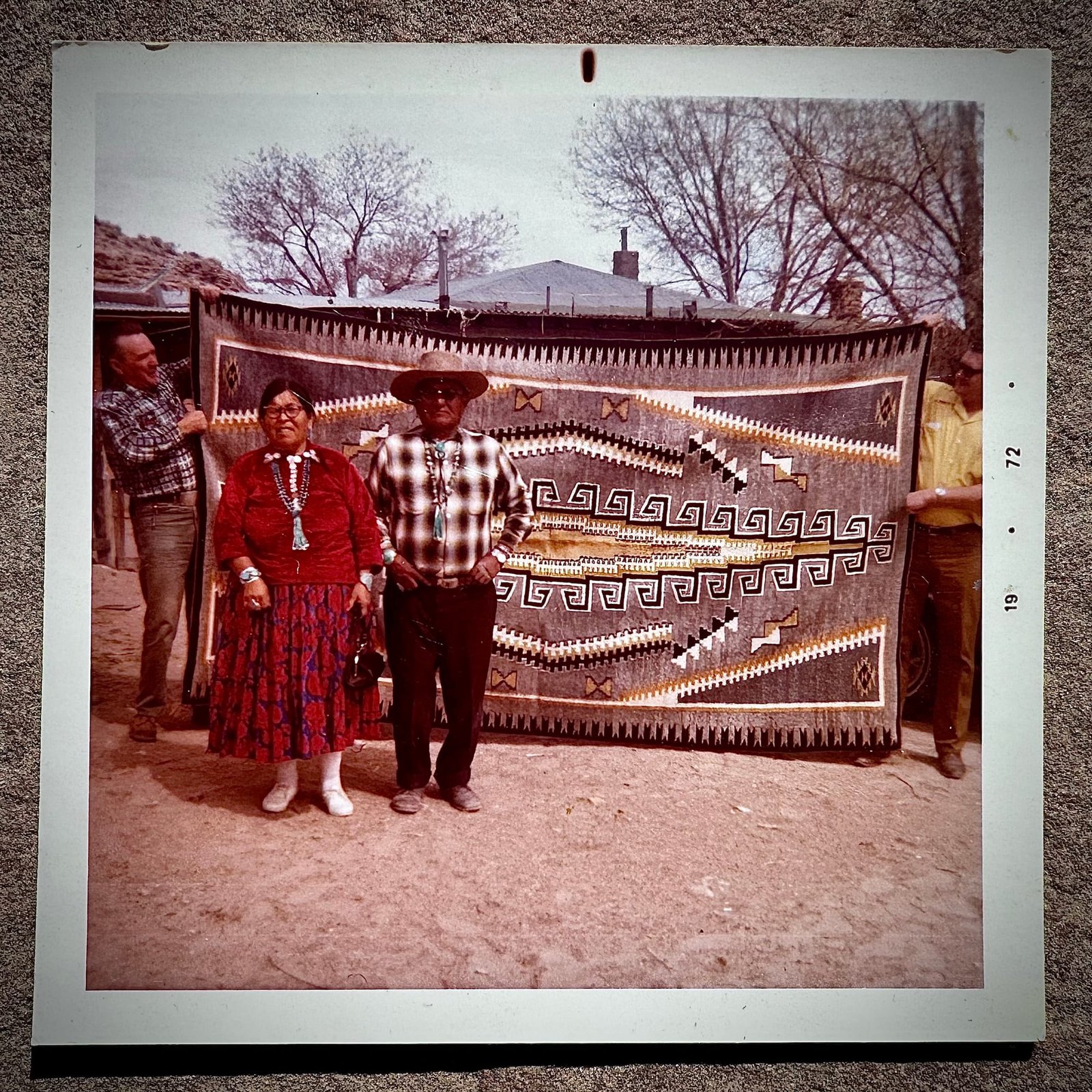 Begay’s maternal great-grandmother, Mary Alice Yazzie (center), with a weaving at Sunrise Trading Post in 1972
MB & ZF: Some of your work goes onto a horse, some of it goes onto a wall, and some of it goes into a museum. Does this affect how you’re making a piece?
NB: At the beginning of my process, I’m inspired by the sheep and by nature, and my work has always naturally gravitated toward the horse rider. However, whether my work ends up on a horse or it ends up on a wall, I’m content.
MB & ZF: There is a dominant idea in popular culture that Diné weaving is traditionally a women’s art form. As we know, tradition is a fluid and ever-evolving topic for Native people. Can you speak to your understanding of this history and how it affects your experience carrying on the legacy of weaving today?
NB: My grandmother held the view that work still belongs to everybody. If you’re alive and you need to cook for yourself, and if that entails chopping wood, building a fire, something that’s seen as masculine and you’re female, it just needs to be done. They raised me with that understanding. For example, if you are cold, are you just going to sit there and be cold, or are you going to figure out how to weave yourself a blanket to keep warm? For outsiders, it was an anomaly to see a Navajo boy weaving or processing wool. They’d create elaborate tales and attribute the behavior to being intersex just to make it make sense to their brain. Our way of life has been co-opted and corrupted by the outside views coming into our culture.
MB & ZF: Do you think the intersex assumption that you described was developed through a strictly Christian lens? Or was it partly an attempt at understanding older Diné understandings of gender, such as Nádleehi, and the long history of gender fluidity in Diné communities?
NB: A little of both. I read the intersex story in a book. In my sense, being fortunate enough to grow up with traditional grandparents, they told me stories affirming that everybody has their place in society. In our traditional stories, they say that the first men and the first women had so many sets of twins to explain all the types of people. The first set of twins were intersex and they gave ceremonies to the Navajo people. The second pair were trans women and they gave tools and the knowledge of farming to the people.
These traditional stories give something to the people to survive. Growing up, I was always told that if that’s who you are, be who you are and don’t let anybody tell you otherwise. Coming from other family members who didn’t understand that, who were taken away and exposed to other ways of growing up, they said the opposite: They were against it. I have gone back and forth between feeling proud of who I am and then feeling very small and like I should hide.
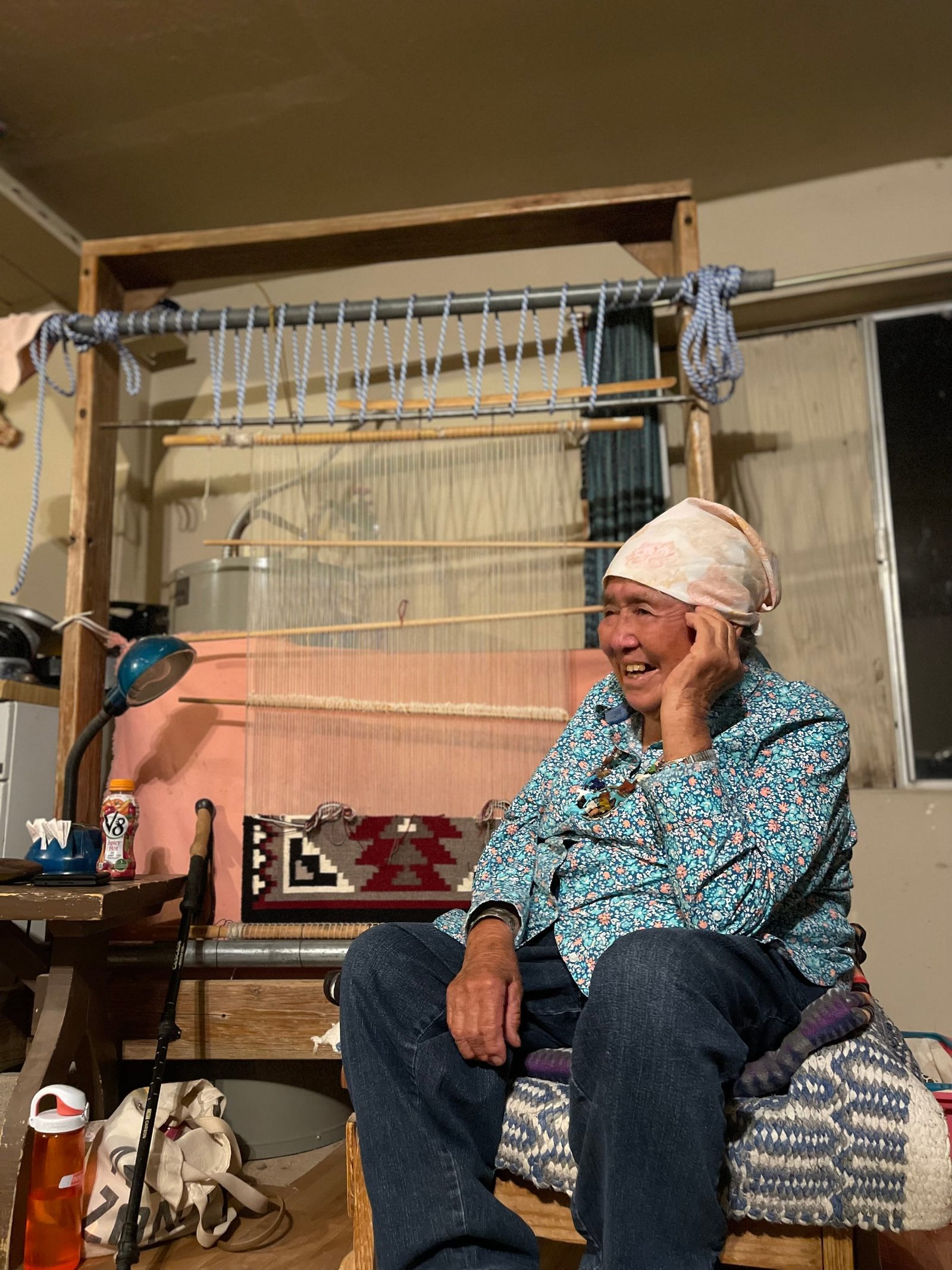 Begay’s paternal grandmother, Maggie Lee Begay, with her loom
MB & ZF: You have spoken about how Diné teachings and creation stories impact and influence your weaving process. Were the teachings of Spider Woman and Spider Man ever part of your weaving training passed down by your grandmother?
NB: The story of Spider Woman was passed down to me from my grandmother, but the teachings I learned about sheep are what truly impact my weaving. I pay homage to Spider Woman, of course, but in all honesty, it’s the sheep. We call ourselves the Diné, and we call our sheep dibé. Apparently, as a baby, when my umbilical cord dried and fell off, she was the one who had the honor of taking it and placing it in a sacred place, which in our culture will shape who you are in the future. In Navajo culture, this is done by the grandmother or the mother. They’ll place it, for example, at the doorway of their house so the child will always have their mind at home. Or they’ll put it in the horse corral because they want the child to become an experienced horseman.
She told me that when my umbilical cord was ready, she took it to the heart of the sheep corral. She dug far down until she hit dirt and placed my umbilical cord there. She covered it back up and left a prayer that this would be the grandchild to take over her weaving legacy. We were shearing sheep together when she told me this. I said, “Thank you, Grandma. Thank you so much.”