
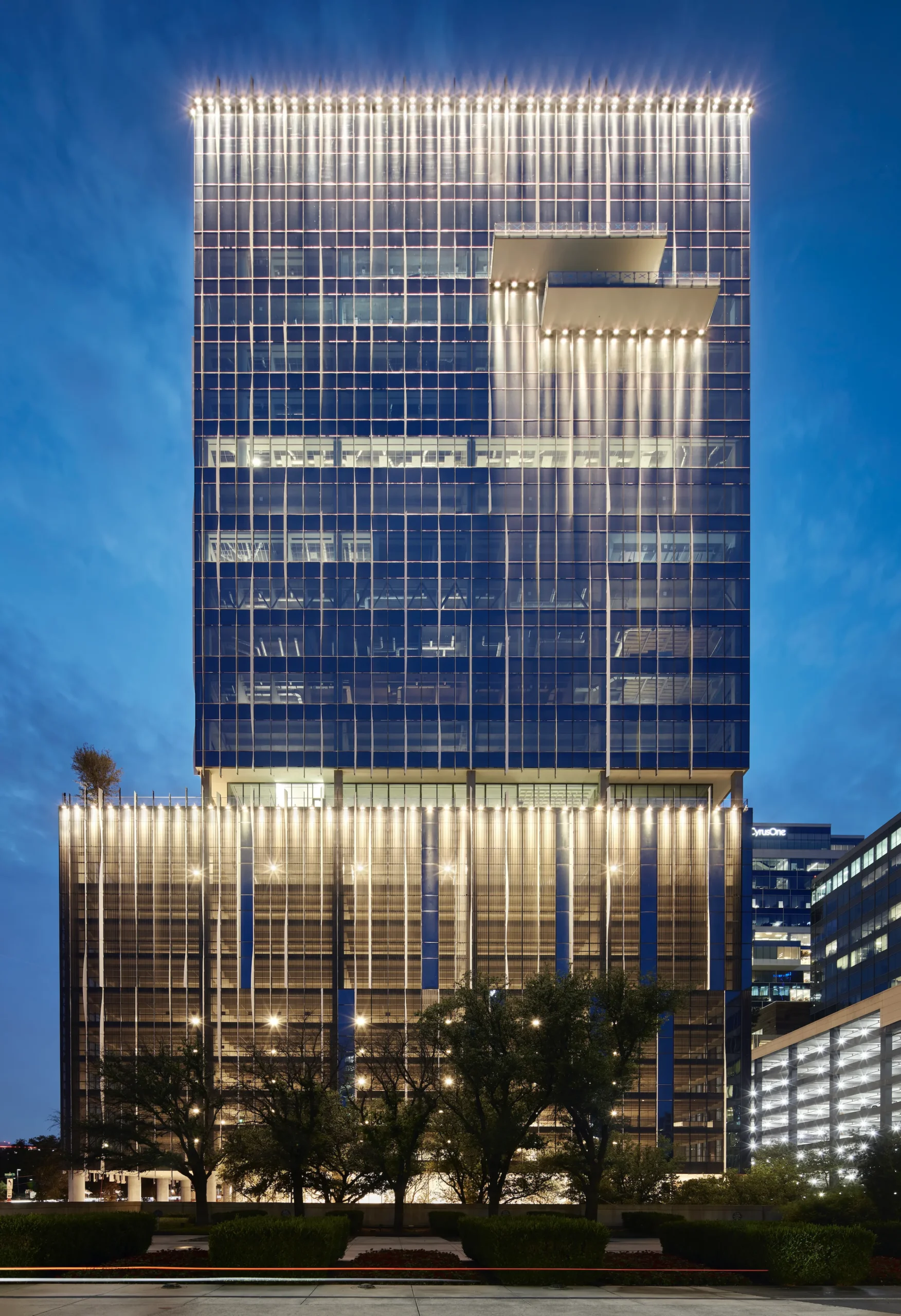
Kengo Kuma and Associates Teams with Corgan for the Newest Tower in Dallas’s Harwood District
✕
On the edge of downtown Dallas, real estate developer Harwood International has been transforming 19 city blocks into an eponymous mixed-use neighborhood since 1984. The undertaking has been as coherent in principle as it is steadily paced: office and residential towers are uniformly high-end and connected by a walkable streetscape, which alternates between leafy respites and hospitality destinations.
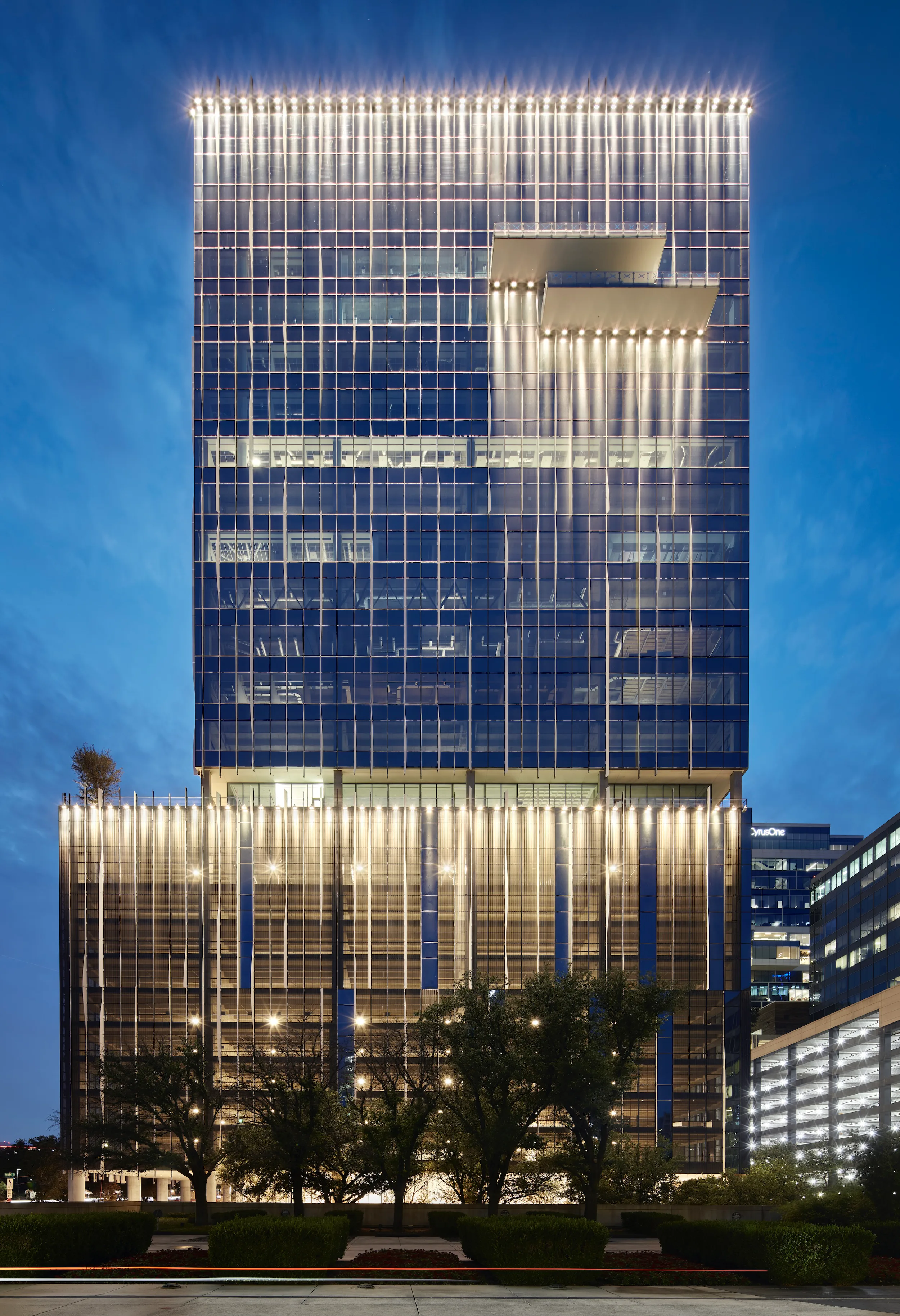
Photo courtesy Corgan
As an urban composition, the Harwood District has been a successful rejoinder to car-centric Sun Belt developments. Yet, filled with benign glass volumes, it appears largely indistinguishable from its competitors. The new 27-story office tower Harwood No. 14 is the latest example of an initiative to remake the image of the district.
The Harwood District got its first design jolt in 2018, with the opening of the twisting, horizontally banded Rolex Building overseen by Tokyo-based Kengo Kuma and Associates (KKAA). Since the facility’s headline-generating completion, ongoing collaboration between Harwood International and KKAA has yielded a high-rise hotel in 2023, followed last spring by Harwood No. 14. The most recently finished project was realized by Harwood’s in-house team and Corgan serving as architect of record and production architect, respectively.
For the Rolex commission, Kuma envisioned a blurring of the natural and constructed environments: atop a traditionally crafted stone plinth, the architect shifted floors to release the building from the Dallas grid and create continuity with the sloping terrain. KKAA adapted that expression to the budget of a speculative office building, by making Harwood No. 14’s monumental lobby stair resemble a topographical map.

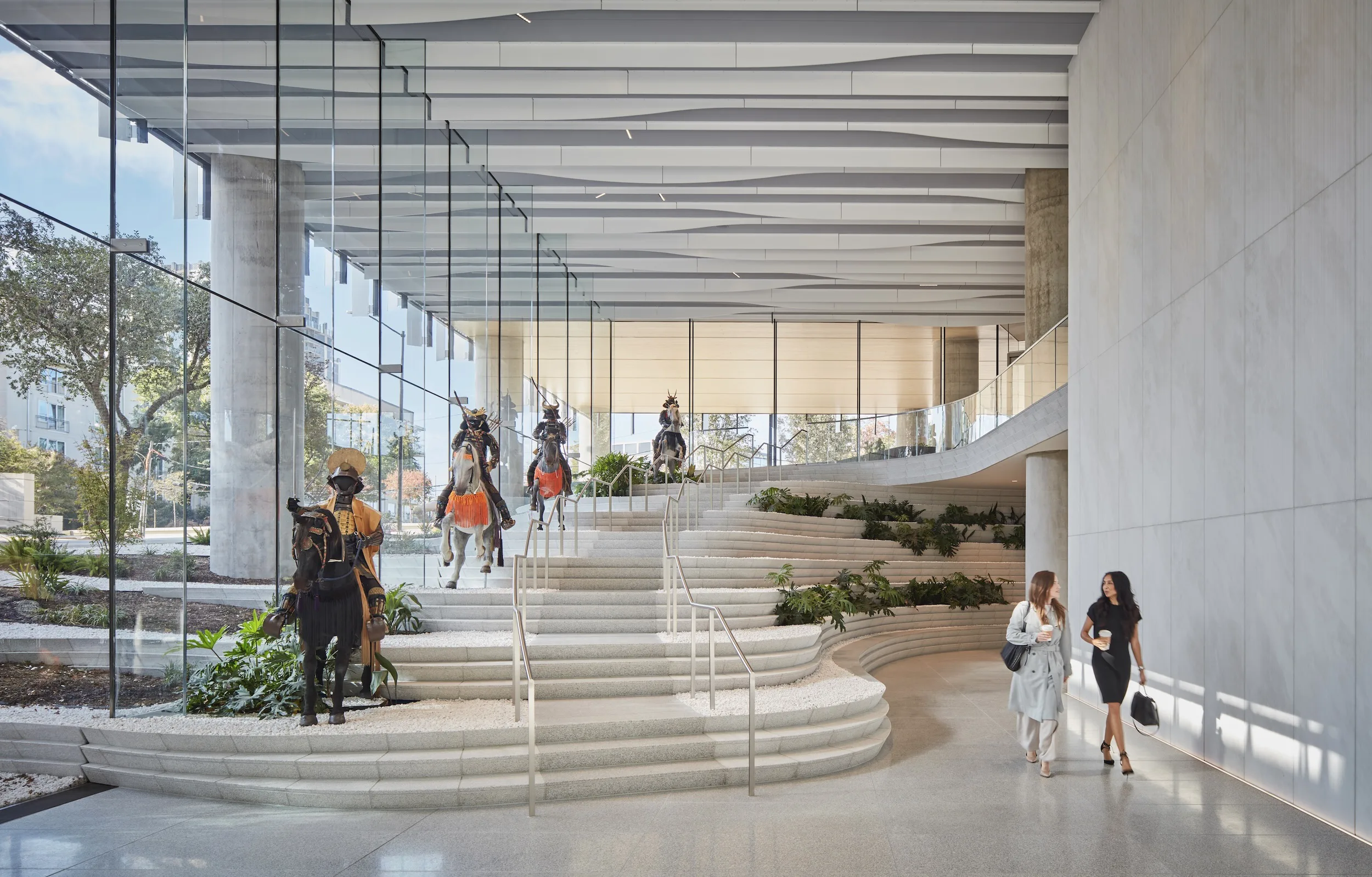
The lobby stair resembles a topographical map. Photos courtesy Corgan
The Harwood District’s grid is rotated approximately 45 degrees counterclockwise of a precise north–south axis, and the streets rise in a similar southeast-to-northwest direction. To accommodate the 18-foot slope directly beneath Harwood No. 14, KKAA and its collaborators conceived a double-height lobby whose pedestrian entrance is located at the lowest part of the site at the building’s east-facing corner. In the western half of the ground floor, the curving stair appears where building and earth feel compressed. It links to an upper-level elevator lobby serving the garage as well as a motor court that tucks beneath the southwest elevation.
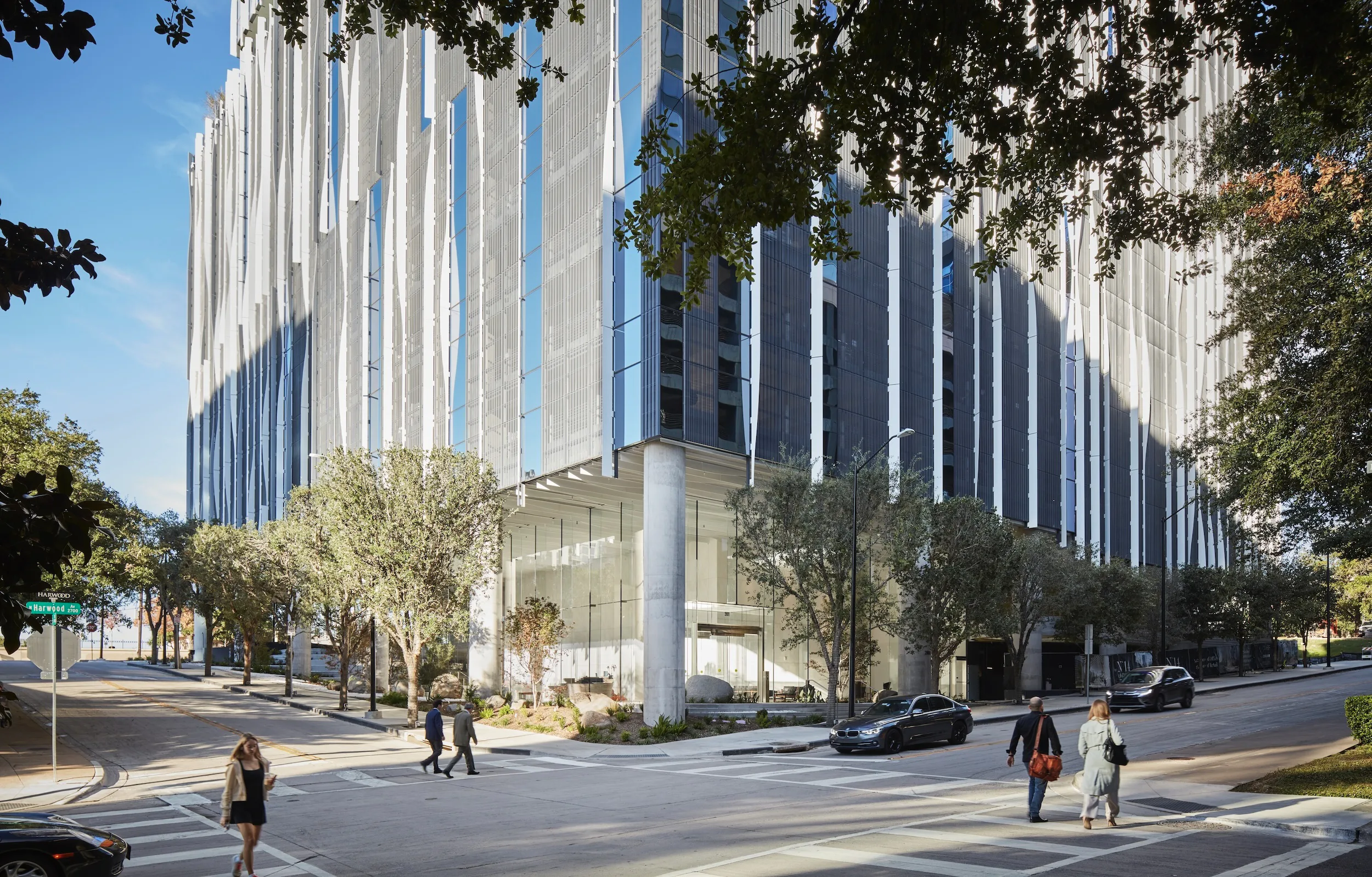
The tower sits on a sloping site. Photo courtesy Corgan
To fabricate the undulating staircase without tailor-making 1,500 granite blocks, Corgan analyzed KKAA’s concept in an algorithm that maximizes unitization. As a result, approximately 85 percent of the sawtooth-profile stairs are identical, whereas custom units are focused at tightly radiused curves. The bespoke blocks also organize the building plaza into wavelike tiers, which appear to slip beneath the lobby’s low-iron, mullion-less glazing and meld into the signature stair. Plantings on both sides of the envelope blur the line between landscape and architecture, while boulders scattered throughout the grounds pay further homage to the Rolex Building—they’re extracted from the same Oregon quarry from which the watchmaker’s plinth was sourced.
A rectilinear volume rises 120 feet from the ground floor and steps back at a lushly planted roof terrace on two sides before finishing its ascent to 27 stories. Excepting the suite of lobby spaces, the base contains parking sheathed largely in perforated aluminum units, while the upper building includes 360,000 square feet of office interiors enclosed in a standard curtain wall. KKAA proposed uniting the two volumes by a series of aluminum fins that billow from the exterior, which would also apply the lobby’s organic quality to the tower as a whole.


Views of the lushly planted roof terrace. Photos courtesy Corgan
Corgan was again tasked with transforming a poetic, albeit expensive idea into constructable strategy. “The reality is that there are only three templates for the fins,” says principal Matt Mooney, the firm’s chief practice officer. “If you randomize placement and rotate the profiles in plan, you end up getting this seemingly random pattern that’s also very cost-effective.” Because all 2,400 water jet–cut panels attach to standoffs that connect to the enclosures’ internal mullions, they arrived on site preassembled.
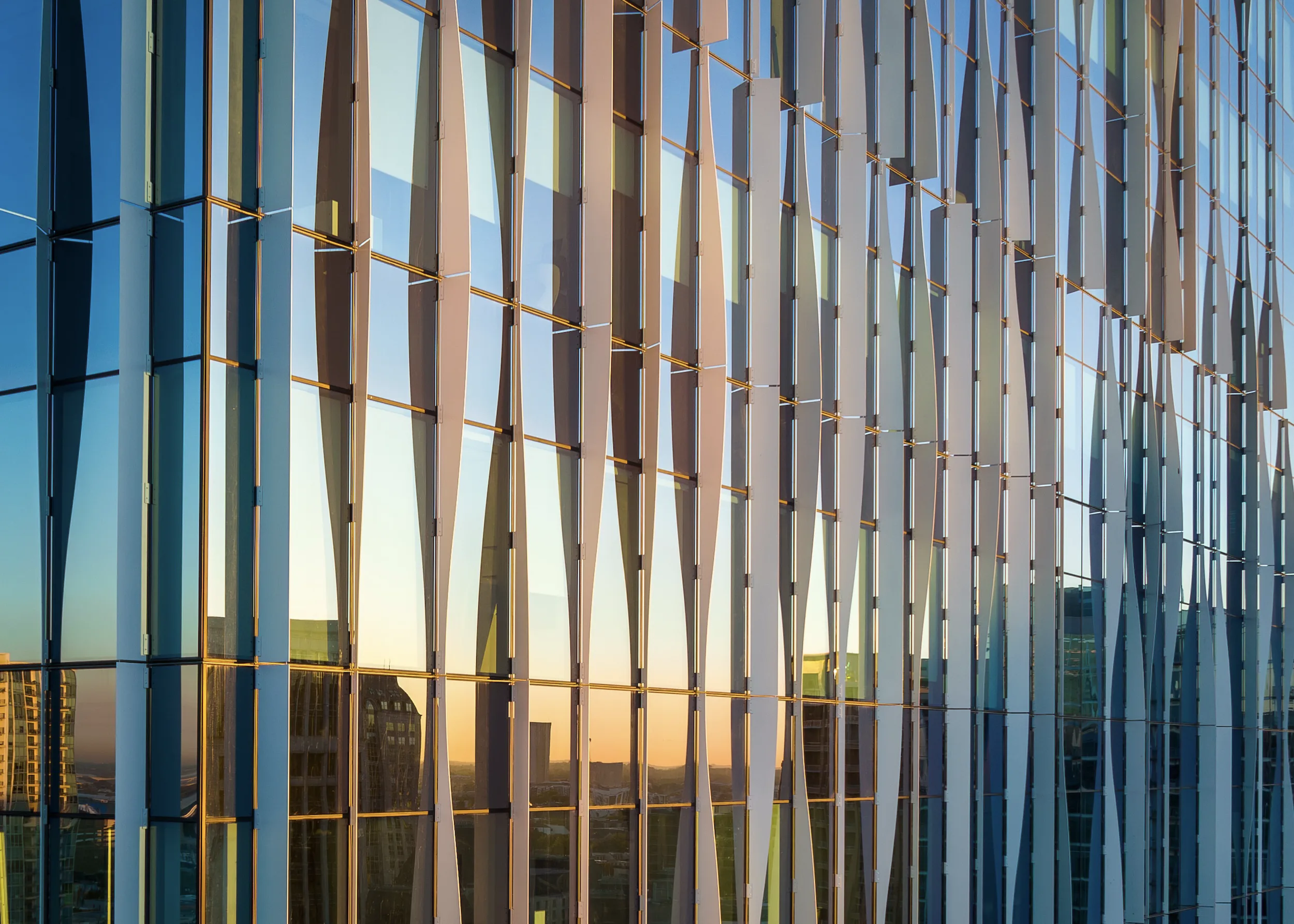
Aluminum fin detail. Photo courtesy Corgan

Photo courtesy Corgan
“These projects are very much math equations: you have to work your way back from the lease rate to determine what can be built,” Mooney remarks. Using what he calls “the simplest chassis we could build,” KKKA and its collaborators concentrated their creativity on the lobby and exterior shade system to transform real estate into architecture. The achievement is reflected not only in an occupancy rate that is well above the Dallas average, but also in the team’s reconvening for a Harwood No. 15 coming soon.

