Nevzat Sayın Designs a Hidden-Gem Space for One of Istanbul’s Leading Independent Art Galleries
✕
As in other cities around the world, two trends are colliding in Istanbul. In the Beyoğlu district, on the northern shore of the Golden Horn, an internationally acclaimed art scene is booming alongside the rapid gentrification of a formerly industrial area. In 2023, Renzo Piano debuted the new Istanbul Modern here. This fall, as the city buzzes with activity for the 18th iteration of the Istanbul Biennial, one of the contemporary art galleries spearheading the city’s cultural scene opened its third location in Galata, Beyoğlu, a historic and gritty neighborhood that was once a busy port. Sanatorium’s founder and director, Adnan Yerebakan, tapped Nevzat Sayın, founder of local architecture firm Nevzat Sayın Mimarlık Hizmetleri (NSMH), to design a new gallery that would be contextually grounded and echo the curatorial focus on material experimentation.
-.jpeg "Sanatorium gallery, Galata")
Photo © Egemen Karakaya
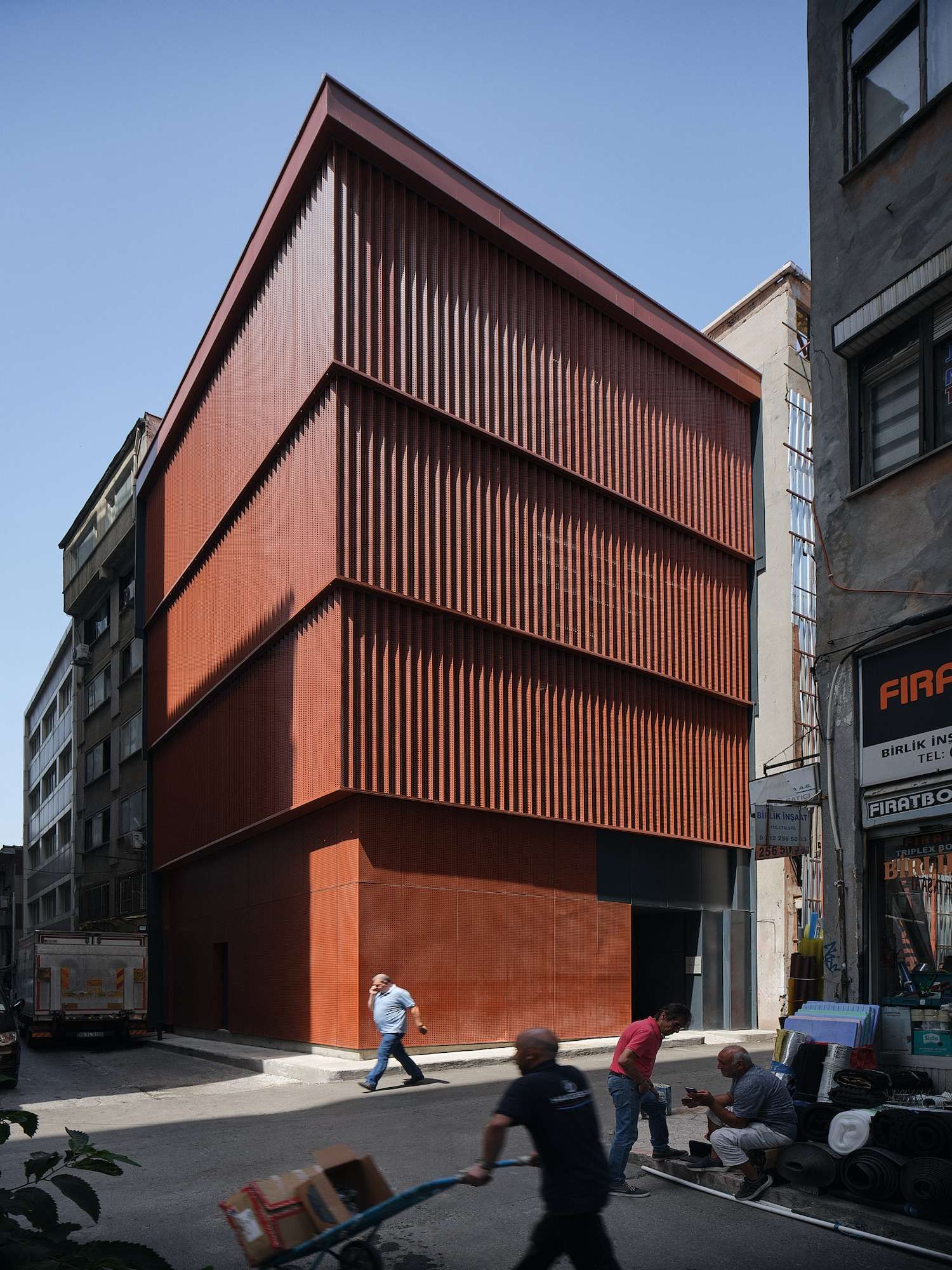
The new five-story, 6,500-square-foot gallery, clad entirely in reddish-brown perforated steel, sits handsomely at the corner of narrow, winding streets lined with workshops and small manufacturing facilities tied to the shipping industry. The facade is divided into four horizontal segments, each of which expands slightly outward, culminating in a flat cornice that crowns the building. The resulting shadow lines animate the building, accentuating the gallery’s monomaterial presence on the street. This play of light and shadow is further enhanced by the corrugation of the metal cladding on the upper three levels, which catches light differently as the sun moves throughout the day. At night, illuminated from within, the building glows red.
NSMH took inspiration for the color of the veil-like facade from another hidden gem just a few hundred feet away from Sanatorium’s new outpost. The Arap Camii (or Arab mosque) is a 14th-century Catholic basilica repurposed by Andalusian Muslim refugees fleeing the Spanish Inquisition. Constructed by Dominican friars, it is one of the only examples of medieval Gothic architecture in Istanbul. Inside, the ceiling is a tight grid of shallow wood battens, stained a deep red, a hue the architects mirror with the gallery’s rust-colored facade.
-.jpeg)
-.jpeg)
Photos © Egemen Karakaya
To keep the focus on the artworks, the intentionally understated gallery spaces are insulated from the surrounding neighborhood, with natural light limited and filtered by narrow windows set behind the perforated facade. The ceilings are scalloped, with uplighting both emphasizing the grain of curves and diffusing light throughout the space. Two floors are dedicated to ongoing exhibitions, and two more are flexible for larger group shows, video screenings, or site-specific works. The top floor houses the administrative office and a small terrace that is concealed from the street by the metal veil.
.jpeg)
.jpeg)
Photos © Egemen Karakaya
Timed with the opening of the Istanbul Biennial, Sanatorium debuted its inaugural exhibition at its new space in Galata: Desert Hyacinth, a solo show by Guggenheim Fellow Al Qasimi. According to the artist, the work deals with themes of beauty and growth in harsh conditions—an apt metaphor, coincidentally or not, for the new gallery itself.
.jpg "Sanatorium gallery, Galata")
Installation view of Desert Hyacinth by Al Qasimi. Photo © Yerlestirme Fotografla