
MJMA and HDR Rejuvenate Queen’s University’s John Deutsch Centre in Ontario
Queen’s University figures prominently in the college town of Kingston, Ontario. The school’s collegiate Gothic–dominated campus has welcomed students for nearly two centuries. Located on the northern border of the academic grounds, the John Deutsch University Centre (JDUC), has long served as the primary social hub for the institution’s undergraduate and graduate population. Though beloved, JDUC was a laggard in terms of contemporary accessibility and building performance standards and was poorly connected to the rest of the campus. In July 2025, the school completed a multiphase overhaul designed by Toronto-based MJMA and HDR that ameliorates those flaws.
The project’s final budget of approximately $89 million was largely funded by the students’ union and required its approval via referendum to move forward—a prior proposal had been rejected. MJMA and HDR submitted their conceptual design in 2018 and were commissioned the following year. Pandemic-related supply chain and bidding disruptions delayed the project shortly after, with the groundbreaking taking place in 2022.
“Students felt that the prior proposal did not properly seek their input so our process increased communication through frequent engagement,” explains MJMA partner Ted Watson. “Those conversations guided our aim to balance the scale and materiality of the campus, much of it stone and wood, with a contemporary and sustainable design that includes Indigenous references.”
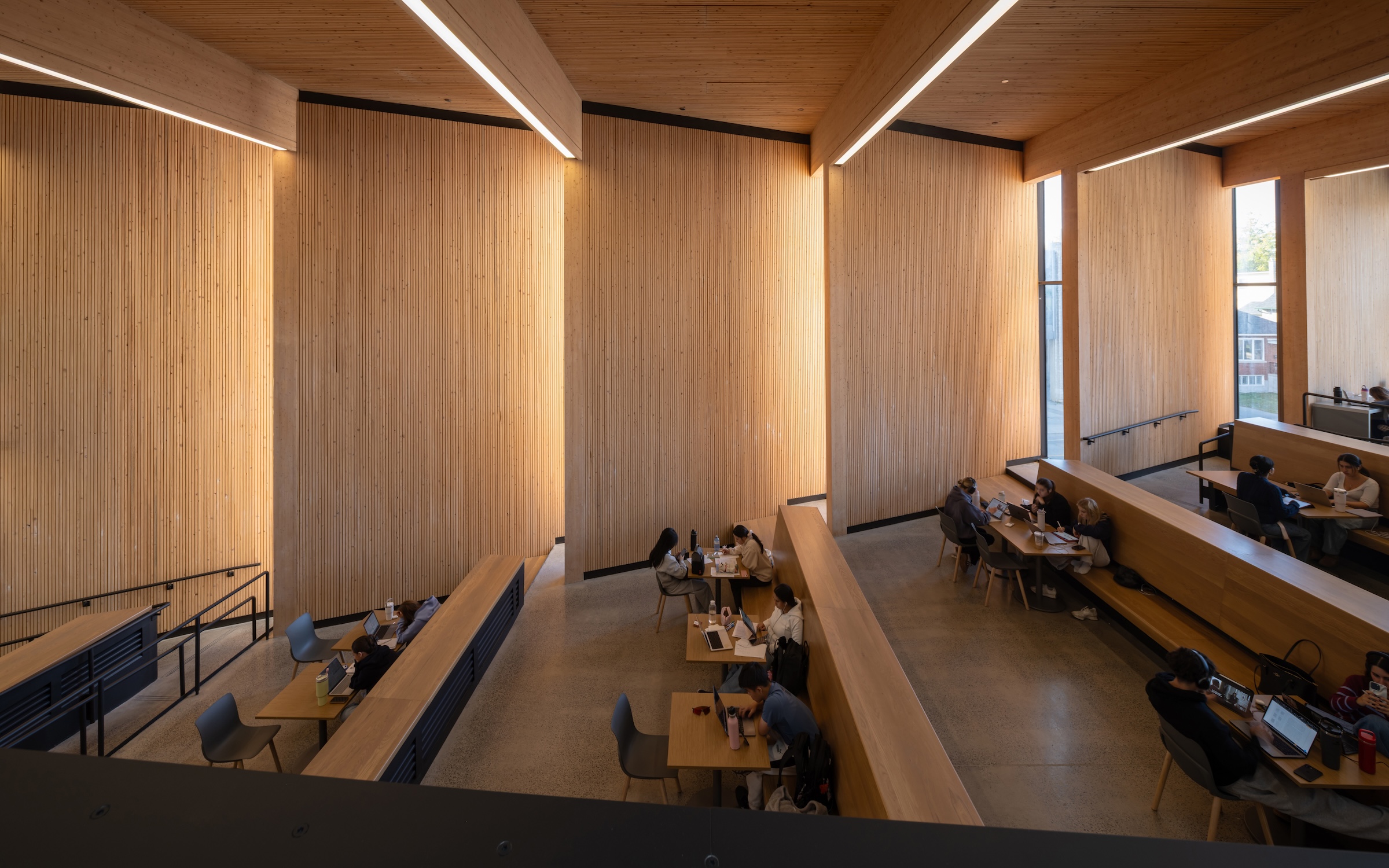
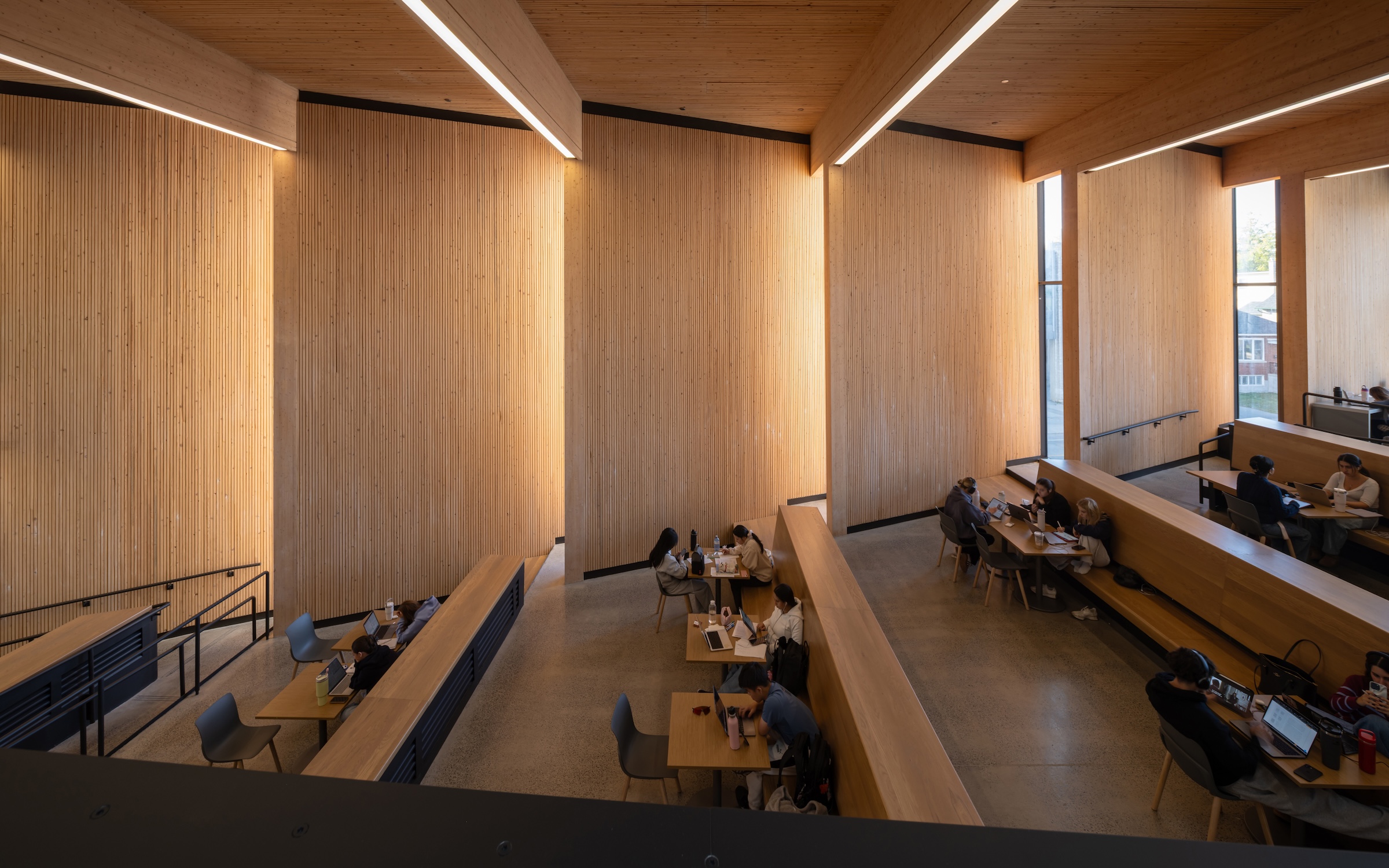
The new wing includes mass timber structural elements, such as glulam and nail-laminated timber, within its second and third levels. Photo © Scott Norsworthy

Wallace Hall, a wood-paneled multipurpose auditorium, is located within a hall built in 1947. Photo © Scott Norsworthy
The 93,500-square-foot complex includes a historic structure, which houses a multipurpose auditorium named Wallace Hall along with meeting rooms, offices for student clubs, and a pub. It is conjoined with a seven-story residential tower. The former was built in 1947 to replace an 80-year-old structure lost to a fire, and the latter was added in 1964. The project scope included the erection of a stone-brick clad, mass timber and steel structure on the site’s northwest corner. That building, named the Kathleen Beaumont Hill Wing, substitutes a since demolished brutalist edifice dating from 1973, which was programmatically inflexible, inaccessible, and possessed aging MEP systems. All three buildings are threaded together by a renovated atrium and spacious routes of circulation.
The three-story Kathleen Beaumont Hill Wing rises from a steel-framed podium, which tapers upwards at its northwest-oriented, glass-clad corner entrance. The ground level, which Watson jocularly refers to as the center’s “mud room,” where one “gets the snow off their boots,” accommodates a student-run retail space and a restaurant. A grand staircase with stadium seating delivers students to the second level and its amply daylit double-height auditorium. That space is externally demarcated by canted piers of beige-colored, Roman-style stone brick, and, within, transitions to an array of soaring glulam posts and beams, a nail-laminated timber shear wall, and roof panels.
The design team placed the entirety of the auditorium’s mechanical duct work within steel framing between the timber flooring and concrete deck. It is fed supply air through steel louvres, which were integrated with solid white oak bench seatings. Above, lighting fixtures are recessed by microlam covers to create a seamless look with the glulam beams. A 13-foot-wide service core on the building’s east flank provides elevator access to all levels.

A skylight was carved through the roof and floor plate to provide daylight to student government and engagement spaces. Photo © Scott Norsworthy
The atrium, sandwiched between the new wing and the existing structures, was rehabilitated with an expanded skylight, and new ceilings, lighting, and finishes. A similar treatment was applied to a space buried in the eastern portion of the 1947 building, where a skylight and atrium was carved out through the roof slab and floor plates to brighten spaces used by the student government that were formerly devoid of daylight.

The existing atrium was rehabilitated with new finishes and an expanded skylight. Photo © Scott Norsworthy
Throughout the existing structures, contemporary building systems were installed; fireproofing was applied to floor slabs and columns; an accessible elevator was installed; and furnishings and details were refreshed. Notably, JDUC utilizes existing, shared campus-wide chilled water and steam loops for heating and cooling.
Programmatically, the auditorium and atrium include spaces dubbed by the design team as “teaching circles,” which resemble Indigenous sharing circles, and “teaching thresholds” named after the Seven Grandfather Teachings of the Ojibwe, an Algonquin-speaking tribe living in the region.
An integral aspect of JDUC’s rejuvenation was the redesign of its surrounding landscaping, which largely consisted of hard surfacing, and a haphazard pathway into campus shared by service vehicles. Now, JDUC is surrounded by rain gardens and native plantings, including Canada wild rye and river birch trees, and the service road has been transformed into a plaza.
1

2
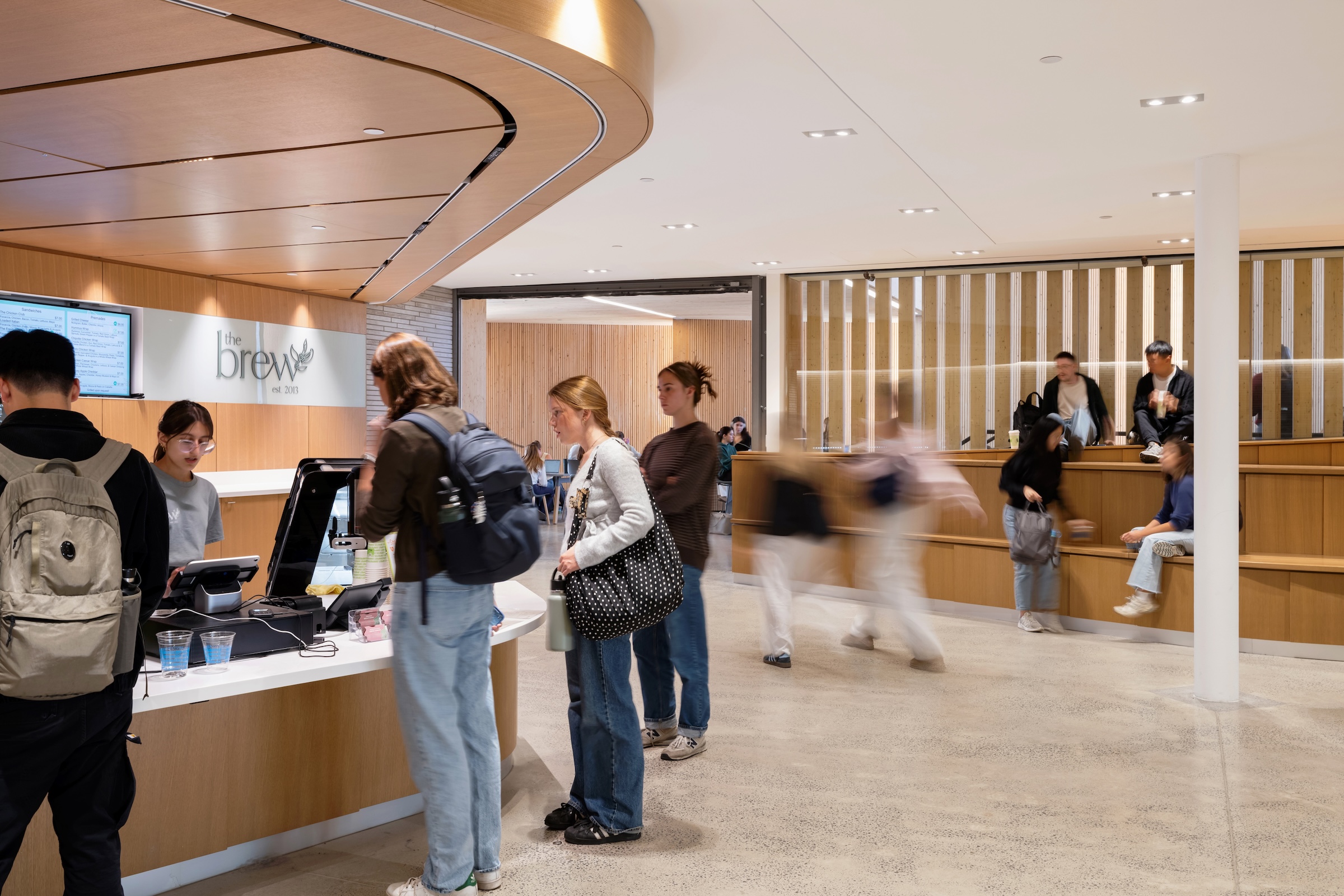
A coffee shop is located on the top floor of the new wing (1); and a pub is found in the 1947 structure’s ground floor. Photo © Scott Norsworthy
For Donald Chong, HDR design principal, the years-long effort was an act of conservatorship and invention. “Our role as architects was to contribute something intergenerational for the students, and to act almost as a steward of the campus,” he explains. The tally of the design team’s intervention, from the contextually appropriate insertion of a new structure and landscaping to the rehabilitation of popular, but flawed buildings, deftly meets those goals.

Axonometric drawing courtesy MJMA & HDR; click to enlarge.

