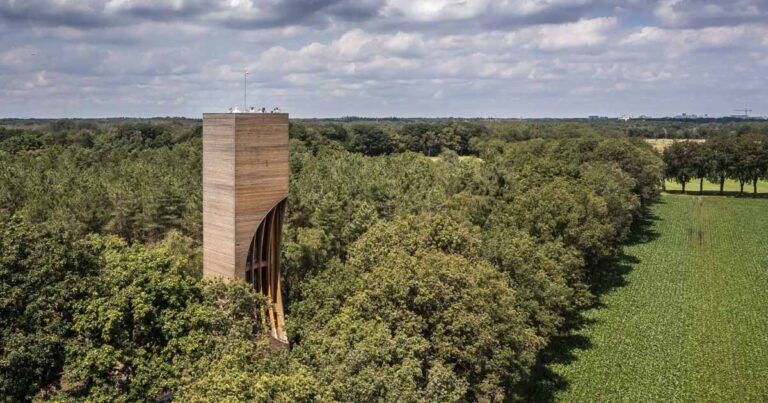

From the RECORD Archives: ‘Samuel Mockbee: A Life’s Work – AIA Gold Medal Winner’
✕
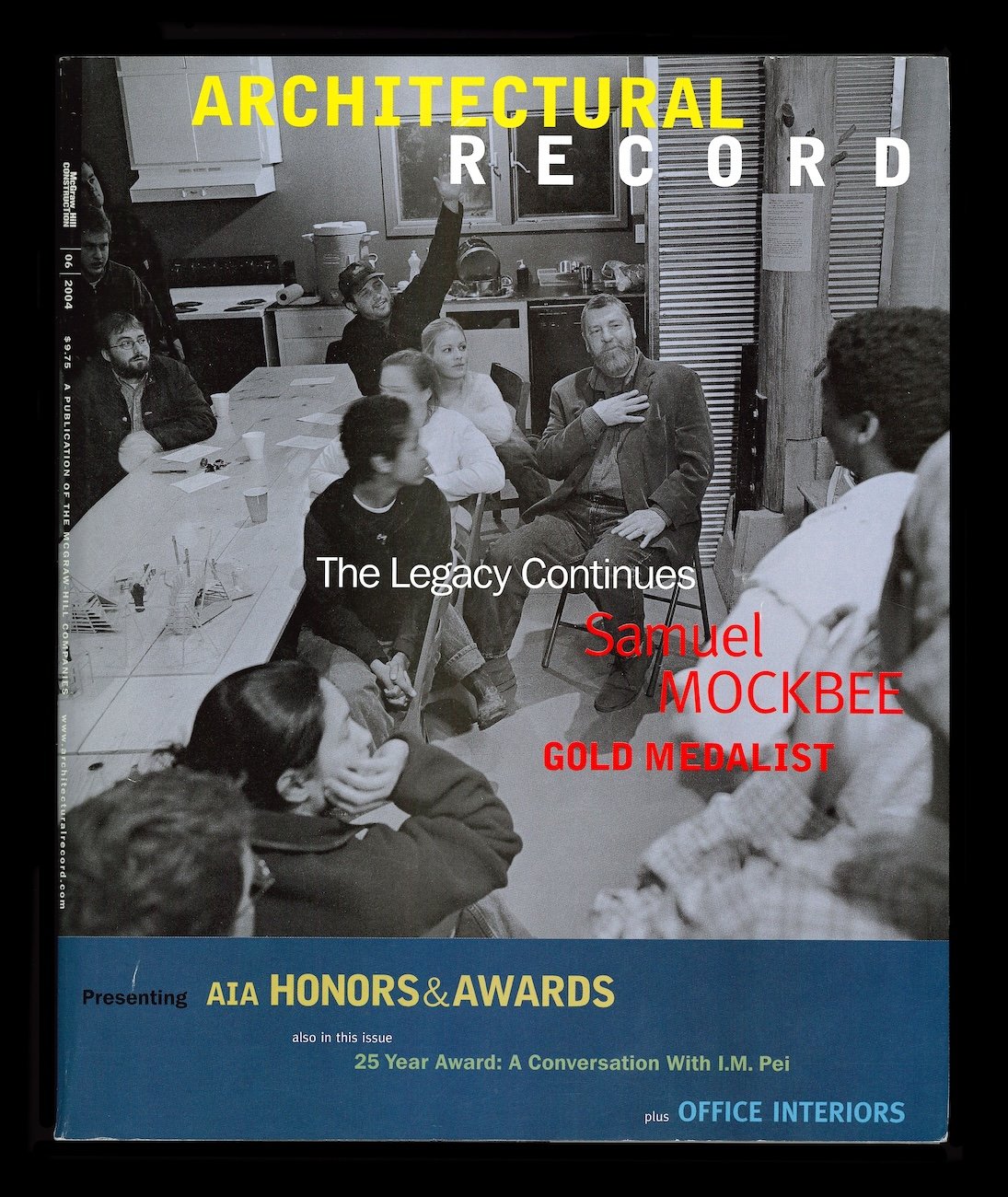
In 2004, Samuel “Sambo” Mockbee, who died three years prior at age 57, posthumously received the AIA Gold Medal. RECORD’s June issue of that year features the pioneering architect and educator on the cover, as well as an extensive profile by Andrea Oppenheimer Dean. Dean—the author of Rural Studio: Samuel Mockbee and an Architecture of Decency (2002)—details Mockbee’s academic legacy, body of work, and unique design ethos grounded in humanitarianism. A sixth-generation Mississippian, he described his style as modernist with Southern roots, employing vernacular references such as dogtrot forms, galvanized roofs, porches, and metal trailers. Mockbee believed that architecture should advance social and environmental aims, and that “everyone, rich or poor, deserves a shelter for the soul.” Out of this philosophy grew Rural Studio, an immersive design-build program affiliated with Alabama’s Auburn University that Mockbee cofounded with D.K. Ruth in 1993. An alumna of the program, Jennifer Bonner, working with Sambo’s daughter Carol Mockbee as interior designer, recently completed a house near Seaside, Florida—not far from a curious bungalow realized by Mockbee in the early 1990s.
‘Samuel Mockbee: A Life’s Work – AIA Gold Medal Winner’Introduction by Robert Ivy, FAIAWords by Andrea Oppenheimer DeanArchitectural Record, June 2004
Before there was a Rural Studio, there was an architect named Sambo. He grew up in the heady milieu of Mississippi, a place redolent of earth and growing things, of social disparity, and great literature. Coming of age during the contentious 1960s, Sambo absorbed the world surrounding Meridian, Mississippi, played football, attended Auburn University, and joined the army. Then his worldview shifted.
© Architectural Record, June 2004
After a stint working in Georgia, he returned to Mississippi, where, in conjunction with a series of partners, he began to make architecture suited to the geography and culture of the nation’s poorest state. Using the simplest materials and familiar forms, he wrested newness from a people struggling to emerge from a rich but historically oppressive past. Great writers from William Faulkner to Walker Percy had succeeded in moving on; uniquely, Sambo took architecture to a New Southern frontier.
While early projects smacked of postmodernism, very quickly a bevy of buildings, from houses to simple chapels, proclaimed a refreshed, empathetic sensibility. Soon Sambo & Company were redefining what it meant to live and work in the South. Publications took notice, as did the universities.
Ultimately, he found his full voice through other people, particularly at Auburn’s Rural Studio, where he and collaborator D.K. Ruth cofounded a residential architectural program that offered a total immersion in the art of building, engaging all of the arts in the service of a specific community. That work continues to flourish to this day.
In naming Mockbee as the 2004 Gold Medalist, the American Institute of Architects not only recognized his gifts, but also espoused Sambo’s values, which fiercely and unsentimentally addressed basic human needs.
© Architectural Record, June 2004
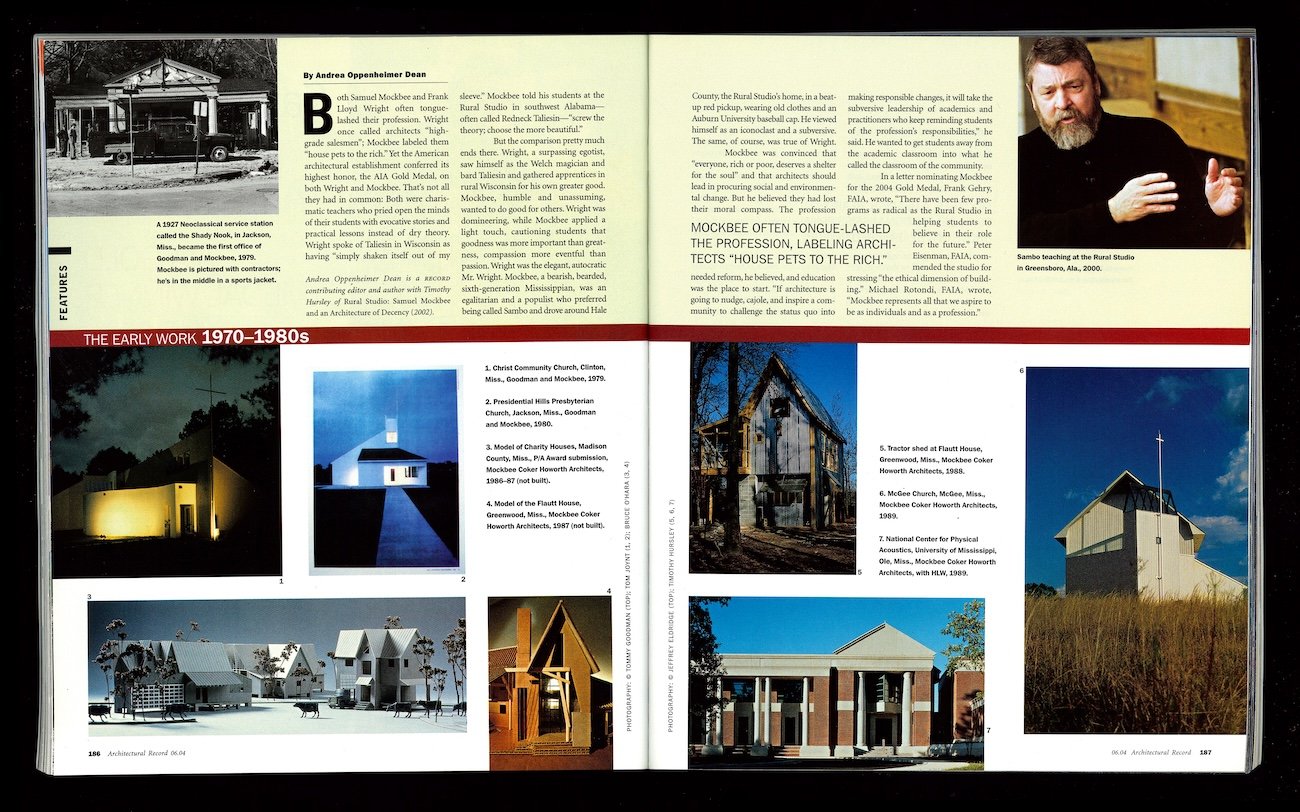
Both Samuel Mockbee and Frank Lloyd Wright often tongue-lashed their profession. Wright once called architects “high-grade salesman”; Mockbee labeled them “house pets to the rich.” Yet the American architectural establishment conferred its highest honor, the AIA Gold Medal, on both Wright and Mockbee. That’s not all they had in common: Both were charismatic teachers who pried open the minds of their students with evocative stories and practical lessons instead of dry theory. Wright spoke of Taliesin in Wisconsin as having “simply shaken itself out of my sleeve.” Mockbee told his students at the Rural Studio in southwest Alabama—often called Redneck Taliesin—“screw the theory; choose the more beautiful.”
But the comparison pretty much ends there. Wright, a surpassing egoist, saw himself as the Welsh magician and bard Taliesin and gathered apprentices in rural Wisconsin for his own greater good. Mockbee, humble and unassuming, wanted to do good for others. Wright was domineering, while Mockbee applied a light touch, cautioning students that goodness was more important than greatness, compassion more eventful than passion. Wright was the elegant, autocratic Mr. Wright. Mockbee, a bearish, bearded, sixth-generation Mississippian, was an egalitarian and a populist who preferred being called Sambo and drove around Hale County, the Rural Studio’s home, in a beat-up red pickup, wearing old clothes and an Auburn University baseball cap. He viewed himself as an iconoclast and a subversive. The same, of course, was true of Wright.
© Architectural Record, June 2004
Mockbee was convinced that “everyone, rich or poor, deserves a shelter for the soul” and that architects should lead in procuring social and environmental change. But he believed they had lost their moral compass. The profession needed reform, he believed, and education was the place to start. “If architecture is going to nudge, cajole, and inspire a community to challenge the status quo into making responsible changes, it will take the subversive leadership of academics and practitioners who kept reminding students of the profession’s responsibilities,” he said. He wanted to get students away from the academic classroom into what he called the classroom of the community.
In a letter nominating Mockbee for the 2004 Gold Medal, Frank Gehry, FAIA, wrote, “There have been few programs as radical as the Rural Studio in helping students to believe in their role for the future.” Peter Eisenman, FAIA, commended the studio for stressing “the ethical dimension of building.” Michael Rotondi, FAIA, wrote, “Mockbee represents all that we aspire to be as individuals and as a profession.”
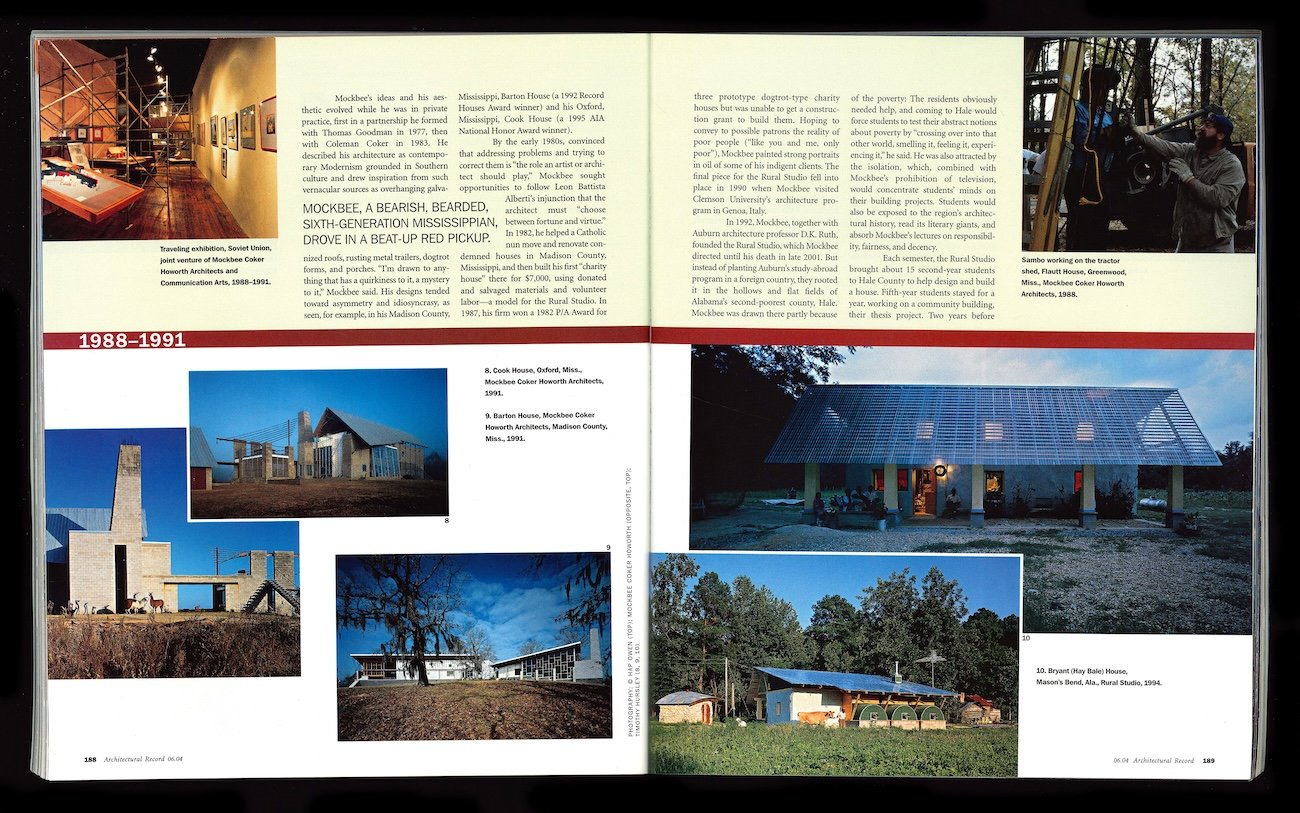
Mockbee’s ideas and his aesthetic evolved while he was in private practice, first in a partnership he formed with Thomas Goodman in 1977, then with Coleman Coker in 1983. He described his architecture as contemporary modernism grounded in Southern culture and drew inspiration from such vernacular sources as overhanging galvanized roofs, rusting metal trailers, dogtrot forms, and porches. “I’m drawn to anything that has a quirkiness to it, a mystery to it,” Mockbee said. His designs tended toward asymmetry and idiosyncrasy, as seen, for example, in his Madison County, Mississippi, Barton House (a 1992 Record Houses Award winner) and his Oxford, Mississippi, Cook House (a 1995 AIA National Honor Award winner).
By the early 1980s, convinced that addressing problems and trying to correct them is “the role an artist or architect should play,” Mockbee sought opportunities to follow Leon Battista Alberti’s injunction that the architect must “choose between fortune and virtue.” In 1982, he helped a Catholic nun move and renovate condemned houses in Madison County, Mississippi, and then built his first “charity house” there for $7,000, using donated and salvaged materials and volunteer labor—a model for the Rural Studio. In 1987, his firm won a 1982 P/A Award for three prototype dogtrot-type charity houses but was unable to get a construction grant to build them. Hoping to convey to possible patrons the reality of poor people (“like you and me, only poor”), Mockbee painted strong portraits in oil of some of his indigent clients. The final piece for the Rural Studio fell into place in 1990 when Mockbee visited Clemson University’s architecture program in Genoa, Italy.
© Architectural Record, June 2004
In 1992, Mockbee, together with Auburn architecture professor D.K. Ruth, founded the Rural Studio, which Mockbee directed until his death in late 2001. But instead of planting Auburn’s study-abroad program in a foreign country, they rooted it in the hollows and flat fields of Alabama’s second-poorest county, Hale. Mockbee was drawn there partly because of the poverty: The residents obviously needed help, and coming to Hale would force students to test their abstract notions about poverty by “crossing over into that other world, smelling it, feeling it, experiencing it,” he said. He was also attracted by the isolation, which, combined with Mockbee’s prohibition of television would concentrate students’ minds on their building projects. Students would also be exposed to the region’s architectural history, read its literary giants, and absorb Mockbee’s lectures on responsibility, fairness, and decency.
Each semester, the Rural Studio brought about 15 second-year students to Hale County to help design and build a house. Fifth-year students stayed for a year, working on a community building, their thesis project. Two years before Mockbee’s death, the studio launched an outreach program, accepting a handful of students from other universities and other disciplines to undertake a variety of design and social-work assignments.
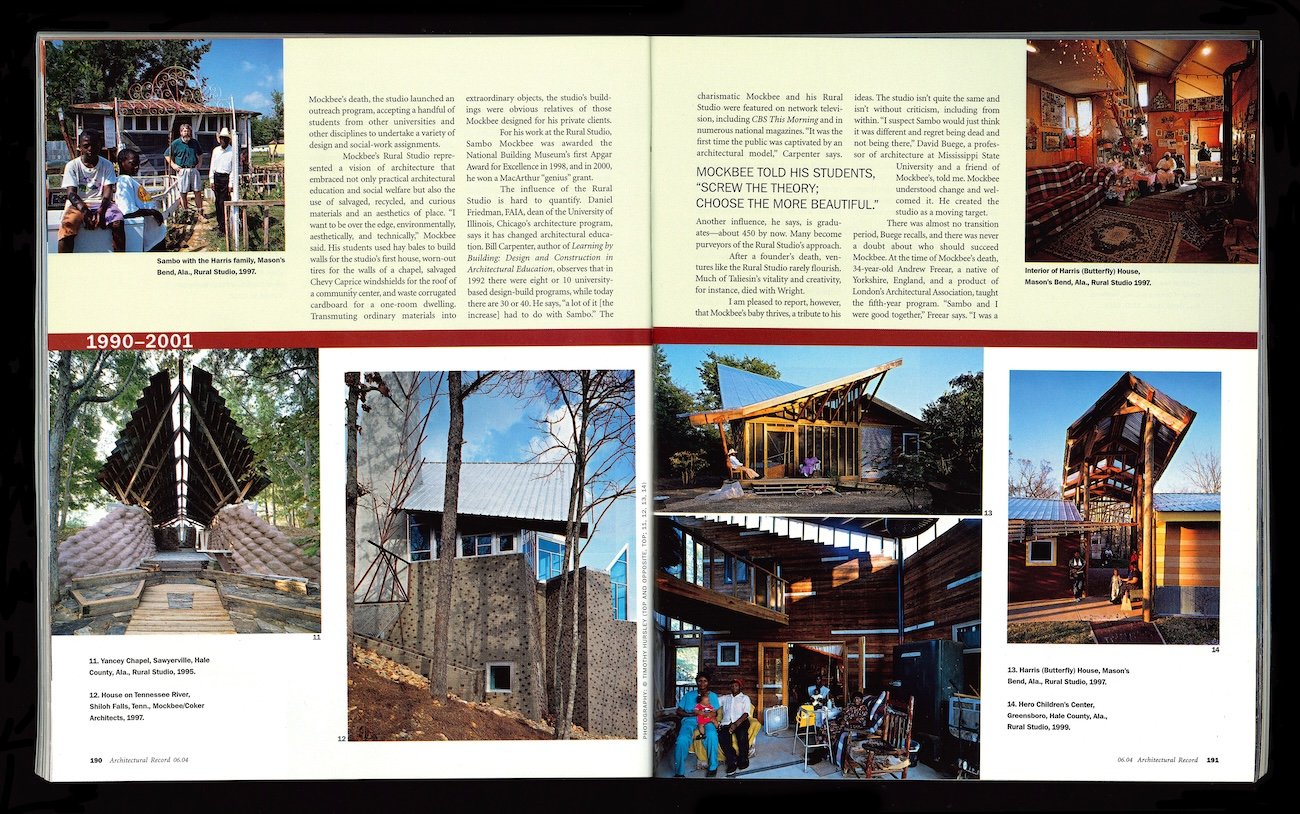
Mockbee’s Rural Studio represented a vision of architecture that embraced not only practical architectural education and social welfare but also the use of salvaged, recycled, and curious materials and an aesthetics of place. “I want to be over the edge, environmentally, aesthetically, and technically,” Mockbee said. His students used hay bales to build walls for the studio’s first house, worn-out tires for the walls of a chapel, salvaged Chevy Caprice windshields for the roof of a community center, and waste corrugated cardboard for a one-room dwelling. Transmuting ordinary materials into extraordinary objects, the studio’s buildings were obvious relatives of those Mockbee designed for his private clients.
For his work at the Rural Studio, Sambo Mockbee was awarded the National Building Museum’s first Apgar Award for Excellence in 1998, and in 2000, he won a MacArthur “genius” grant.
The influence of the Rural Studio is hard to quantify. Daniel Friedman, FAIA, dean of the University of Illinois, Chicago’s architecture program, says it has changed architectural education. Bill Carpenter, author of Learning by Building: Design and Construction in Architectural Education, observes that in 1992 there were eight or 10 university-based design-build programs, while today there are 30 or 40. He says, “a lot of it [the increase] had to do with Sambo.” The charismatic Mockbee and his Rural Studio were featured on network television, including CBS This Morning and in numerous national magazines. “It was the first time the public was captivated by an architectural model,” Carpenter says.
Another influence, he says, is graduates—about 450 by now. Many become purveyors of the Rural Studio’s approach.
After a founder’s death, ventures like the Rural Studio rarely flourish. Much of Taliesin’s vitality and creativity, for instance, died with Wright.
I am pleased to report, however, that Mockbee’s baby thrives, a tribute to his ideas.