Albany’s long-awaited Skyway Park opens to pedestrians and cyclists on a former interstate exit ramp
As of late last week, New York’s capital city has a new elevated park that repurposes a stretch of underutilized freeway infrastructure while providing pedestrians and cyclists with a singular new means of access to the Hudson River waterfront.
While it doesn’t appear to reach the urban-idyllic heights as New York’s most famous elevated park (although it does possess the same development-spurring qualities), Albany’s fittingly named Skyway Park is a solid example of a 21st century infrastructural overhaul that puts people, not cars, first. Located just north of the city’s downtown core, the half-mile-long park (more of a park-like pedestrian bridge, really) is located atop Interstate 787’s seldom-used northbound Clinton Avenue exit ramp, which links Quay Street near the city’s riverfront Corning Preserve with Broadway and Clinton Avenue near Quackenbush Square.
The exit ramp was permanently closed last April, and the park was initially stated to open in late 2021.
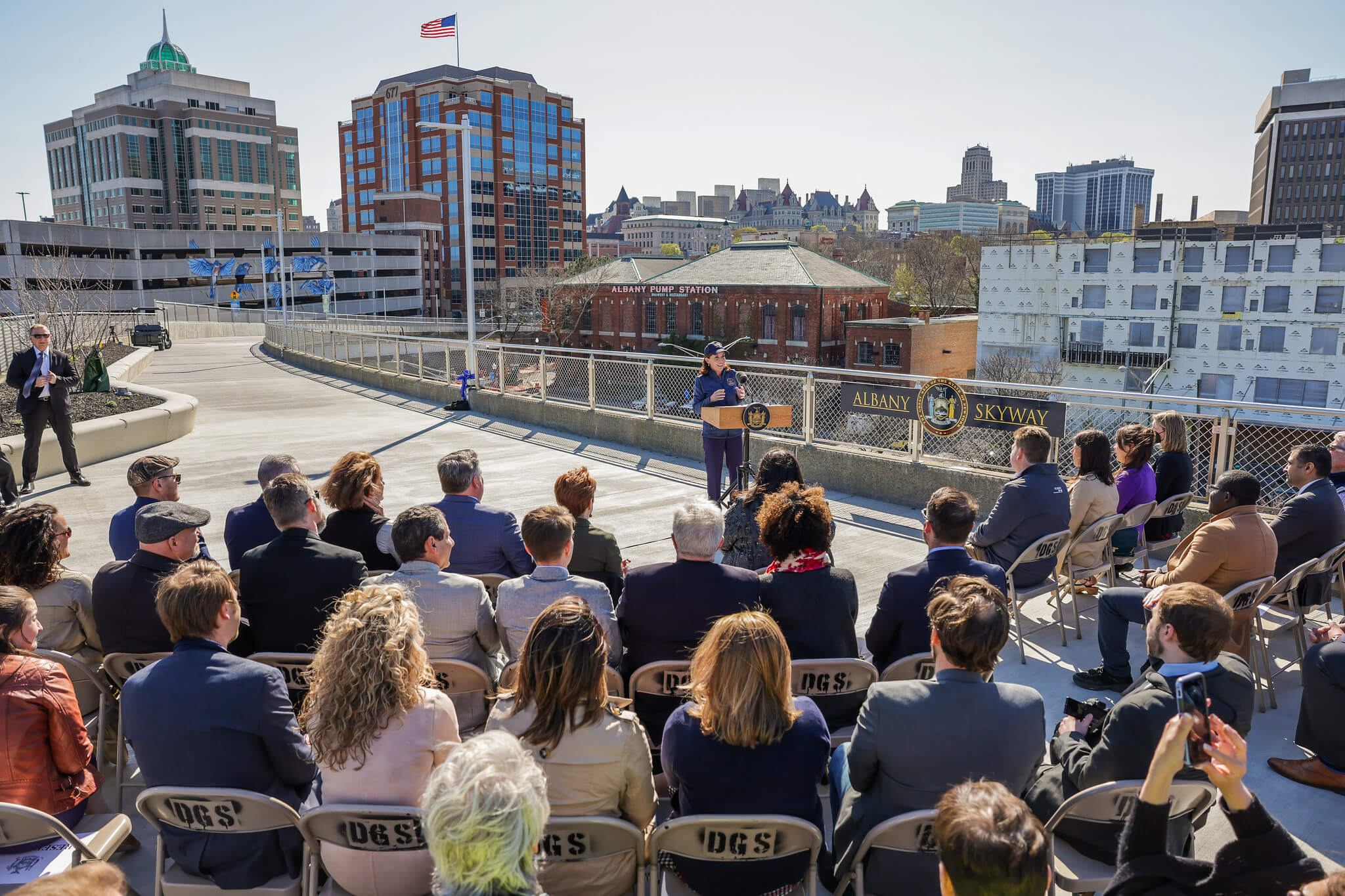
Inaugurated during an April 29 ribbon-cutting ceremony by New York Governor Kathy Hochul, the much-anticipated offramp-turned-elevated park provides a direct pedestrian link to Corning Riverside Park—a popular green space wedged between the Hudson River and I-787—from the downtown area and nearby neighborhoods including Arbor Hill, Sheridan Hollow, Clinton Square, and the Warehouse District. In a statement, Albany Mayor Kathy Sheehan referred to the area of the city that will directly benefit from the new park and the riverfront access that it provides as “one of the most historically underserved census tracts in our region.”
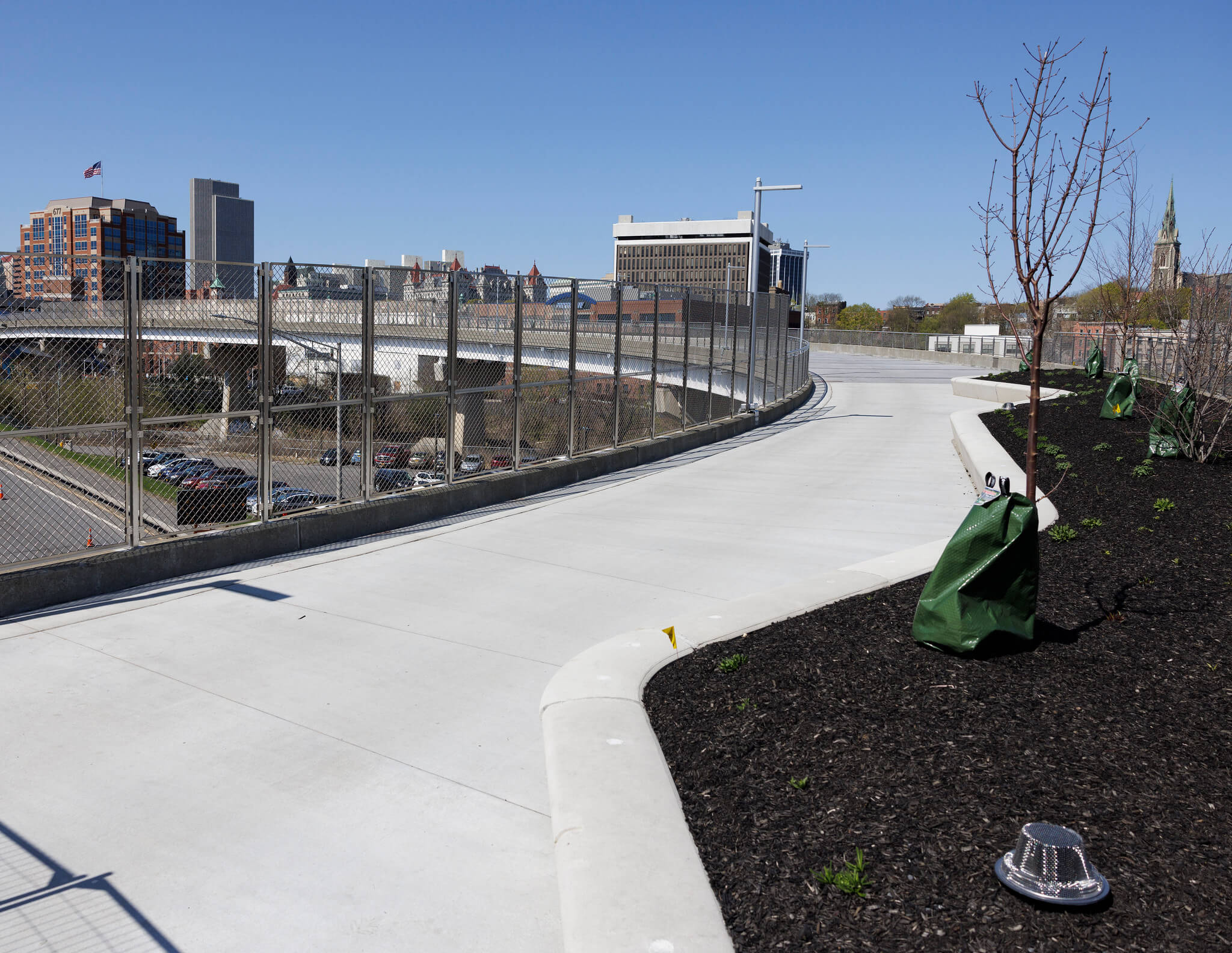
The $13 million, neighborhood-reconnecting park-slash-pedestrian bridge also links downtown and environs to a stretch of the Mohawk Hudson Hike Bike Trail, which is part of the 750-mile-long Empire State Trail. Completed in 2020, the trail is the longest multi-use state trail in the nation.
Described as an “urban oasis,” the fully accessible, ADA-compliant Skyway Park features pedestrian lighting, amphitheater-style seating, and landscaped areas designed around its main pedestrian and cyclist path. A generous shade structure can also be found at the Broadway entrance of the multi-use park. Myriad traffic improvements, including new crosswalks, high-visibility crossing signs, and push-button beacons, were also executed at Quay Street on the north and south ends of the Corning Riverfront parking lot in conjunction with the park project.
Heralding Skyway Park as a “game-changer for the city,” Hochul called Albany’s newest park “the perfect example of a transformative infrastructure project that promotes equity and connectivity.”
“Infrastructure can be more than just building roads and bridges—like the Skyway, it can be about improving quality of life and righting the wrongs of the past,” the Governor continued. “With this ribbon-cutting we are reuniting divided communities, revitalizing Albany’s beautiful waterfront, and recommitting to a transformative vision that is a skyway for the future of infrastructure in New York.”
Skyway Park is a project of the New York State Department of Transportation (DOT), which worked in close partnership with the City of Albany. The city will maintain the park, which is also hopes with provide a sizable boost to local tourism along with economic development.
During the April 29 ribbon-cutting festivities at Skyway Park, Hochul also announced a June public process start date for the DOT’s Livingston Avenue Railroad Bridge replacement project. Providing a “critical link” for passenger rail service between the Northeast Corridor and Albany-Rensselaer, the $400 million project will see the existing, Civil War–era bridge spanning the Hudson River be replaced with what the Governor’s Office called a “new, modern structure capable of supporting higher-speed passenger rail, freight rail, maritime transport, and bicycle-pedestrian access.”
“Sometimes we have to fix the mistakes of the past with infrastructure,” said Hochul in reference to Skyway Park. “That’s what we’re doing in Buffalo, we’ve done it in Rochester, and Syracuse and in the Bronx. And right here, we have this opportunity, which is extraordinary.”

