
a rare mind: remembering the greatest works of frank gehry following his passing at 96
buildings by Frank gehry that shifted the world
With the death of Frank Gehry at 96, the design world is revisiting the buildings that reshaped cities, reoriented cultural institutions, and redefined what architecture could look and feel like. Across more than six decades, Gehry created works that fused sculptural ambition with technical innovation, pushing the boundaries of form, material, and emotion. Below, a closer look at a selection of the projects that most clearly express his influence.
Take a trip back in time here to revisit a collection of his physical models displayed at Milan’s Triennale Design Museum during the 2009 exhibition ‘Frank O. Gehry: Since 1997.’
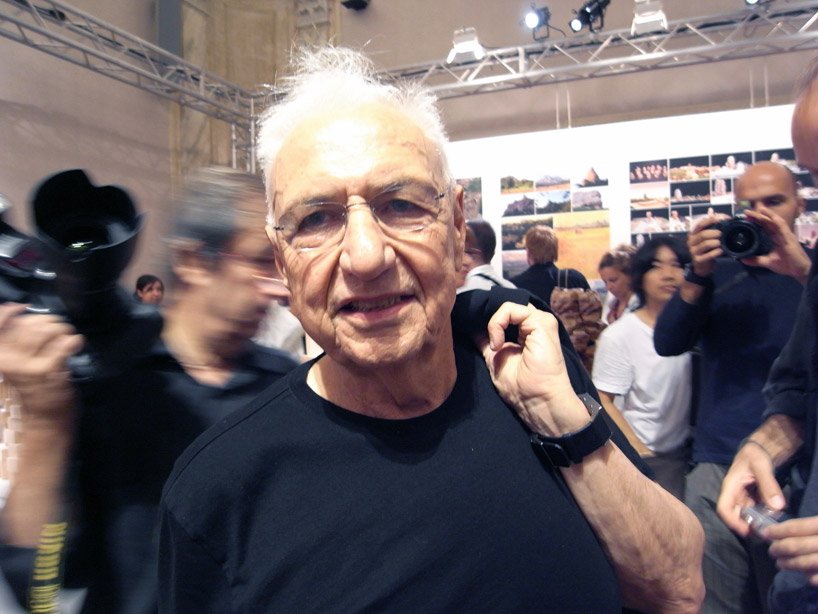 Frank Gehry at the 12th International Architecture Exhibition in Venice, 2010 | image © designboom
Guggenheim Museum Bilbao (1997)
Frank Gehry’s Bilbao museum remains his most transformative achievement, both architecturally and culturally. Clad in sweeping titanium panels and organized as a composition of fluid, interlocking forms, the museum demonstrated how digital modeling could translate sculptural complexity into buildable architecture. It’s more than an aesthetic icon. It jumpstarted the revival of a declining industrial city, drawing millions of visitors and sparking what became known worldwide as the ‘Bilbao effect.’ Few buildings have had such measurable civic and economic impact, and its shimmering presence on the Nervión River continues to symbolize the power of architecture to change the fate of a city.
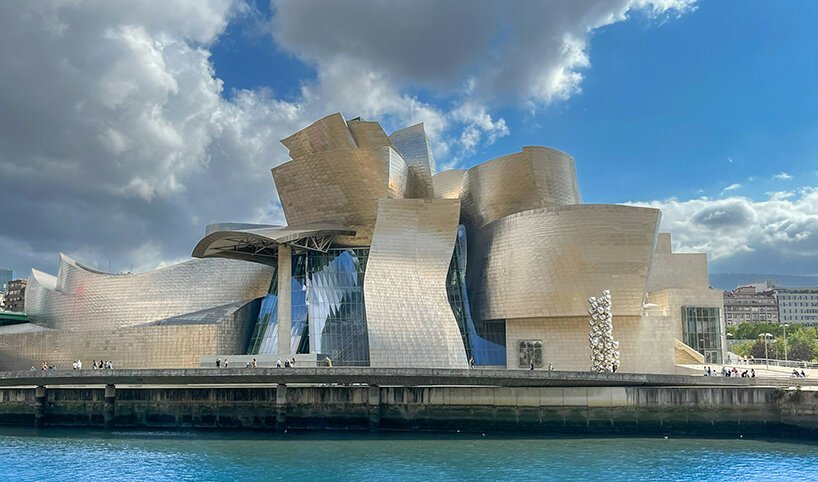 Guggenheim Museum Bilbao, Bilabao, Spain, 1997 | image © Hans-Jürgen Weinhardt
Walt Disney Concert Hall, Los Angeles (2003)
Nearly two decades in the making, Walt Disney Concert Hall stands as one of the most acoustically and formally ambitious buildings and concert venues in the world. Its stainless steel exterior unfurls in sweeping, sail-like planes, while the interior features Douglas fir and oak surfaces that enhance the hall’s acclaimed acoustics, shaped with the help of Yasuhisa Toyota. The project offered Los Angeles a defining civic monument and became a long-awaited cornerstone for Grand Avenue’s cultural district. Today it remains both a beloved public space and a testament to Gehry’s ability to merge sculptural exuberance with functional precision.
 Walt Disney Concert Hall, Los Angeles, USA, 2003 | image © Tim Cheung
Situated in the Bois de Boulogne, Frank Gehry’s Fondation Louis Vuitton resembles a collection of glass ‘sails’ billowing around a solid core. The architect used advanced glass technologies to create curved, transparent forms that give the museum a startling lightness despite its size. The building navigates the delicate balance between parkland and monumental architecture, becoming at once a cultural destination and an experiential journey through layered spaces, gardens, and promenades. It demonstrated Gehry’s continued evolution late into his career, pushing digital fabrication and structural engineering to new heights.
 Fondation Louis Vuitton, Paris, France, 2014 | image © Iwan Baan
Vitra Design Museum, Weil am Rhein (1989)
Frank Gehry’s first European project marked a turning point in his international recognition. The Vitra Design Museum introduced a new vocabulary of sharp angles, white plaster surfaces, and expressive, intersecting volumes — foreshadowing the complex geometries that would later define his better-known works. Although it’s modest in scale, the building holds outsized influence as an early example of deconstructivist architecture and as a beacon in Vitra’s campus of radical design.
 Vitra Design Museum, Weil am Rhein, Germany, 1989 | image © Arvydas Venckus
Dancing House (Fred and Ginger), Prague (1996)
One of Frank Gehry’s most distinctive urban buildings, the Dancing House is defined by the dialogue between a curving glass tower and a more static stone volume, often described — at Gehry’s suggestion — as ‘Fred and Ginger.’ This nickname is of course in reference to the iconic dance duo Fred Astaire and Ginger Rogers. Built on a difficult riverside site, the building sparked controversy for its bold departure from Prague’s historic architecture, but ultimately became a beloved landmark. It remains a key example of Gehry’s ability to inject movement and personality into tight, complex city contexts.