A New Welcome Pavilion by Lemay Aids with Procession to Quebec’s Most Visited Religious Heritage Site
St. Joseph’s Oratory, a minor basilica, sits prominently on Montreal’s West Mount, one of three peaks of the city’s eponymous mountain. The religious landmark, visible across much of the municipality, is beloved by residents, pilgrims, and tourists alike. But it has long lacked a universally accessible entrance facility to receive the swelling number of annual visitors, which now count some 2 million. In response to that need, the congregation commissioned Montreal-headquartered Lemay in 2015 to design a new welcome pavilion, with a more legible organizational framework and much-needed space for programming, that doesn’t try to upstage one of Quebec’s most significant heritage sites.
“Our challenge was to create a meaningful architectural presence while ensuring the new intervention would never challenge the dominance of the oratory itself,” explains Lemay design principal Pierre Leclerc. (An oratory is a place of prayer, in this case for a community of priests, the Congregation of Holy Cross.)
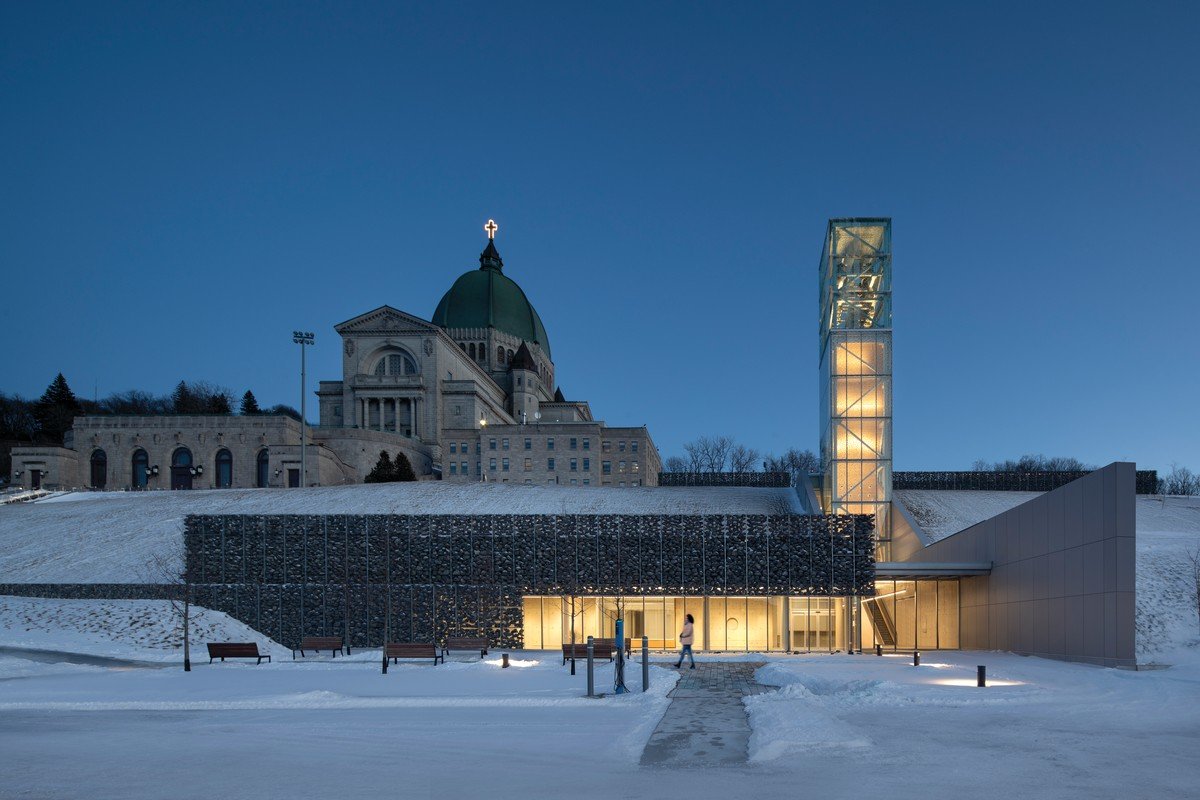
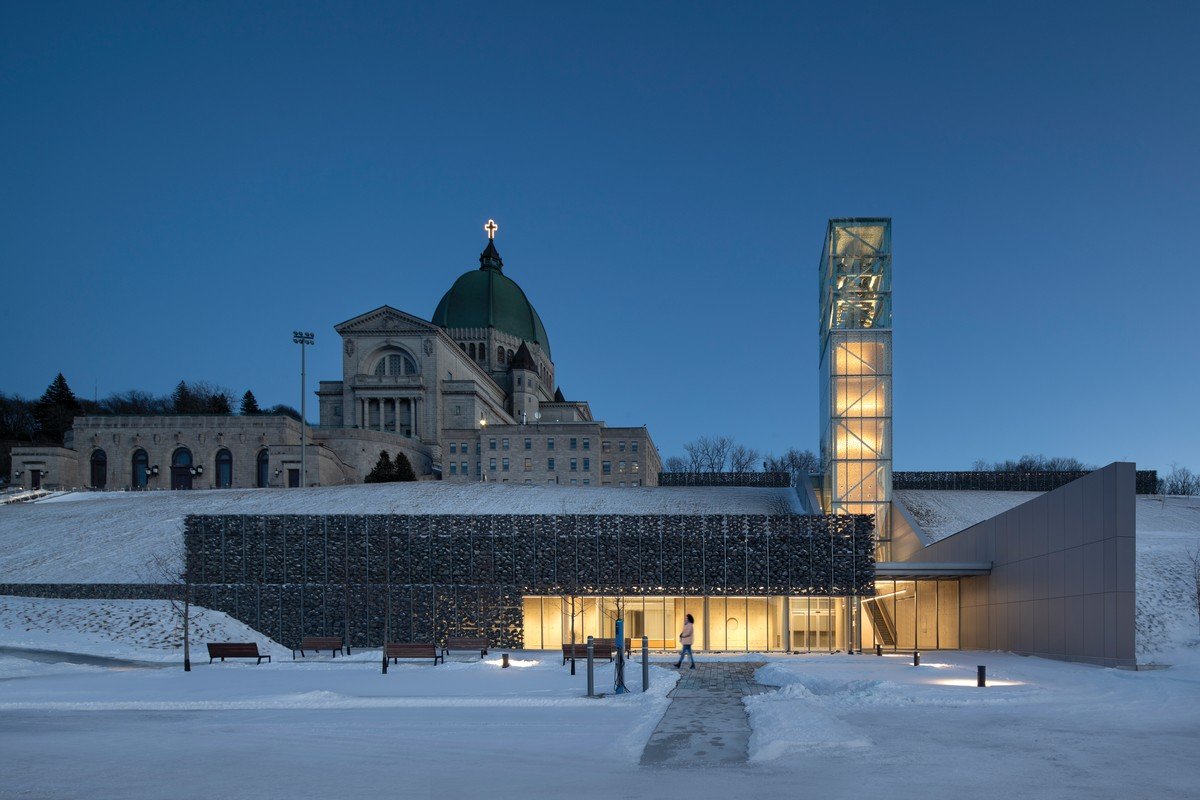
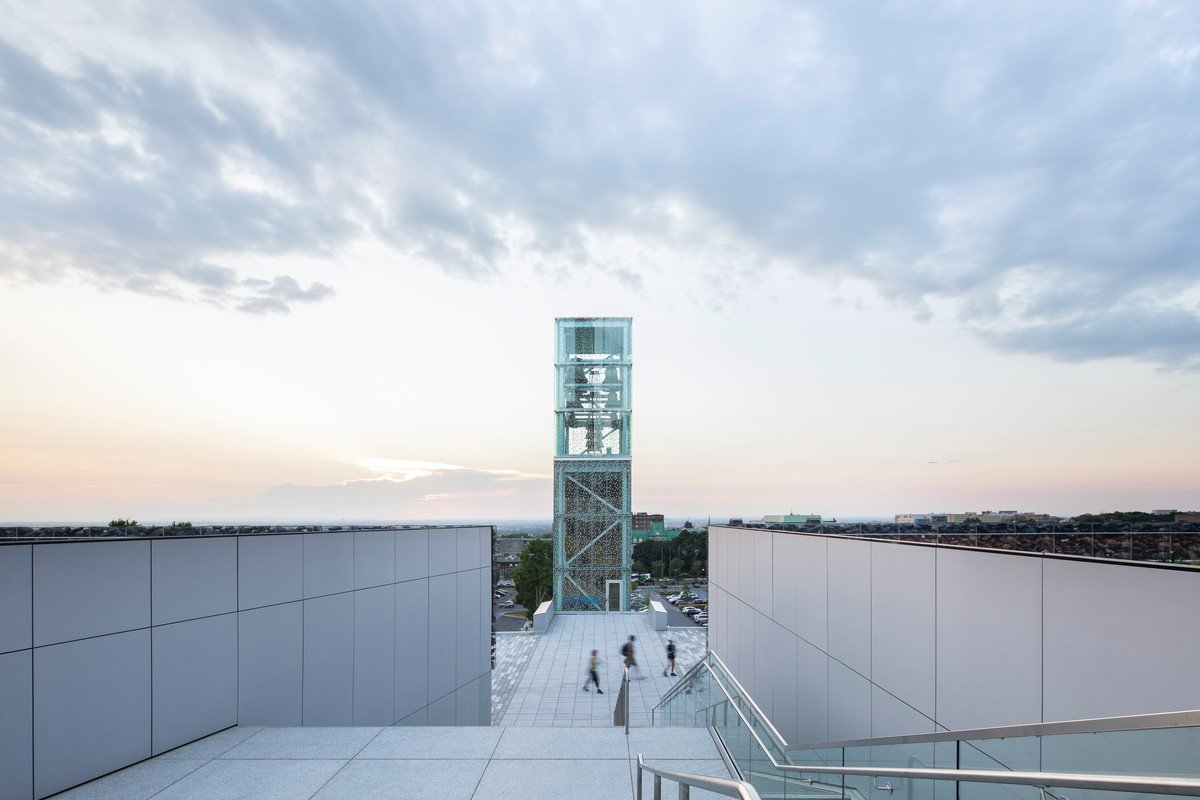
The four-story terraced structure opened in February and, with its clever siting, appears as a mostly rocky outcrop of the hill’s slope. That effect is achieved by embedding the 62,100-square-foot pavilion in the mountainside, where it is shrouded in loosely packed gabions filled with granite rubble sourced from the project’s site during excavation. The structure is topped with hard and soft landscaping, designed in collaboration with Montreal-based landscape architect Version Paysage. But standing proudly above the partially subterranean pavilion is a steel-framed and glass-clad carillon tower that houses 61 bells—57 of which were originally cast for the Eiffel Tower but never used there—which marks the entrance.
1
The pavilion is fronted by a carillon tower (1 & 2). Photos © Adrien Williams, click to enlarge.
2
Construction of the oratory took place from 1924 to 1967 and was stewarded by multiple generations of architects; the design blends a Renaissance Revival exterior with a spare Art-Deco sanctuary. The structure supplanted a small chapel administered by Saint André Bessette (1845–1937), a reputed healer and devotee of St. Joseph, which had been originally built to accommodate the many worshippers who thronged nearby Collège Notre-Dame, but it quickly proved inadequate.
Despite Bessette’s renown for curing the sick and disabled, St. Joseph’s Oratory demonstrated conspicuously little in the way of accessibility. Visitors would strenuously climb hundreds of steps to the basilica’s Crypt Church and sanctuary and scrabble up a narrow staircase to a seven-decade-old welcome center halfway up West Mount or try to find a spot in a crowded parking lot adjacent to the sanctuary.
Before construction could begin, the design team had to overcome myriad regulatory hurdles. St. Joseph’s Oratory is protected by multiple agencies, both provincial and municipal, and bureaucratic processes. A particular challenge was articulating a convincing rationale for the use of gabions, a traditional retaining system, as a facade element. “This required us to demonstrate how reusing on-site materials both honored the site’s geological character and advanced sustainable construction practices in a heritage context,” says Leclerc. Additionally, all the building materials were to be sourced from within Quebec.
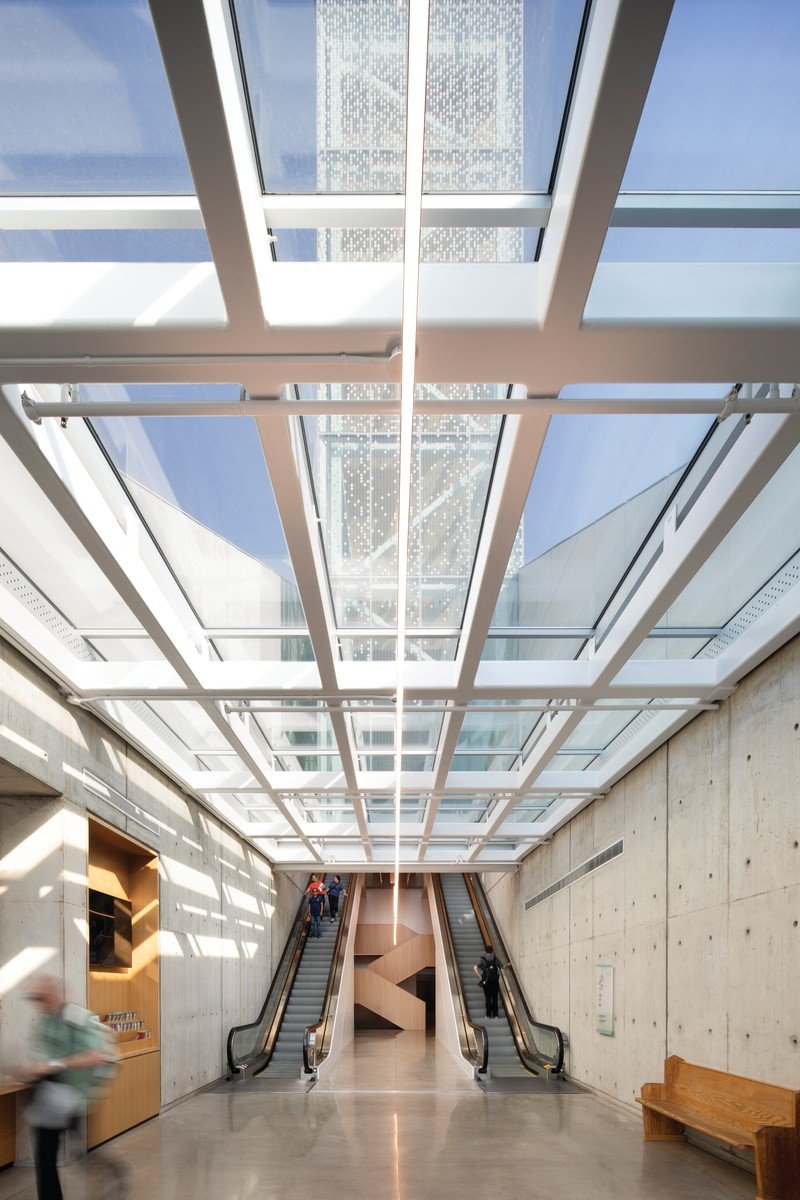
The welcome pavilion is oriented west, and it is arranged around an unobstructed, universally accessible pathway that leads to the oratory’s votive chapel and Crypt Church. Visitors reach the slightly recessed entrance, located on a plateau near the base of the peak, through a landscaped plaza where it is flanked by gabions to the north and a retaining wall to the south. Within, the ground floor is divided between a central skylit reception area and administrative spaces. The second level, just 20 feet wide, features an indoor landing with captivating upward views of the carillon’s interior. The bulk of the pavilion’s program, including a gift shop and café, is placed on the third floor, and the fourth contains a multipurpose event space and additional offices, and leads to the oratory’s crypt and votive chapel.
Staggered sets of escalators are the primary means of circulation throughout the intervention—additional escalators, predating this project, deliver visitors from the Crypt Church, where Saint André Bessette is entombed, to the sanctuary. The conveyances are supplemented by grand staircases and two elevator cores to maintain access for all. Glazed apertures frame views of the site’s landmarks, including the oratory dome, the carillon tower, and Mount Royal.
“These carefully positioned openings transform wayfinding into an intuitive, experiential process rather than a navigational challenge for people from around the world with varied capabilities,” notes Lemay design director Ricardo Serrano.
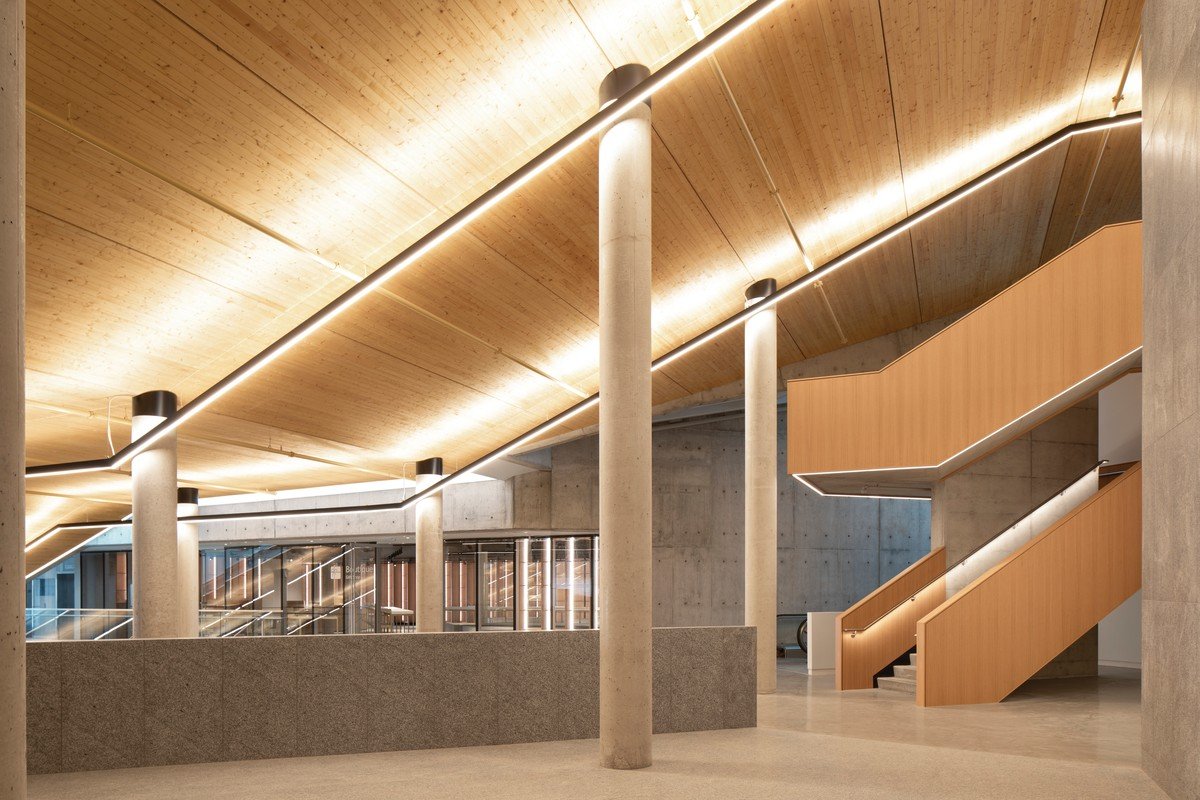
Cross-laminated timber is used as roofing. Photo © Adrien Williams
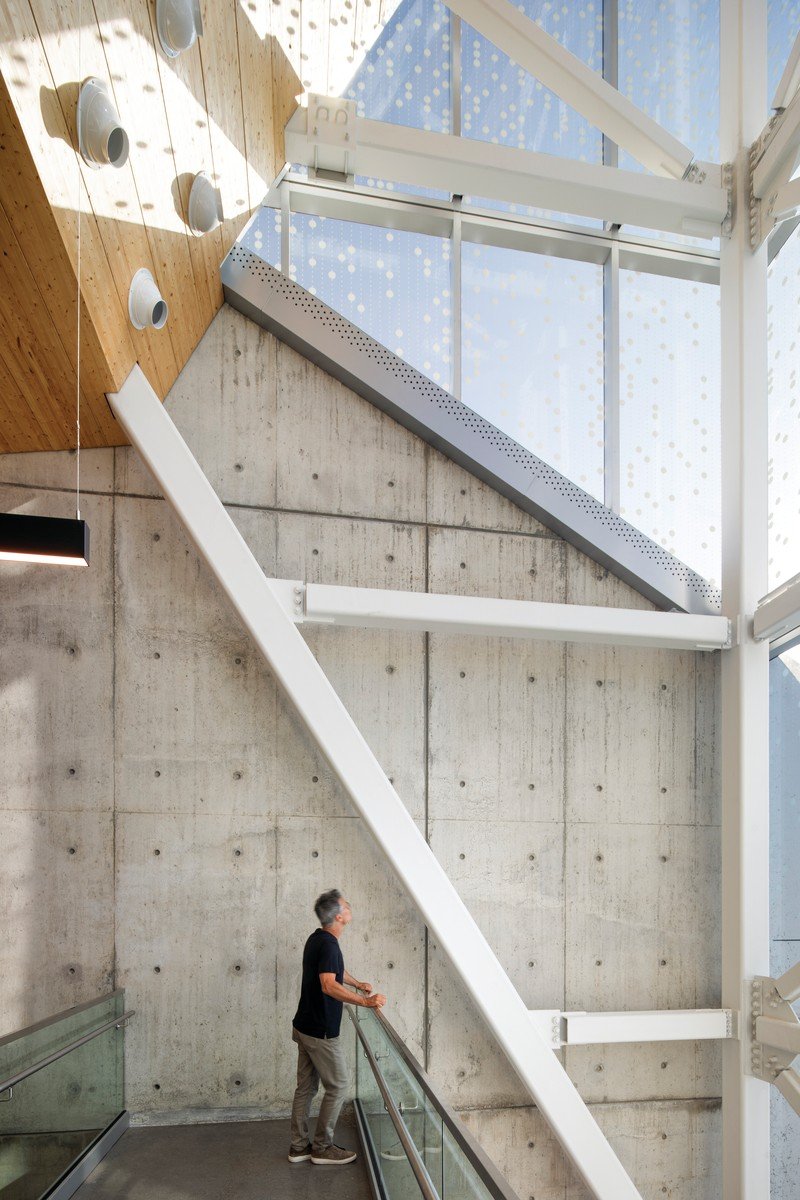
In keeping with the objective of maintaining the oratory’s primacy, interior detailing is kept simple, if not spartan. Concrete, used for the building’s foundation, shear walls, floor and roof slabs, and columns, is left exposed as the dominant surface treatment. Four different mixtures were tested prior to the team’s selection of the concrete’s final light gray appearance. White-painted steel beams support the apertures and add a measure of brightness within the pavilion; wood ceiling paneling and cross-laminated timber roofing, both hewn of black spruce, are threaded through the primary circulatory route to provide a degree of warmth in a sometimes severe setting. White oak millwork and granite surfaces are used intermittently.
3
4
Concrete shear walls and steel beams are left exposed (3 & 4). Photos © Adrien Williams
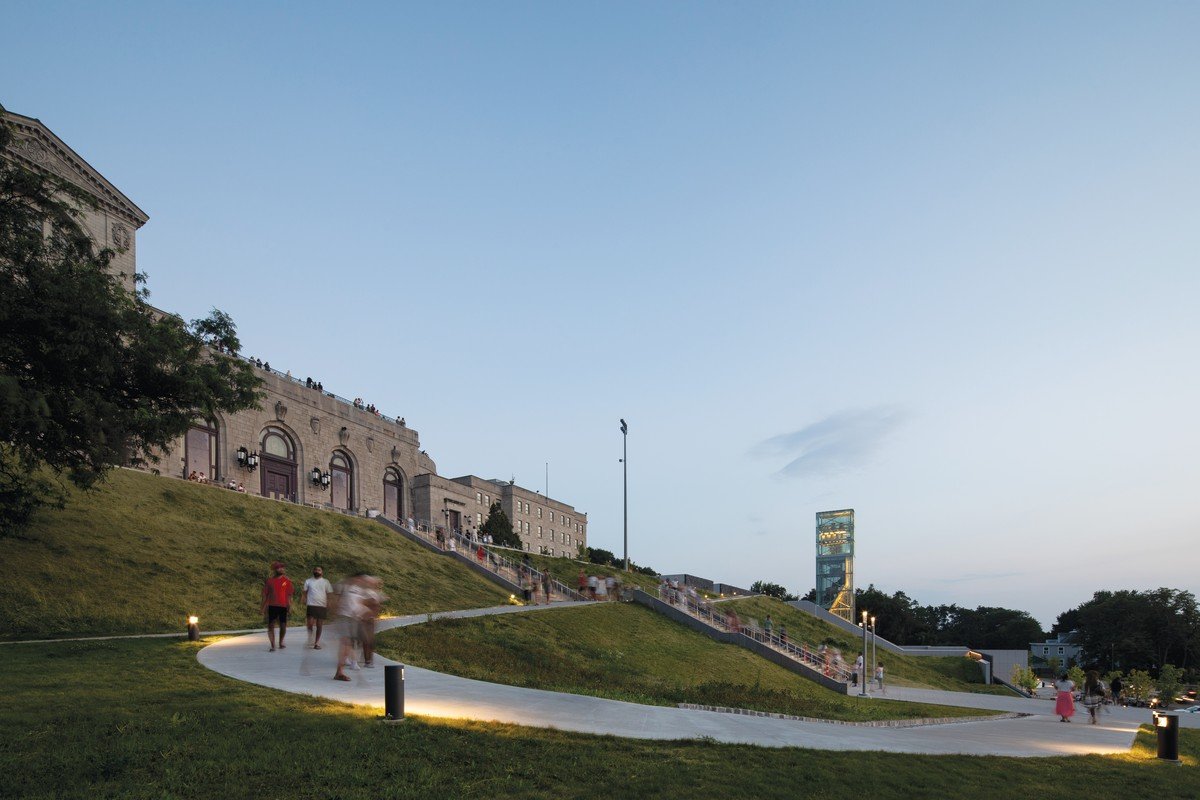
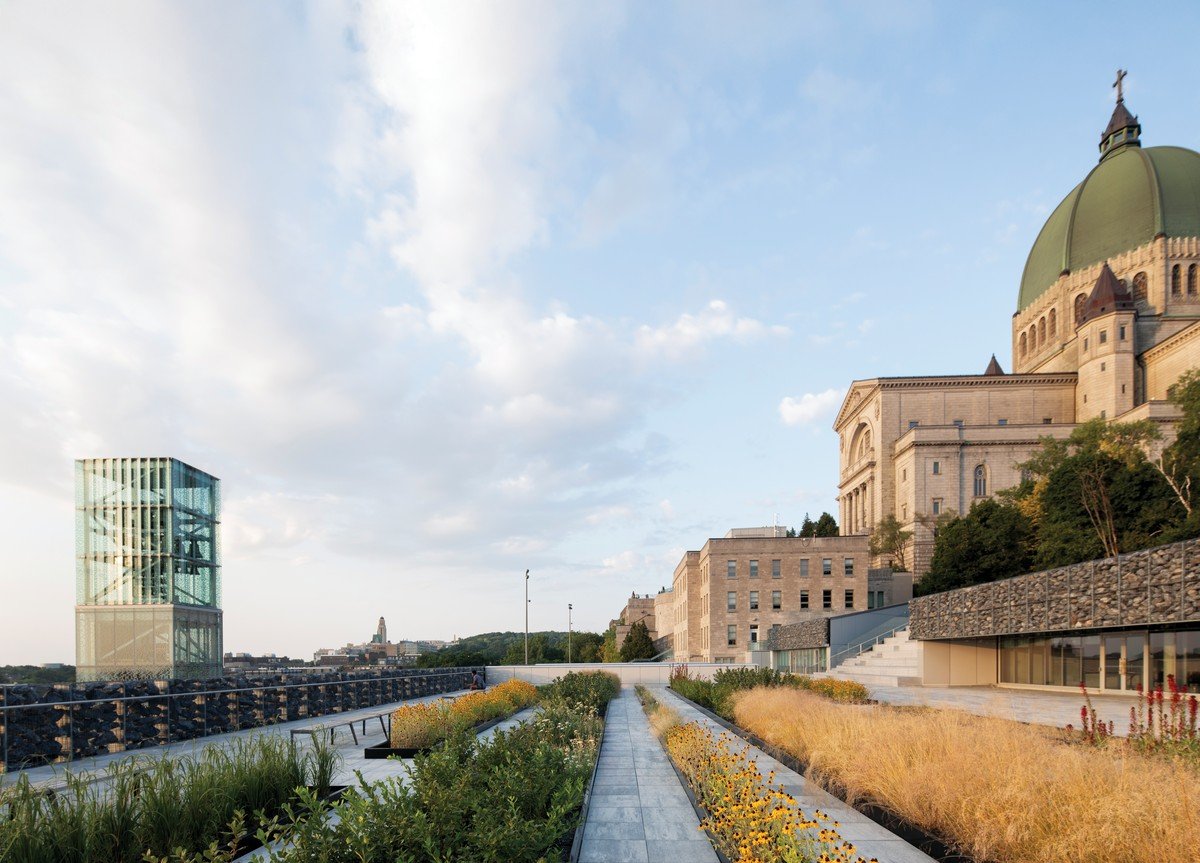
At the roofline, concrete columns sprout into a web of steel framing to buttress granite stadium stairs, while roof slabs support the plazas. The expansive outdoor space is open to the public, who can also access it by winding paths that surmount the bulk of the pavilion. The gabions, seen within the structure as light-filtering elements, rise above the parapet to function as balcony railings. Notably, the terraces and plazas offer front-row seats for frequently programmed carillon performances.
5
Paths provide access to the oratory and public space atop the pavilion (5 & 6). Photos © Adrien Williams
6
On a crisp October day, I walked the grounds and through the welcome pavilion with Leclerc and Serrano. We stood on the uppermost terrace as the carillon tower’s glass panes glistened at high noon, and soft light began to diffuse through the gabion screens. Both spoke of the great honor and weight of responsibility they felt in contributing to such a cherished patrimonial site. Their reverence for the oratory is made clear through a somber design that prioritizes pragmatism over excess.

Images courtesy Lemay
Credits
Architect:
Lemay — Yanick Casault, project director, principal; Pierre E. Leclerc, design principal; Andrew King, design principal; Ricardo Serrano, design director; Ramzi Bosha, design director, interiors; Myriam Perreault, project coordinator
Engineers:
ELEMA experts-conseils (structural); BPA (m/e/p); MHA (civil)
Consultants:
Version Paysage (landscape); KJA (conveyance); Patrick Macoska (carillon)
General Contractor:
Pomerleau
Client:
St. Joseph’s Oratory of Mount Royal
Size:
62,100 square feet
Cost:
Withheld
Completion Date:
February 2025
Sources
Curtain Wall & Skylights:
S8 Vitrerie Architecturale
Mass Timber:
Nordic Structures
Gabions:
Gabion Express
Acoustical Ceilings:
Armstrong
Roofing:
Couverture Montréal-Nord (built-up roofing); Toits Vertige (green roof)