

A Biotech Firm’s New Wood-Clad Lab Building Melds into Its Rural New Hampshire Site
While bucolic Hanover, New Hampshire, doesn’t immediately call to mind a biotech hub, it has certainly become one in the last 20 years. Research emerging from Dartmouth College’s engineering, medical, and business schools, academics’ growing comfort with entrepreneurship, and an influx of venture capital investment have all contributed to the New England town’s small but mighty niche.
Much of the area’s initial biotech growth is thanks to Tillman Gerngross, an Austrian-born professor of engineering at Dartmouth who, in 2007, co-founded Adimab, a company that develops antibodies for autoimmune and infectious diseases, partnering with pharmaceutical companies such as Merck and Novo Nordisk. Adimab and Dartmouth have gone on to inspire biotech spinoffs that have made their home in the region, including companies working to improve diagnostic testing in cancer diagnoses and develop treatments for neurodegenerative disorders.

Photo © Timothy Downing
Architect Sylvia Richards, who is married to Gerngross, has witnessed Adimab’s growth up close. Since 2011, the company has been based out of two buildings in what became a kind of business park for similar ventures, with clusters of life-sciences and manufacturing buildings tucked into a lush, wooded area in Lebanon, 10 miles south of Hanover. Richards stepped in over the years to design small adaptations and additions to Adimab’s existing structures, such as cladding a particularly utilitarian building with mirrors, an inspired move that draws attention to the verdant surroundings rather than its drab aluminum siding.
Recently, Richards completed Adimab’s first standalone and purpose-built lab facility connected to its original campus and nestled into the woods like a grown-up treehouse. The compact, three-story building, realized in collaboration with Vermont-based project architect Christoper Smith, has a mass-timber frame and load-bearing CLT walls; Atlantic cedar boards and bronze screening help to further merge it with its surroundings. And, it too has mirrored panels on the lower level, tricking the eye into imagining a floating form. Large spans of triple-pane glass framed in white oak and aluminum reflect the sky and trees and offer the scientists working inside the gift of daylight and green vistas.
The 27,000-square-foot building is meant to help attract and retain talent, but it also alleviates Adimab’s previously cramped quarters for its 140 employees. In addition to lab workstations, it provides much-needed conference rooms, open office areas, and flexible lounge spaces.
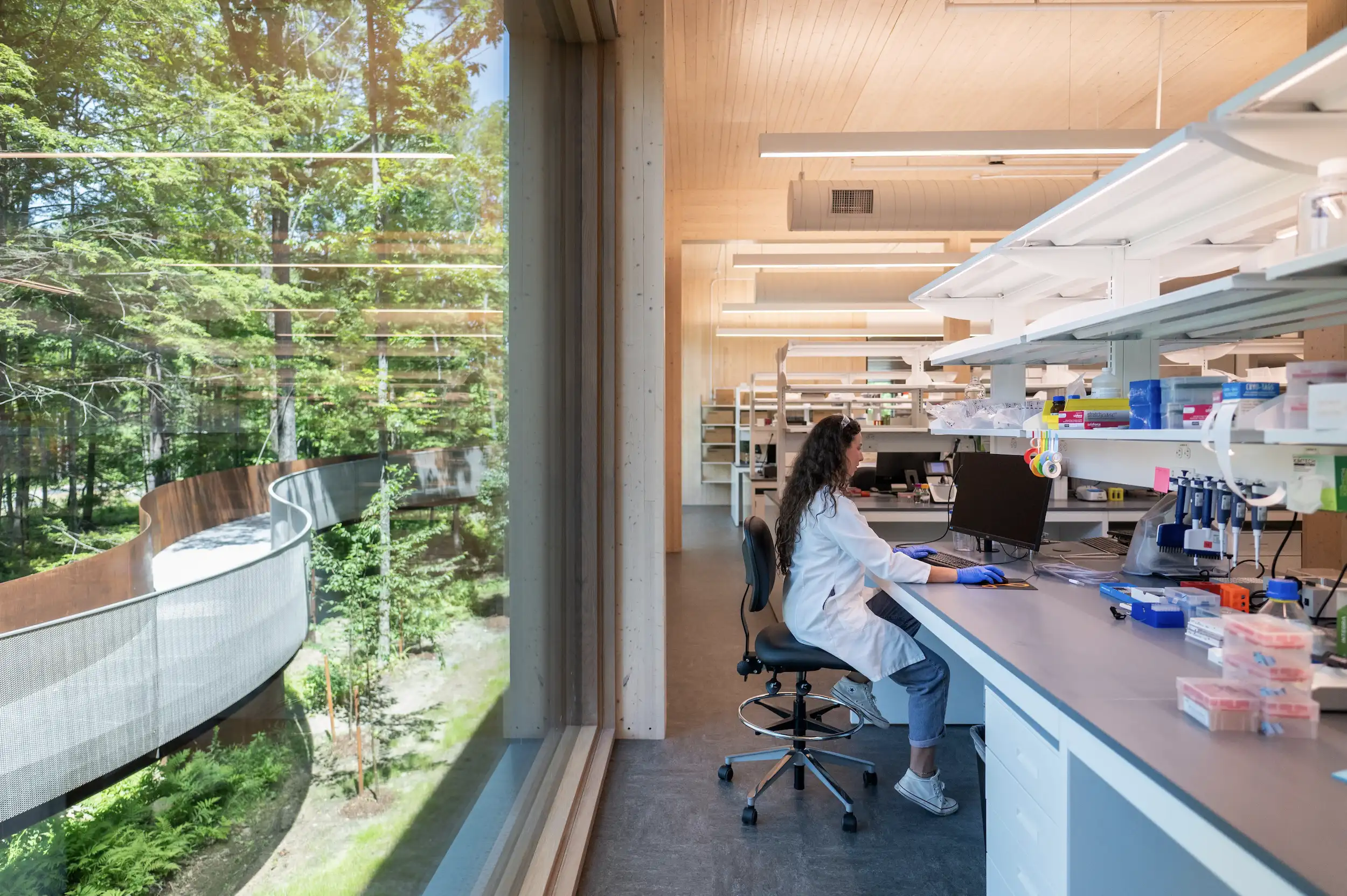
Photo © Timothy Downing
The decision to use mass timber, sourced from nearby Quebec, emerged out of conversations around sustainability with the client. “What I love about mass timber here is that this is a science building and this is a precision material,” says Richards. “Mass timber is more exact, in my opinion, than a steel building. It’s a fantastic product.” (The project was recognized by WoodWorks in June with a 2025 Wood in Architecture Award.)
Inside the lab spaces, Richards and her team of engineers showcased the necessarily intense and complex HVAC systems without obscuring the wood—the highlight of the building’s quiet, calm palette—by splitting the post-and-beam structure to create gaps where systems could be tucked up close to the ceiling.
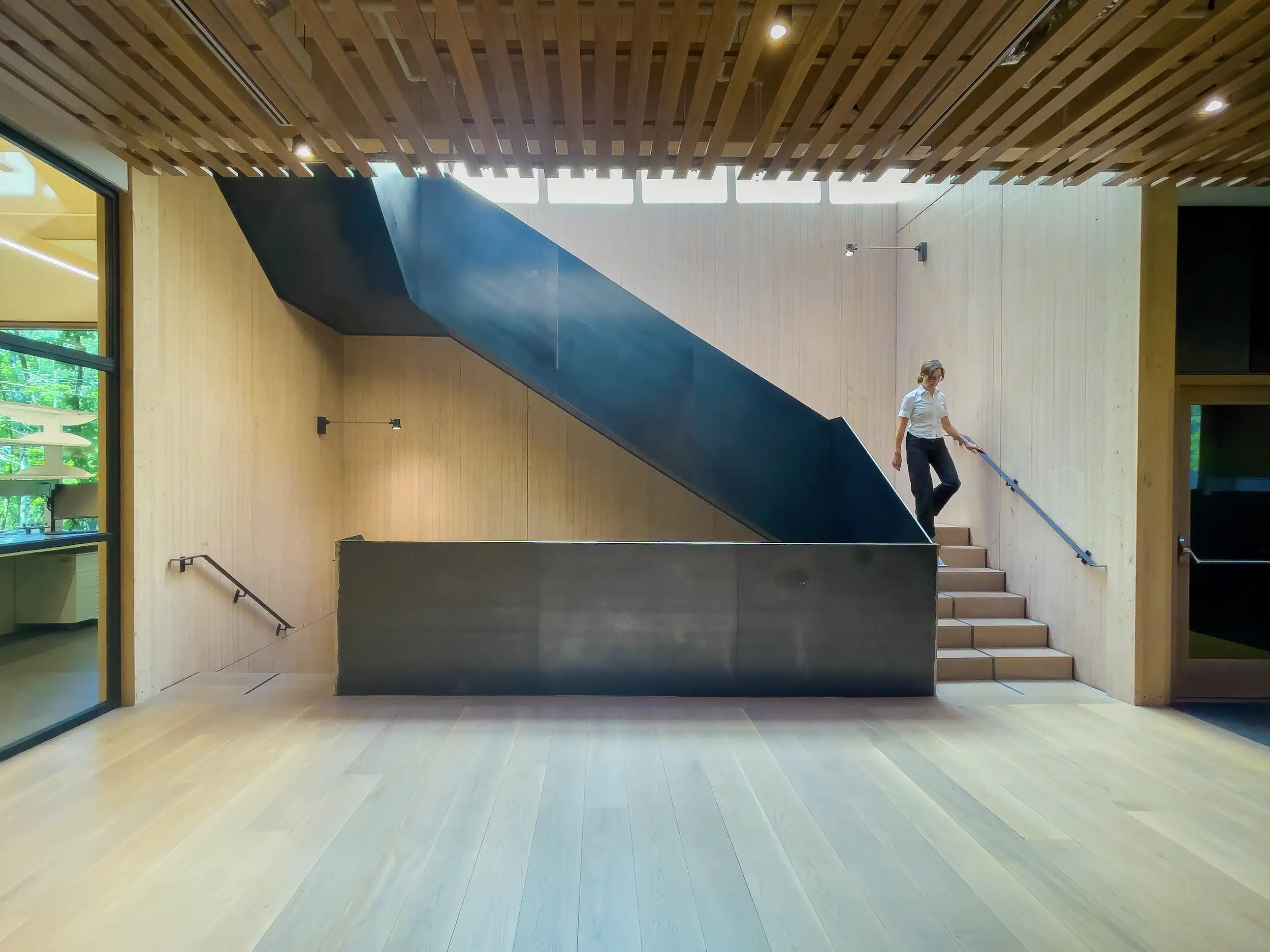
Photo © Timothy Downing
Vibration is a major concern in laboratory buildings, so Richards added a concrete topper slab for the electrical conduit and vibration isolation mats for sensitive equipment. Lighting was also important, and Richards wanted to avoid the harsh overheads found in most labs. In the new building, overhead lighting is connected to solar sensors, modulating the brightness in the room according to the amount of daylight—typically ample—and the task at hand.
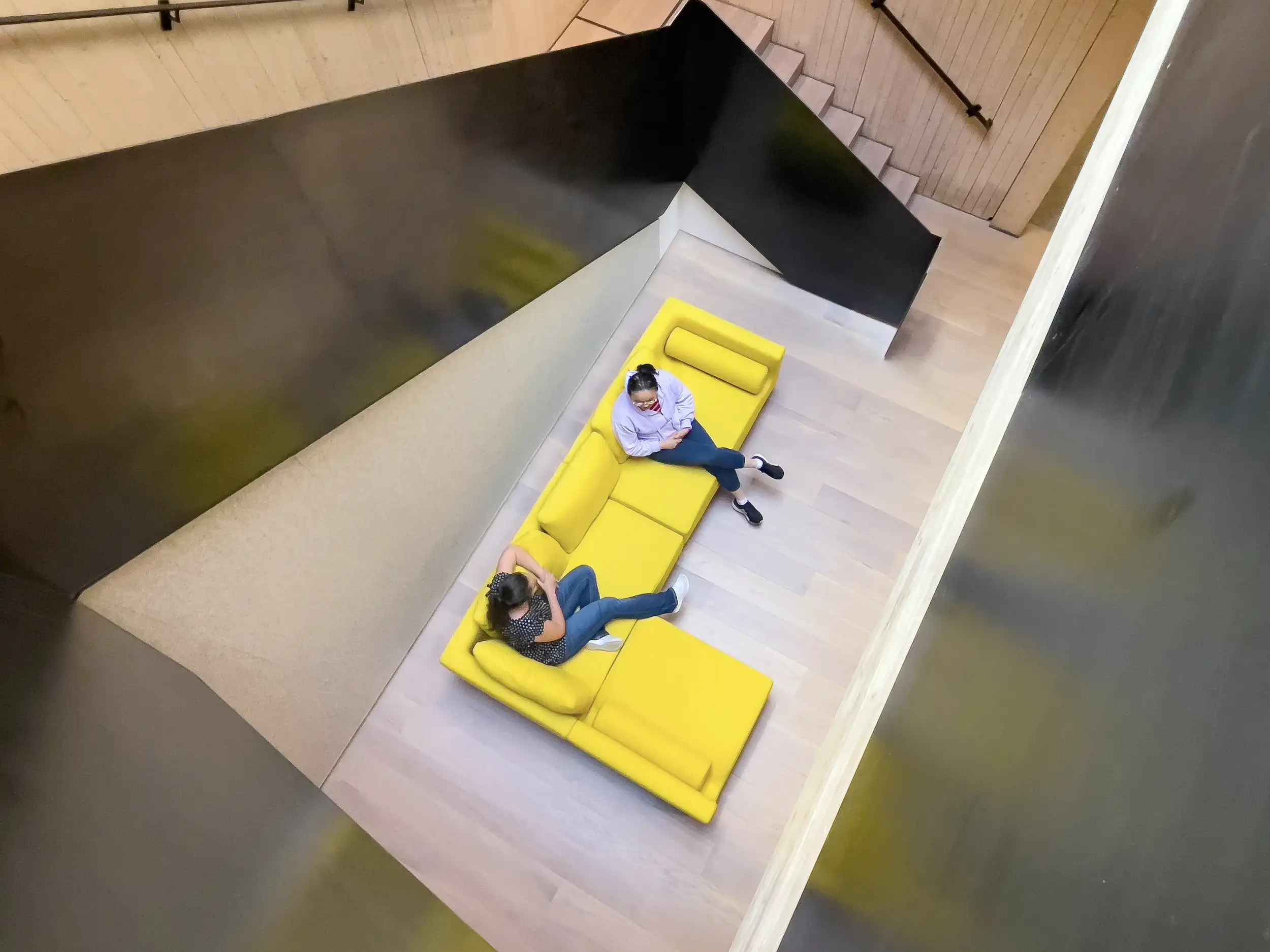
To connect the structure’s three floors, Richards inserted a central black-steel stair with white oak risers and treads. It’s a graceful addition that avoids the cold echo chamber of a concrete fire stair. “We really wanted to have the stair open because Adimab’s existing space was all on one floor and they loved the collaborative spirit,” says Richards.
1

2
Photos © Timothy Downing
Conference rooms and lounge areas were treated with a similarly light and open touch, with an emphasis on sustainable wool wallcovering and upholstery. (Richards knew she was on to something when she found employees working in the new building’s residential-like meeting areas before the lab spaces were officially open.)
In addition to the project’s complex systems, Richards’s other greatest challenge and constraint was its wetland siting. “I would have suggested a multistory building anyway, but it was a reason to keep it tight,” says the architect, who marveled at the construction team’s ability to work in a 15-foot lane between the site and the tree line. A parking lot was also required as part of the project, so Richards needed to devise a way to get employees from their cars and through the woods surrounding the facility. “We had this desire to keep the building nestled in the woods and really took that seriously” she says. To create a sinuous weathering steel footbridge as the connector, Richards digitized the area to find a path that would work at an ADA pitch without disturbing trees or wetland. The curving journey mimics other paths around the building that, on a recent day, were host to school children harvesting berries and a grounds team freshening up plantings.

Photo © Timothy Downing
Like the biotech industry, Richards initially found herself surprised to be putting down roots in a rural area. She and Gerngross met at MIT, and she imagined a career in an urban setting. After Gerngross found a job at Dartmouth and the two started a family, Richards softened to the area’s intimate scope, working on small projects, interacting closely with tradespeople on job sites, and understanding construction in a way that wasn’t taught at school. Those early hands-on projects gave her confidence and an intricate knowledge of materiality and texture. “I realized that there’s this through line right to here,” says Richards.